Wednesday, January 26, 2022

Aging and Perspective


The Sphinx (not the one in Egypt) sat outside Thebes, perched like a cat on a short pillar if the illustration above is representative.  It would eat people if they were unable to solve a riddle it would pose to them.  I'm not sure why.

One day, the otherwise unfortunate Oedipus encountered it.  He answered the riddle which, as we know, asked what goes on four feet in the morning, two feet at noon and three feet in the evening.

I've always thought the riddle misleading, as it refers to something done in a day, not a human lifetime.  But sphinxes must eat, I suppose.  It didn't get to eat Oedipus as he guessed rightly that the riddle describes a man.  His good luck didn't last, however.

The third foot mentioned in the riddle is a cane.  In the evening of our lives, we're supposed to walk through use of a cane, it seems.  I don't use one yet, but probably may be said to be in the evening of my life.

We change with time.  That's the way of it.  The universe is change, as Marcus Aurelius wrote.  We hope that there are changes which offset the steady decline of our abilities.  It's usual to claim that age brings wisdom.  I think it can fairly be said that what we know increases as we accumulate experiences over time, but I don't know that it can be said that we become wise over time.  We may know a good deal, have experienced a good deal, but it doesn't follow that we have good judgment or good sense.  I think wisdom would require those characteristics.

Nonetheless, something should change as we age, regardless of whether we become wise, and I think that to be perspective.  Concerns change with time; circumstances do as well.  What the older believe significant is different from what the younger feel is significant.  That's as should be.  If it isn't, there's something wrong.  The change in perspective which I think should take place is the realization, too long avoided sometimes, that was has been of such concern to us over the course of our lives, for the most part was unimportant.  The problem is, that change of perspective may not do us, or anyone, any good as it comes too late.

Those said to be wise have remarked that we should treat every day as if it is the last for us.  We may die at any time.  "Memento mori" is supposedly what was whispered in the ear of someone awarded a triumph in ancient Rome-perhaps the greatest public recognition of glory ever given any Roman.  At the height of his glory the triumphant general was told to remember he must die.  He remained merely a mortal.  

It's a useful reminder for us all, but though we're aware of our mortality it isn't much of a concern even when we're reminded of it in one way or another.  Other concerns get in the way of it.  What aging does, inevitably, implacably, is bring us closer to death.  Being closer to it, we see it "better."  If we're lucky--and wise--we know we approach the end of all we've done, thought, felt, and said, and the end, for us, of all felt, thought, done and said by others.

This should alter our perspective, because it should make all that's excited, angered, outraged and disturbed us feel small.  Even silly and vain.  It should become difficult to understand and to accept what we hear, see and read, now, day after day.  The self-righteousness, hatred, crassness, cowardice, avarice, hypocrisy that is spewed from TVs, social media, pundits, politicians is mere noise, sound and fury signifying nothing, to paraphrase the Scottish play as we're supposed to call it.  We more and more resemble chattering monkeys. 

Some as the end approaches become concerned with the afterlife which may await us, and in that sense turn their heads from the absurd antics of others.  Too often, that's an expression of fear and regret.  Efforts are made to placate God, to repent of misdeeds.  Suddenly, the self-love and self-infatuation that's characterized us for so many years is concerning; it may do us harm.  

It's unfortunate that our self-regard dissipates only then, if it does at all.  Fear of judgment in the afterlife has done nothing to temper our conduct, if our history is any indication, as we're quite content to be selfish, bigoted and hateful until that possibility draws close.  As it is, we do nothing to rectify what's been done; we merely regret it, uselessly.

If it's wisdom we acquire with age, it doesn't seem to do us, or anyone, any good.  It's a sad kind of wisdom, knowing that we've been unwise for the greater part of our lives, and that others are and will be unwise as well.

But though we can't change the past, we can impact the present, and the future of others if not ourselves.  Or we can try to do so, at least.  We can make others feel good, we can provide them with comfort, material and spiritual, we can teach by conduct and in speech or the written word, we can exemplify the life of virtue, we may even inspire.  It may be that the effort will have no significant result.  Living life an accordance with nature is worthwhile in itself, however.


Thursday, January 20, 2022

The Silence of the Supremes


The Supreme Court's authority not to exercise its authority may be one of its greatest powers.  The power to decline, to evade, to ignore has a kind of grandeur or glory.  As important as an issue may be, the Supremes may avoid it merely by doing nothing.  "True, we can do something, but we won't" saith the Court in many instances.  Like God, the Supremes need not answer prayers; they may decide that the prayers of some aren't of sufficient significance, or are clumsily made, or may be answered at another time.

The Justices need not explain their decision not to decide.   I think it's true that normally, they don't.  And why should they?  What does it matter?  They owe us no explanation.  Deciding not to decide means, in their case, that there's no way their decision not to decide may be found to be an improper decision.

In deciding not to decide, however, the Supreme Court may nonetheless decide the matter it says it will not decide.  That's the case with its latest decision not to decide, its denial of the application in the matter of Trump v. Thompson.  There, the minions of the person formerly known as President of the United States sought a stay of mandate and injunction pending review of a Court of Appeals decision finding no basis for that person's effort to avoid release of records concerning the January 6, 2021 storming of the Capitol on the grounds of executive privilege.  By deciding not to accept that application, the Supremes in effect sanction the decision of the Court of Appeals.

It appears that all but one of the Justices agreed in the denial of the application.  The one who did not, Justice Thomas, didn't write to explain why he would have accepted it.  This isn't unusual, and perhaps to be expected in the case of a Justice who, judging from oral arguments to the Court, may be the most Silent Supreme in history.

Justice Kavanaugh took pains to tell us not why he agreed the application should be denied, but why he might accept such an application in the future.  In other words, he thoughtfully explained why he might vote to accept an application by a former president to prevent disclosure of documents on the grounds of executive privilege.

He wrote that there could be circumstances where a former president would appropriately claim executive privilege even where a current president doesn't.  A sitting president may improperly decline to assert executive privilege for partisan reasons, for example.  According to Justice Kavanaugh, unlike the Supreme Court, a president may not decline to exercise authority without recourse or review.  Perhaps Justice Kavanaugh is a zealous defender of the uniqueness of the Supreme Court's unlimited power to decline.

Also, according to Justice Kavanaugh, there may be circumstances where the holding that former presidents may not exercise executive privilege would cause the president and president's advisors to fail to freely discuss and consider possibilities for action; it would have a chilling effect, in other words, to the detriment of the nation.

He provides no concrete examples in support of this speculation, and it would seem most difficult to make such a case with regard to documents concerning what took place on January 6. 2021.  Also, it's an unnecessary claim for him to make, as the Court of Appeals did not hold that a former president could not raise executive privilege, and as noted by the Supreme Court in denying the application, all the Court of Appeals said on the subject was non-binding dicta.  It couldn't be relied on by any litigant. 

So it's curious why he bothered to engage in this needless exercise.  Perhaps as the most junior member for the Court, he feels a need to express himself at every opportunity.  Perhaps he wants to provide some assurance to someone regarding his position on such matters in the future.

But my feeling is that when a Justice decides to, unnecessarily, enlighten us on why a matter might be accepted for decision in the future, that Justice should be required to explain why it shouldn't be accepted by the Court in the case at hand.   There's something dubious, even disingenuous, about declining to explain why a decision is made while simultaneously signaling how a decision would be made in the future.


Wednesday, January 5, 2022

A Day that will Live in Ignominy


On January 8, 2021, I wrote a post about the events of January 6th of that year at the Capitol of our Great Republic, remarking that it represented the end of American Exceptionalism.  That it surely did, and does, especially as it seems that that the hope of many of our especially craven politicians and pundits is that those events will be disregarded or forgotten, or even thought of fondly, like the antics of well-meaning but fractious children.

I don't refer to the self-infatuated blowhard who it seems has cancelled his plans to pontificate publically on the first anniversary of those events.  This cancellation would seem wise even from a purely self-interested perspective (and what other perspective does he have?).  What he would say is what he has said.  Watching him say it again would be like watching a demented person repeat a story he's already repeated many times, in much the same way with much the same words.  It wouldn't be a pretty sight even for his biggest fans.  Because refraining from making a spectacle of himself once more would be wise, he may yet do so, but in a less open format.

I refer to people who've actually been elected to office.  That in itself doesn't speak well for them, as this may hardly be called a mark of distinction in these sad times.  But for an elected official to be intentionally disingenuous about disgraceful conduct directed against a lawful election is especially ignominious, as it implies that such an official is unconcerned with and indeed against lawful elections generally, concerned only that the result of an election is desirable.  That is a view which would render representative democracy ineffective.  If accepted, elections would merely be a show to those elected, the winner being the one who could most efficiently "fix" the outcome.  That elected officials, and pundits and those who effect public opinion, could countenance this and even think it's desirable is shameful.

I suppose I should acknowledge that this is to assume that those seeking to disregard or justify what took place on January 6, 2021 don't believe that the 2020 election was stolen.  In a way, this assumption credits them with more intelligence than they may have.  But it's hard to believe that any reasonable person accepts what's being called "The Big Lie," a reasonable person being one who requires more than unproved allegations, shot down in court after court, to accept election fraud.  It's true, though, that reasonableness isn't something we see much of in our Glorious Union right now.  It's also true, unfortunately, that there are those in politics who will stop at nothing to assure that they will retain their position and power.

Perhaps it wasn't all that much different in the past.  Perhaps instead we live in a time when those who are unreasonable, ignorant, prejudiced and intolerant are more able to make themselves known and noticed than ever before.  I've speculated along those lines in this blog more than once.

Still, though, we may have come to the point in the U.S.'s decay when it no longer matters how the majority of people may vote.  Instead, it may be more important what some people, regardless of whether they're a majority, believe is right.  People who think they know what's right have found democratic government to be wanting--a kind of inconvenience--since at least the time of that pioneer of totalitarianism, Plato.  Ironically, Plato feared that a democratic form of government would allow demagogues to sway people away from what is right and good (that being what Plato thought was right and good) thus impeding the march to perfection he sought to impose on us.  Plato sought to change us.  Now, though, demagogues serve to prevent change, change being an evil in the eyes of those who hold power and have privilege.  

I fear, by the way, that I can't take credit for the felicitous phrase "self-infatuated blowhard."  I've seen it applied to another favorite of many among us, Martin Heidegger.  I just had to use it myself in another connection, and apply it to another ignominious figure.


Thursday, December 23, 2021

Homage to Krampus


Christmas is somewhat dreary again this year, courtesy of the pandemic and those astounding individuals who, unconsciously imitating those who feared vaccines for preposterous reasons long ago, have made certain it continues to be a problem.  There were fears in the past that those vaccinated would become like the animals from which some ingredients of the vaccine were derived, and it seems that fears now are similar in quality.

It seems appropriate that in less than merry Christmases, the remarkable figure of Krampus should be given some respect and attention.  Perhaps that should be the case even during happier holidays.  Not Krampus as depicted in the movies which have been made more or less recently, which are inevitably crass and horrific, but Krampus the legend, a companion of sorts to Saint Nicholas.  

I'm fascinated by Krampus.  I don't know how he came to be associated with the figure of Nicholas, who has become Santa Claus.  It seems Krampus was known in Central Europe and the Balkans.  Being a demonic figure in looks if not in character, it's been thought by some that he's a remnant of pagan beliefs, pagans being naturally drawn to demons in Christian tradition if not demons themselves.  For some reason, he follows or perhaps accompanies Saint Nicholas in his December travels.  Nicholas dispenses gifts to good little girls and boys.  Krampus, carrying chains with him, punishes naughty little girls and boys, usually by smiting them with birch branches or rods.  Sometimes he merely leaves them as a kind of gift for parents of naughty children, who are encouraged to wield them in punishment themselves.  He's also depicted as chasing after women, a randy fellow, possibly because he's part goat.   It seems he was a popular part of the Christmas season in 19th century Europe.  This post features a Krampus card, similar to a Christmas card.

Just how Saint Nicholas came to be part of the European Christmas tradition is unclear (to me at least) as well.  He was a bishop in what is now Turkey.  It seems he miraculously saved children from peril in one or two instances.  He was also said to distribute gifts to children and others, at or around the time of his feast day, December 5th.  His myth traveled to Europe for one reason or another, where he eventually served as the inspiration for what we know as Santa Claus.

It seems somehow appropriate that Krampus would visit houses with or just after Nicholas this time of year.  Santa is said to make lists of who is naughty or nice.  I imagine that the Saint would have one list, Kampus another.  In the likely event that a house would contain both good and bad children, Nicholas would give gifts to some and Krampus would whack the others with his birches. 

Thus, children would learn directly and emphatically the rewards for being good and the punishment for being bad.  These would be made perfectly clear.  Nicholas handing out gifts while Krampus chases children round the Christmas tree, chains clanking as his rods whistle through the air, is an image which could not be forgotten.  It's unfortunate that Krampus isn't charged with punishing the stupid as well as the bad, in which case many parents would be beaten by him as well.

There's justice in this legend.  Even Oliver Cromwell, who banned the celebration of Christmas as frivolous when he became Lord Protector, would have approved.  Well, of the part with Krampus in it in any event.  Perhaps we should keep Krampus in Christmas along with Christ.
 

Monday, November 29, 2021

Brains in Vats and the Untrammeled Mind


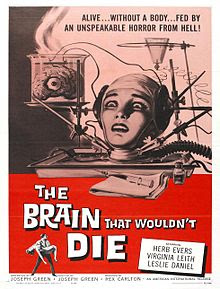
Not a brain, but a brain in a vat.  That's what won't die, at least in that part of the world (if there is one!) inhabited by philosophers.  "An unspeakable horror from hell!"  Indeed.

It's difficult to imagine a less serviceable avenue of thought than that indulged in by many philosophers for many centuries, relentlessly wondering if there is what is suggestively referred to as an "external world" and, if so, if it can be known by us. Worse, though, is their shameless tendency to write on the subject, if indeed it can be called one.  The consideration of the "question" is singularly purposeless, not merely because it's incapable of resolution, not indeed merely because it's questionable there is a "question" to be addressed, but because its consideration along with any possible resolution makes no difference to us, or to our lives.

It can't be disputed that we always act as if there is an "external world" and for the most part that our belief in it and its characteristics is substantially justified.  Anyone who seriously questions it could be accused of deliberately and thoughtlessly disregarding his purported belief.  Such a person would have to be mentally ill--"There is no world, but I live in it" isn't a statement most would make, and if one would make it seriously one would be treated, justly, as not quite sane.  That is what's done by philosophers who chew on this old chestnut and do so verbally and in print, to the amazement and bewilderment of those who listen to them or read their words (assuming, of course, that they exist).

What's particularly curious about this fixation with our claimed ignorance is that it's sometimes asserted that our incapacity is established by "scientific evidence."  There is of course the problem that it's questionable whether there can be any evidence, scientific or otherwise, if we can't know the "external world."  But it would seem obvious that the scientific evidence indicates that we evolved over time through our interaction with the rest of the world and interact with it consistent with our expectations time and time again.  If the results of experiments are "scientific evidence" it's apparent that scientific evidence in support of the existence of an "external world" is overwhelming.

Why, then, is this fantastic subject one of continuing interest and effort?  Let's ask, following Cicero:  Qui bono fuisset?  Where we humans are concerned, it's always important to consider who benefits from a particular act, question or issue.  Benefit--ours in particular--is always uppermost in our minds.

Who would benefit from a belief that we can't know the world, that we're separate from it, that it isn't real, or less than real; isn't true or less than true?

Those who thrive on it, clearly.  Philosophers, of course, do so.  For some it's their bread and butter.  Most if not all of the religious, as well.  "My kingdom is not of this world"--so said Jesus or so said someone who said Jesus said it.  The clergy in particular.  What would they do if people didn't think there was a world beyond this one; a world better than this one, which is the "real world"?

Anyone who benefits from disregard of or disparagement of the world as it is conceivably gains from the perception that there's something fundamentally wrong with things, so we may have to include politicians and pundits as well among those who claim the world isn't as it appears to us.  

No wonder that Plato, who first wrote extensively of a reality not of this world, was a totalitarian at heart.  If the world isn't real, then clearly we should seek what is real.  If we can't, we should be made to do so, for our own good.

And so we see what metaphysics and epistemology can lead to, if untrammeled by the world!  Without weights or guide lines, they ascend uncontrolled into the air like the balloon of the Wizard of Oz, they render us inhabitants of that city in the sky, Cloud Cuckoo Land of Aristophanes.  No wonder, perhaps, that Heidegger was a Nazi.