Showing posts with label Cicero. Show all posts

Thursday, August 14, 2025

Sanctuary! Sanctuary!


Here we see Quasimodo, splendidly played by Charles Laughton, crying "Sanctuary!" and claiming the protection of the sacred space of Notre Dame Cathedral for Esmeralda, having first dramatically snatched her away from the noose.  She was to be hung for witchcraft.  I couldn't bring myself to use images from Disney's weird version of Victor Hugo's novel.

"Sanctuary" was originally used to refer to a place sacred to a divinity and so apart from the profane world of men and women.  Gradually, it came to signify a place where human law did not apply.  So, at least in theory, a fugitive from temporal law or power having entered the sacred space could claim sanctuary and be beyond the reach of the temporal authorities; in effect, immune while in that space.  In practice, it seems that this rule was disregarded in some cases.  Sometimes, this immunity became a subject of negotiation.  For example, those having authority over the sanctuary might allow the person claiming protection to be taken into custody if it was promised that person would not be killed.

These sad days, we hear of "sanctuary cities" or jurisdictions.  Those in them aren't immune from the application of all law, however.  Instead, those municipalities refuse to cooperate with immigration authorities, much to the chagrin of conservatives, who now, unlike their predecessors, delight in the relentless enforcement and imposition of federal law, everywhere, local government be damned.

It's unfortunate that sanctuaries don't exist which can be fled to avoid the ever-expanding power of the federal government generally.  If churches, or at least that part of them surrounding the altar, were such sanctuaries how crowded they would be! It's a remarkable thing to see federal troops which were once used to enforce the rights of citizens to education and travel, to vote and assemble, now used largely to intimidate and to quash alleged "emergencies."  Emergencies in our Glorious Union now seem ubiquitous, judging from the peculiar logic of El Presidente and his lackeys.  Anything which can be used as a pretense for the exercise of Executive Authority will do.

O tempora, O mores!  One can almost hear Cicero crying out about the decadence of our times and customs, and the morals or lack of them of our representatives in all branches of government.  He was saddened by the decline of integrity in Republican Rome, soon to become autocratic and imperial.  It seems today that integrity has not merely declined, but has disappeared.  When did our legislators and judges of the high court become so meek, so obliging, so obsequious, so craven, so venal?  Have they (and have we) become willing victims of despotism?

Many of us seem to have Daddy Issues.  I don't refer to those issues which it's claimed by some involve the sexual activities or imagination of certain females.  Instead I refer to what seems to be a kind of creepy insecurity and desire to be led, if not dominated, by a father figure who will tell us what to do.  Presumably, he'll protect us as well.  Various figures in or on the outskirts of politics have voiced their fascination with and desire for a Daddy,  They may want to be spanked, poor creatures, or even better see someone else spanked.  Perhaps most characteristic of this childish desire for a Daddy is the relief that's felt at the fact that responsibility and authority is transferred to someone else.  Daddy will fix it, whatever it is.

Daddy will certainly fix us, in any case, they hope.  But some of us hope to find sanctuary even from Daddy.

Monday, November 29, 2021

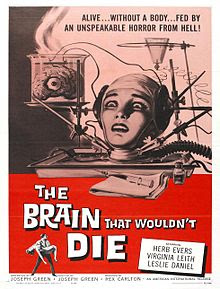
Brains in Vats and the Untrammeled Mind


Not a brain, but a brain in a vat.  That's what won't die, at least in that part of the world (if there is one!) inhabited by philosophers.  "An unspeakable horror from hell!"  Indeed.

It's difficult to imagine a less serviceable avenue of thought than that indulged in by many philosophers for many centuries, relentlessly wondering if there is what is suggestively referred to as an "external world" and, if so, if it can be known by us. Worse, though, is their shameless tendency to write on the subject, if indeed it can be called one.  The consideration of the "question" is singularly purposeless, not merely because it's incapable of resolution, not indeed merely because it's questionable there is a "question" to be addressed, but because its consideration along with any possible resolution makes no difference to us, or to our lives.

It can't be disputed that we always act as if there is an "external world" and for the most part that our belief in it and its characteristics is substantially justified.  Anyone who seriously questions it could be accused of deliberately and thoughtlessly disregarding his purported belief.  Such a person would have to be mentally ill--"There is no world, but I live in it" isn't a statement most would make, and if one would make it seriously one would be treated, justly, as not quite sane.  That is what's done by philosophers who chew on this old chestnut and do so verbally and in print, to the amazement and bewilderment of those who listen to them or read their words (assuming, of course, that they exist).

What's particularly curious about this fixation with our claimed ignorance is that it's sometimes asserted that our incapacity is established by "scientific evidence."  There is of course the problem that it's questionable whether there can be any evidence, scientific or otherwise, if we can't know the "external world."  But it would seem obvious that the scientific evidence indicates that we evolved over time through our interaction with the rest of the world and interact with it consistent with our expectations time and time again.  If the results of experiments are "scientific evidence" it's apparent that scientific evidence in support of the existence of an "external world" is overwhelming.

Why, then, is this fantastic subject one of continuing interest and effort?  Let's ask, following Cicero:  Qui bono fuisset?  Where we humans are concerned, it's always important to consider who benefits from a particular act, question or issue.  Benefit--ours in particular--is always uppermost in our minds.

Who would benefit from a belief that we can't know the world, that we're separate from it, that it isn't real, or less than real; isn't true or less than true?

Those who thrive on it, clearly.  Philosophers, of course, do so.  For some it's their bread and butter.  Most if not all of the religious, as well.  "My kingdom is not of this world"--so said Jesus or so said someone who said Jesus said it.  The clergy in particular.  What would they do if people didn't think there was a world beyond this one; a world better than this one, which is the "real world"?

Anyone who benefits from disregard of or disparagement of the world as it is conceivably gains from the perception that there's something fundamentally wrong with things, so we may have to include politicians and pundits as well among those who claim the world isn't as it appears to us.  

No wonder that Plato, who first wrote extensively of a reality not of this world, was a totalitarian at heart.  If the world isn't real, then clearly we should seek what is real.  If we can't, we should be made to do so, for our own good.

And so we see what metaphysics and epistemology can lead to, if untrammeled by the world!  Without weights or guide lines, they ascend uncontrolled into the air like the balloon of the Wizard of Oz, they render us inhabitants of that city in the sky, Cloud Cuckoo Land of Aristophanes.  No wonder, perhaps, that Heidegger was a Nazi.  
 

Thursday, September 24, 2020

Welcome to the Fifth Circle


The Fifth Circle of Hell as described in Dante's cheery Divine Comedy is populated by the wrathful, those condemned by their indulgence in the sin of Anger, broadly speaking.  Anger expressed, and Anger repressed.  Those souls condemned for the expression of Anger spend their unending time fighting each other near the surface of the river Styx, or the mud or marsh associated with that river.  Those that are condemned for the repression of Anger, the sullen, are lodged farther beneath the surface, complaining or perhaps better yet stewing at the bottom of the fiery mud and water.  Their complaints appear as bubbles on the surface.

It seems we're in the Fifth Circle of our own peculiar hell.  Medusa and the Furies may not be in evidence as they we're in Dante, but we have plenty of figures that resemble them among us.  

We're possessed by a curious anger, I would say.  At least some of us are.  For a president to refuse to accept the outcome of an election before it takes place, should it go against him, is obviously unprecedented in our Great Republic.  Therefore, it's also unprecedented that this fact seemingly leaves many of us unconcerned.  Our commitment to representative government as well as the rule of law is questionable.  We've heard of such doings in the past in connection with other nations, called "banana republics."  Have we become one?  Ben Franklin famously said we have a republic, if we can keep it.  Perhaps we no longer can, or no longer want one.

If so, how and why did this transformation take place?  One tires of comparisons with the Roman Empire, but are the satires of Juvenal, coming as they did after the Roman Republic was replaced by the Roman Empire, suggestive?

The People who once upon a time handed out military command, high civil office, legions...everything, now restrains itself and anxiously hopes for just two things: bread and circuses.

 Or perhaps Cicero is more apropos:

The evil was not bread and circuses, per se, but in the willingness of the people to sell their rights as free men for full bellies for the excitement of the games which would serve to distract them from the other human hungers which bread and circuses can never achieve.

The consuls and the Senate handed out just about everything in the Roman Republic, except when a dictator was appointed, and not the "people" as we would understand that word, so Juvenal may be said to exaggerate.  Also, the real people may have been more concerned with their bellies then than now.  But we love entertainment as much if not more than the people of Rome did, although they were less adverse to the sight of blood and death than we are, as a rule, except as portrayed in TV and movies and, of course, video games.  And, if the "bread" referred to by these ancient writers is thought of broadly as securing continued life, in a more or less comfortable condition, I think there is something analogous involved.

Personal security and self-satisfaction seem of particular concern to us now.  Provided we're not interfered with, called upon to do things we need not do (particularly for others), and are reassured with some frequency that our way of life is proper and indeed admirable, we're content.  We're perfectly happy if someone else makes the important decisions.  It bothers many of us not at all.  We resent having to make such decisions and, worse yet, having to think about what's involved in making them.

We particularly resent any implication that we can or should be better than we are or that there are others less fortunate than we are, who should be given assistance.  That makes us very angry.  We fear the less fortunate, and being selfish we are suspicious that that they're selfish too, and so envy us and wish us harm.  We want security, sameness and salvation from the perceived evils of others and the world at large.  We want a leader who thinks as we do, and will protect us from those who don't.

Sunday, July 21, 2019

Acropolis Now


Above is a picture I took of Athens, on a full moon night last month.  You can see the Acropolis in the distance.  You can see moonlight on the sea.  I'm rather fond of the picture, taken with a cell phone in the early morning.

I've been away from the blog for some time.  I've lacked the energy, perhaps, but also the interest.  It's difficult to be interested in these times, though they're no doubt interesting to some, and will be interesting to historians of the future.  I nearly wrote "if there is a future."

I'm being over dramatic, of course.  There will be a future.  We go on and on, and are none the better for it if I am any judge. There is something remarkable about us.  We don't change but we survive.  We don't adapt, we don't learn, we simply still are here, and will be here until our unchanging nature exhausts the world.

I've now been to many places.  I've walked where Cicero, Cato, Augustus and Caesar walked when I visited the Roman Forum.  More recently, I walked where Socrates, Plato, Aristotle, Diogenes and Zeno walked when I visited the Agora of Athens. It's unfortunate to live in this time, when there are no people comparable to those who went before.  Is anyone now living who can be described as great, or noble, or heroic?  Is there anyone who will be worth remembering or studying when this time is past?

If the Pythia was still sitting on her tripod at Delphi, which I was also fortunate enough to visit, perhaps she could answer such questions.  I suspect she could and even would, but in no clear manner, as it seems was her practice in ancient times.  She could also be quiet droll, as Croesus learned.  Any answer would do, comforting or not.  Delphi's magic is long gone but we still strive to learn the future in ways not all that different from consulting oracles.

In this disturbing, dull and shabby age, it's particularly pleasurable, to me at least, to see the ruins of the ancient world.  As unremarkable as we are, the achievements of the ancients were remarkable.  I cannot imagine how the Parthenon and the other structures were built on the Rock, as it was called by one of our guides.  Nor can I imagine how the great temples were built in the mountains at Delphi, or how it was that so many traveled so far and so slowly to reach the oracle.  Were they actually better than we are now, in many ways?  Perhaps we do change then....for the worst.

Moralists and the religious enjoy declaring that we become decadent over time.  I don't think we're more decadent than those who lived in the past, though.  I think that we're merely more stupid than they were.  How else explain how a prosperous people and nation have come to be ignorant, bigoted,  petty and cruel?  A certain degree of dullness is required.  The bovine are self-satisfied, fearful of change, content with what is, resentful of what is not, is different.

Well, let's carry on.  Stoicism is not a philosophy of the status quo, as some have said.  It is a philosophy, instead, which grants us a measure of peace and serenity when the status quo is deplorable.


Monday, April 8, 2019

What Comes After Disgust?


This has become a pressing question, for me.  Not with respect to life in general, I hurry to say.  I suffer no existential crisis.  How could I, being an aspiring Stoic?  Not for me the despair and nihilism felt by some.  In the broad sense, what is, is, whether I accept it or not, and it happens I accept it.  But enough about me.

What prompts the question is the state of our nation.  More particularly, the state of our nation's politics and politicians.  More and more, day by day, sometimes hour by hour or minute by minute, it and they inspire nothing but disgust in me; loathing, even, that most extreme form of disgust.  To be clear, I refer not only to the scatter-brained oaf inhabiting the White House and those who facilitate his caperings (and there are many Republicans, alas) but all those who participate in the corruption that overwhelms our governors and government.

I'll speak plainly.  Politicians are by their nature liars.  Perhaps it's more correct to say that politicians must be liars.  In order to be a politician, one must dispense with honesty and honor as it's necessary to please those who have the wherewithal to maintain one's status as a politician, regardless of what they believe, think or do.  The fortunate politician may accept the same beliefs, thoughts and acts, but in order to be successful at politics must placate more and more people, again regardless of what they believe, think or do.  The politician has committed to the sale of his/her soul, assuming they have such a thing.

The U.S. is too often compared with ancient Rome, generally to late Republican Rome.  That's an unfair comparison--to ancient Rome.  Rome even as the Republic decayed produced men of honor and even genius--Cicero and Cato, for example.  Who do we have to compare with them?  We're fortunate if our politicians are able to speak coherently, let alone speak the truth.  The Roman Republic was an oligarchy, of course, but in what sense are we better?  Juvenal (I think) wrote that all things were possible in Rome if one has money, and that is the same here and now.  But money is all that we honor and respect.  It's no longer a tool, it's an end in itself.  Our politicians aren't oligarchs, they're clients, in the Roman sense, and are bought and sold like slaves.

Assume, then, that politicians will lie when it suits them.  What reason is there to believe anything they say?  What reason is there to believe they will do anything if they say they will?  One can make estimates as best one can based on the undoubted fact that they will do, as often as possible, what it is in their interest to do as politicians.  So, they may be predictable as self-interested liars are, but though predictable remain, entirely, dishonorable and disgusting.  A government of shills, of whores, in fact, though whores at least provide a service many think is desirable.

Accept that our politics and politicians inspire disgust.  What, if anything, is next for them and for us?
Do we simply resign ourselves to disgust?  Do we tell ourselves that we will abide with what is disgusting provided we are left alone with our disgust?  Is cynicism (small "c") our default position?  That's one option, certainly.  But disgust can become anger and anger can become violent.  What is disgusting can become too disgusting if left unchecked.  Ultimately, we will become one of the disgusting or one of the disgusted.

Sunday, July 1, 2018

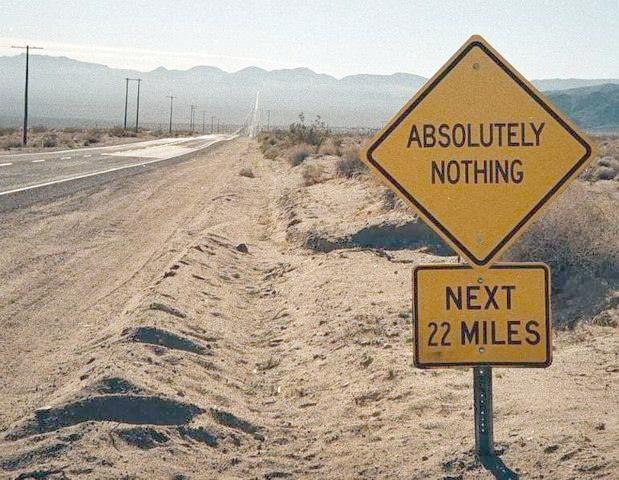
Meet the Nothing

There's something called "the Nothing."  There's something called "Nothingness."  They are (are not, perhaps) a concern to certain philosophers of a certain kind.  Apropos of nothing, Cicero once said (I paraphrase) that there is nothing so absurd that some philosopher has not already said it.

"Nothingness" I suppose represents the state of being nothing, or perhaps is characteristic of nothing, or is the quality of nothing or is characteristic of "the nothing."  Nothing is, apparently, the opposite of Being, or its negation.  I may be mistaken though.  I know nothing of the Nothing.

Heidegger the Great and Powerful wrote of the Nothing in his inaugural address on becoming rector at Freiberg, where he infamously made some speeches praising and indeed glorifying Hitler as, among other things "the future of Germany and its law."  I spent some time asking questions about this speech in a philosophy forum I frequent, and eventually was duly accused of bad faith for doing so and, I would think, also because I didn't understand what he was saying.  Which was nothing?  I still don't know.

I think Heidegger is something of a sacred cow in some philosophical circles and his followers eagerly leap to his defense whenever he is questioned or mocked.  They may be all the more avid in his defense because there's no doubting the fact that he was a member of the Nazi party, and never publicly expressed any remorse over that membership, nor to my knowledge did he ever publicly express criticism of the Nazi regime before, while or after it was in power.  As a result, those who defend him are defensive in doing so.

But I've been told many times, sometimes sternly, that his misdeeds in life have nothing to do with the merits of his philosophical works, and I would say that it's likely his fondness for Hitler and the Nazis at the least did not arise due to his writings regarding "the Nothing."  Had, in other words, nothing to do with the Nothing.

I think Rudolf Carnap said all there is to say about "the Nothing" as it is referred to in the inaugural address.  What he says essentially is that "nothing" shouldn't be spoken of as if it is something or used as if it is a name for something, and if it is so used it leads to meaningless propositions.  But Heidegger seems to understand this and indeed says he does in the address.  Nevertheless, he says this is a defect in logic, not in use of the word "nothing" or indeed in "the Nothing."  "The Nothing" is encountered only when one is "suspended in dread" (or anxiety).  It's only this encounter which allows us to understand Being.  "Being" apparently refers to that which is.  That or those which is or are have "Being."

"Being" and "nothing" are concepts, names, or something which fascinate many philosophers, I'm sorry to say.  "Being" seems to me to suffer from some of the same problems as "nothing" or "the Nothing."  It may be used as a noun or name, and is treated as if it is something, a quality possessed by that which is, as opposed, apparently, to "that "which is not.  But at least unlike "nothing" or "the nothing" it actually refers to something which exists; indeed, everything that exists.  "Nothing" doesn't refer to any thing.

The fascination with "nothing" seems to be related to a question which in turn is a fascination of some philosophers.  That question is:  "Why is there something instead of nothing?"

Now some, like me, would say that there are problems with that question.  That problem as I see it is that it also is premised on an assumption that there is something that would exist if something didn't exist, called "nothing."  One can ask if one wants to "Why there is something?" but one can't then refer to anything that is "instead of" something.   Nothing would exist, true, but "nothing" doesn't replace something.

I think the question when posed as, "Why is there something instead of nothing?" or "Why is there something?" isn't one that can be answered by philosophers.  If it can be answered at all, it would be an explanation of the fact that things exist, and that explanation would seem to be one that would formulated by science, not philosophy.  That is, unless one is satisfied by an answer which is merely speculative.

It is a question which invites not merely speculation but the use of words in the fashion used by Heidegger and others when it comes to "nothing" and so invites confusion and what Carnap calls "pseudo-statements."

Carnap suggests such statements by philosophers may serve to do what poetry and art does, or music.  For me, that means that such statements may be evocative, and evoke a kind of knowledge or appreciation of the true or correct.  That may be generally true, but as I think Carnap observes the poets, artists and musicians or composers do a better job in this respect that do philosophers.  Some of the most profound feelings I've experienced arose from reading poetry or listening to music.  But "the Nothing" inspires nothing in me, I'm afraid.  Don't tell anyone, though.  This is between you, dear reader, and me.

Monday, February 26, 2018

Cui Bono Fuisset?


These Latin words, most famously used by Cicero in two of his speeches in defense of persons accused of crime, are generally translated as, variously, "who benefits?" or "for whose benefit?" or "for whose advantage?".  He credited them to the Roman censor and consul Cassius Longinus Ravilla.  The question is usually shortened to "cui bono?".

It's a question commonly asked, though not necessarily in Latin, during investigations of conduct; notably, criminal conduct.  It inquires into motive.  Why would someone do such and such, which leads necessarily to the inquiry--who would benefit from doing it?

The Latin phrase comes to my mind, like Zardoz, when I hear of another mass killing through use of firearms, especially the semi-automatic known as the AR-15 and other weapons designed to mimic automatic weapons typically used in the military, and it would seem increasingly "militarized" law enforcement agencies.  Specifically, it comes to mind when the leadership of the NRA and others leap to defend the sale of such firearms in the wake of these murders, and also promote arming teachers and others to prevent them from taking place.

The response typically given in reply to calls for banning or limiting firearms like the AR-15 is that they're not really military weapons, not assault rifles, not automatic weapons.  This is somewhat understandable as it's not uncommon for those seeking to restrict them to assume they are such weapons.  This kind of response, however, is a non-response, in my opinion.  Whether their sale should be restricted is not dependent on the fact that far more lethal weapons exist.  Based on what I've read, such a firearm is capable for firing 45-60 rounds a minute, depending on the skill of the shooter.  Of course, it may also be rendered automatic for all practical purposes by a bump stock, as we learned in the Las Vegas massacre.  Regardless, though, what is the argument against restricting sale of such a weapon which may, through use of easily used and well-stocked magazines, be employed in firing 45-60 rounds a minute?

If they're not restricted, cui bono?  Manufacturers and sellers of such weapons do, of course.  They would benefit as well if teachers were armed, or armed guards employed.  Money is the constant in their universe of gun control.  They win everyway if only they can sell more guns.  Fear of guns used by others induces the fearful to buy guns.  What, really, do they care if money is the only consideration?

I would maintain hunters and sport shooters do not.  They're not needed to hunt or to break clay pigeons.  Someone using one to do so would I think seem, well, weird.  And not in a good way.  Should the fact gun manufacturers/seller want to make more money figure in this debate?  Absolutely not, again in my opinion.

Who would use them, who would need them?  Who would benefit from them?  I suppose there are those who find them desirable in what I would call a creepy way.  Firearms which mimic military or automatic weapons may make some people with self-esteem problems, or who are excessively fearful or whose self-regard is conditioned on posing or appearing  as a soldier or mercenary or something, feel better or good if they own them.  Should free sale of such weapons be allowed in order to maintain their enjoyment in possessing if not using them?  The peculiarities of such people shouldn't figure in assessing whether and to what extent such weapons should be regulated.

What about what gun advertisers like to call "home defense"?  How likely is it that, in order to protect my home, I'll require a firearm allowing me to fire 45-60 rounds a minute as opposed to the shotguns I own now (personally, I'm not over concerned with home defense, but let's take into consideration the fact that some people are concerned)?  Not very likely.

Unless, perhaps, one accepts what I think is a rather fantastic view, that such weapons will be needed to prevent the government from harming me or my family.  I cannot.  The thought of indefinitely holding off any reasonably large and well-armed body of government agents from the security of my home, or vehicle, or from anywhere else strikes me as remarkably fanciful, at best; deluded at worst.

Do collectors of weapons benefit?  Well, we must make a judgment between whether we continue to gratify collectors or restrict weapons which have such potential to do harm.  My judgment is that the potential to do harm outweighs the desire of a collector.

What about the benefit derived by the defenders of the Second Amendment?  I've been a lawyer too long, perhaps.  I know that the rights granted by the Bill of Rights and the Constitution are and have always been subject to reasonable restriction.  The right to bear arms doesn't in any case imply a right to bear or have any arms one wants.  The Second Amendment will not disappear if such weapons are restricted.

For me, it's difficult to think of any good reason for acquiring such weapons.  So, I tend to think that most of those who buy them are not doing so for hunting, or sport shooting, or collecting but have other uses or purposes in mind, which likely are unreasonable and may do harm.  I would have no objection to such weapons being banned.


Monday, April 24, 2017

My Own Private Pooka


Pictured above are Jimmy Stewart in his capacity as Elwood, and his pooka friend, Harvey, in his capacity as a very tall rabbit.  The image is of course from the film Harvey.  It appears during my favorite scene.  It actually made me laugh out loud--no mean feat, I fear.  Elwood replace a painting above the fireplace with this portrait. 

Harvey had otherwise been a creature we were required to imagine.  We knew him to be a pooka as he was described as such earlier in the film.  A "pooka" is, as Google will tell you, a Celtic fairy, or goblin, or spirit variously referred to as mischievous or benevolent or malignant, also referred to as a shape shifter, or a horse, or a bull.  It's somewhat confusing, and the character of a pooka presumably varies with the legend being retold.  Even the name is variously spelled.  Harvey, happily, though something of a joker was kind and friendly, particularly to Elwood who had a fondness for drink and was thought of as eccentric if not harmlessly insane.

Friends are surprisingly hard to find in these times when we all purport to have so many.  Facebook friends, and I would think all kinds of other friends.  Are there Twitter friends?  In any case, friends who are identified as "friends" who exist, primarily if not entirely, in cyberspace.  I'll confess to being on Facebook, though not as Ciceronianus.  My Facebook friends are all members of my family or old friends, and so are relatively few.  But I know that others have hundreds, and for all I know thousands, of friends.  Facebook is constantly advising me of people I or others of my friends know, and asks if I'd like to make them my friends.  Thus far, I do not.

In all honesty, I don't know why I would want them for my friends.  Already my Facebook page is crowded with dogs and babies, those being it appears among the fascinations of those who have access to it by virtue of the fact I've granted that access.  God only knows what else would show up, unsolicited, were I to allow access to others.

But just what are friends, anyway, now?  Friends are like a second self according to Cicero.  If that's true, I have very few friends indeed.  Cicero may have had high standards of friendship, but I think of friends as being something different from the "friends" that are all too available to us all.  Friends are those we can share intimacies with, enjoy conversation, activities, food and drink with; rely on, trust, consult, without fear of being harmed.  We must know our friends and know them well, in order for them to be friends.

And so I wish for a pooka for my very own.  Well, perhaps not for myself alone; the pooka, being magical, could no doubt patronize others and still seem more than adequately present to me.  The pooka would have to be benign, however.  Mischief I have no problem with, so that it could indulge in as much as it likes.  And if pookas are especially fond of drinkers, I drink, though not with the frequency it seems Elwood did.  I would hope to drink enough for the pooka.

The pooka would have to be fairly well read, fond of irony, fond of history.  I'm not sure just what shape I would prefer.  I've always liked the Cheshire Cat; liked most cats, in fact, so that would likely be best.  An enormous rabbit would do in a pinch. 

Imaginary friends are not all that different from those friends we have so many of these days, who pop in and out whenever we wish to see them or their pictures or read their little comments.  I suspect they would even be better.

Wednesday, August 3, 2016

Lex Lavacrum

Lex Lavacrum is my best effort to translate into Latin the words "Bathroom Law" or perhaps more appropriately "The Law of the Bathroom."  What seems silly in English acquires a certain majesty when translated into Latin, however loosely.  I confess that the idea of bathroom law as a kind of specialty practice has a certain appeal to me.  I rejoice in the silly.  But the fact is that someday soon there may be (if there are not already) courses, seminars, certifications in bathroom law thanks to the efforts of those who seek to regulate human excretion, or at least decree which humans may excrete in certain places.  Public bathrooms and who may use them now consume us, or some of us, there being little else worthy of our concern it seems.

Lex Lavacrum, Lex Dei seems to be the premise on which the laws we see cropping up these days are based, ultimately.  The law of the bathroom is the law of God, and God being concerned most of all with sex commands that only those with appropriate genitals may use public bathrooms.  If you lack the proper genitals, you may not use bathrooms designated for men or women regardless of whether you consider yourself to be a man or woman.  Regardless, in other words, of how you "identify" in the current usage of that word.

What, though, of those of us who identify as neither man nor woman?  There are those who identify themselves as cats or dogs or other creatures, presumably.  Will they demand the right to use our cats' litter boxes or squat on our lawns?  What would God have to say about that?  As noted, I rejoice in the silly.  But this would be a species identity issue, not a gender identity one, and I think we may assume--for the time being at least--that species identity doesn't create legal issues applicable to the Lex Lavacrum.

To be fair (if it's possible to speak of fairness in bathroom law), divine command isn't the sole basis on which bathroom laws are adopted or urged.  There are said to be privacy and safety concerns. 

Now whether and to what extent privacy can reasonably be expected in a public bathroom presents an interesting question.  Whether it should be a concern of the law presents an interesting question as well.  Most men urinate brazenly standing next to other men with considerable frequency.  A man demanding that he be allowed under the law to do so alone in a public bathroom for privacy reasons would probably not get far in court or in a legislature.  But it's likely that the law would recognize that there are privacy concerns at issue in some circumstances.

I'm now at an age when my need to urinate is sometimes of such urgency that urinate I will even if surrounded by nuns or while standing alone in the middle of a crowded arena.  But I admit that I'd feel somewhat uncomfortable doing so, though primarily relieved.  But are privacy concerns in a public bathroom something which demands the adoption of a law to be enforced?  Should the law protect us from embarrassment in these circumstances?

As to safety concerns, I have trouble understanding why they exist.  If it's maintained that people who identify as women or men but lack the requisite genitalia are more likely to assault other people than are others, it's not unreasonable to demand that be established before a law is adopted, and as far as I know there's been no effort to establish that's the case.  In the absence of any evidence to that effect, it would seem as likely that a man could enter a public bathroom and commit assault regardless of whether he identified as a man instead of a woman.

For my part, I see no need for such laws, and think laws should be adopted for good reason.  As Cicero wrote, "The more laws, the less justice" (Summum ius, summa iniura--sounds even better, doesn't it?).

Of course, if the use of public bathrooms isn't such a concern as to demand adoption of special laws governing their use, then may it not also be claimed that the legal system should not be used to enforce the "right" of transgender people to use any particular bathroom? That doesn't work though.  The use of the legal system in that case is to address a prohibition which already exists in the law.  There should be good reason for the prohibition.  If there is none, it should be subject to challenge.

It seems religion is the go-to basis for legal claims that people should or may be excluded from certain places or refused certain services these days.  Ingeniously if disingenuously, the argument is made that it's discrimination to prevent discrimination if the discrimination is based on some sincerely held religious belief.  But this is to maintain that the law should protect and sanction religious conduct and beliefs, though of course only of a particular kind.  The Constitutional prohibition against adopting laws prohibiting the exercise of religion is, like all other Constitutional provisions (except the Second Amendment, according to some) subject to reasonable interpretation.  If it's necessary to unreasonably limit the legal rights of others in order to exercise a religion, the exercise of that religion may be prohibited in that respect.

Regardless of these profound legal issues, though, Ciceronianus won't practice bathroom law if he can help it.

Tuesday, July 5, 2016

Reflections on Independence Day, 2016

This post addresses the Fabulous Fourth, not the movie sequel, which it seems based on reviews is unworthy of reflection.

For two hundred and forty years, our Great Republic has existed and more or less thrived.  Particularly in the last one hundred years, it has been a dominant if not the dominant nation of this Earth.  The United States has been compared to ancient Rome for quite some time.  That comparison has become commonplace.  Those who make the comparison generally mean to condemn Rome if not us, or at least warn us to take care that the fate of our nation not be that of Rome.  Let's indulge in the comparison for a brief time.

The First Punic War commenced in 264 B.C.E.  Augustus established the principate in 27 B.C.E.  During that period of time, Rome grew from a city which held sway over a good chunk of the Italian peninsula to the master of the Mediterranean world and most of Europe, successively defeating and destroying Carthage and the successors states formed from the dissolution of Alexander's empire.  The United States has in a similar period done much the same, relatively speaking.  This seems appropriate as Rome, or at least the Roman Republic, served as a model of sorts to the Founding Fathers as they created the U.S.

It's doubtful, though, that the Founders thought they were founding an empire like that of Rome.  We have for the most part denied imperial ambitions at least though the presidency of Woodrow Wilson, though Wilson submitted meekly enough to the imperial ambitions of England and France, thus participating in the drafting of the Treaty of Versailles, reluctantly signed by many in 1919.  Even before then, though, America had acquired by conquest the American West and a good part of the American East, Puerto Rico and the Philippines and other territories from Mexico, Spain and the indigenous people of North America.  The U.S. managed to buy a great deal of land as well, through the good offices of Napoleon.  So, if imperialism consists of the conquest of territory and its rule by the conquerors, it would seem that America has been de facto an imperial power.

So simplistically far, so simplistically good.  So we carry on.

It's generally thought by many that the fall of Rome began when the Empire replaced the Republic.  If that's so, however, then it was a long, slow fall.  What's usually considered the end of the Empire in the West took place about five hundred years later, and the Empire in the East vanished about a thousand years after that (though it slowly became a very small empire).  Moralists of all kinds seem to be unaware of or ignore the longevity of the decadent Roman Empire.  If it fell due to the sexual and moral corruption they're fond of citing (usually by reference to Nero), we shall be lucky if we last as long no matter how we conduct ourselves or what God we choose to worship (and then ignore when it's convenient to do so, that being our usual practice).

It happens, though, that at its end the Roman Republic was dominated by several gifted and ambitious men, e.g. Caesar, Pompey, Crassus, Marcus Antonius, Cicero, Cato, Octavian the Augustus to be.  Most of them weren't particularly moral in our sense, though Cato certainly was ostentatiously virtuous and Cicero at least contemplated what was and was not moral.  Cicero, though, faulted Cato for his stubborn, uncompromising virtue, famously remarking that Cato thought he lived in Plato's Republic, not Romulus' shithole.

While America is full of ambitious men and women at this time, none seem particularly gifted, or moral for that matter.  Given the civil wars which resulted from the conflicting desires of the great of the Roman Republic, perhaps we should be thankful for this lack of ability.

Unfortunately, though, it's ability that might make the difference in the type of empire America will become if it follows the path of Rome.  Augustus, who created the Roman Empire, was a remarkably able politician.  Our politicians are craven and venal and have been for some time, and it may be that the political success of a capering, stridently ignorant man indicates that in the future they'll be craven, venal and boisterously stupid as well.

It's amusing to indulge in comparisons of this kind.  Overall and in the context of history I think the United States has done well in becoming what it is, but just what the future holds can't be predicted through the study of ancient Rome or any other Empire or nation.

There is one sense in which America now resembles old Rome, however, which may give us a hint as to our political future.  Money was of great importance at the end of the Roman Republic; votes were bought, directly or indirectly.  Roman politicians came from a restricted class, but required the support of the people at election time and treated them very generously in return for their support.  Money dominates our politics now, as well.

The difference is that money isn't used as it was in ancient Rome, to pacify and reward common people for their support.  It's used instead by the rich and powerful to pacify and reward politicians who require it to be elected.  Perhaps this accounts for the quality of our politicians.  It's demeaning to be, for all practical purposes, a lackey, a mere chattel in effect, of special interests, corporations, the very rich.  It's demeaning to be a panderer, and an American politician must pander.  What self-respecting, intelligent, able person could stand such a life?

Now, the votes of electors aren't bought; legislators and their votes are bought instead.  It's hard to say which practice will promote a greater degree of corruption in a nation.

Monday, June 27, 2016

About Cato the Younger

Marcus Porcius Cato, called the Younger to distinguish him from his grandfather, Marcus Porcius Cato the Elder, is not an easy man to like, a grim and dour personality, but has been one that is admired.  That was the case while he was alive and has remained true through the centuries since his death. 

It seems that he is more fortunate in his reputation than his censorious grandfather who, although he had a distinguished military career and also one as a senator and consul, is remembered primarily for a treatise he wrote on agriculture and for declaiming, after every speech he made in the Senate, that "Carthage must be destroyed."  It was destroyed eventually, in part due to his relentless urging.  Grandpa Cato wasn't a likeable fellow either, but was revered by his grandson as a representative of old Roman virtues, unlike the foppish patron of Greeks, Scipio Africanus, who was one of the targets of Grandpa's vindictive style of conservatism.

Cato the Younger was noted for his adherence to Stoic philosophy, and so it's difficult for an aspiring Stoic to be critical of him.  I'm critical of him nonetheless, but not entirely so.  Even his ally against Caesar, Cicero, was critical of him at times, for good reason.   Though Cicero admired the Stoics, he wasn't above ridiculing them and Cato for their extremes--at least as part of a case, in the course of advocacy.  Cicero was a lawyer, after all.

Cicero also was critical of him for his obstinacy and refusal to compromise.  But Cicero admired him as have many others for his refusal to submit to Caesar's rule of the Roman Republic, soon to be the Roman Empire.  When Caesar portrayed Cato as a drunk in his triumph after his victory over Pompey and the optimates, Cicero responded with a kind of panegyric in his praise.  Caesar found it necessary to reply to it; Caesar was never able to forgive Cato as he forgave many others, even after Cato's suicide to avoid submission--perhaps even because of it.

Cato is admired as a hero in the ongoing battle against tyranny.  He was admired as such by the Founding Fathers of our Republic, all of whom looked to Rome in its creation.

Cato's commitment to freedom, however, is more accurately seen as a commitment to custom and Roman traditional virtues and institutions (the mos maiorum).  Individual rights and freedoms were not a concern to Roman government or society generally.  Romans, at least traditional Romans, served the state, not themselves.  Romans were not libertarians; Cato certainly wasn't one.  Cato wanted Rome to be ruled as it had been; by an oligarchy making up the Senate, with some powers held by the plebs and their tribunes as created over time.  Rule by one man or a few by virtue of their control of the legions and catering to the people is what Cato fought against.

I have no reason to doubt Cato's commitment to Stoicism, but it strikes me that his very ostentatious displays (walking barefoot, wearing a simple coarse tunic), railing against clothing and conduct which was not similarly rustic and simple, isn't Stoic.  It's posturing and prideful.  No doubt it had a political purpose and was a kind of propaganda.  But it reflects a concern with what should be indifferent, with appearances--with impressing others.   Living simply, foregoing luxury is appropriate, but vocally condemning those who do otherwise doesn't seem to me to be something advocated by the Stoics.  Perhaps Cato, in this, was more Cynic than Stoic.  Diogenes enjoyed flaunting his simplicity, much to the annoyance of Plato.  But nobody doubted the honesty and integrity of Cato, not even his enemies.

I think what can be doubted was his wisdom--his practical wisdom, in any case.  There is an argument that his refusal to compromise in any respect played a part in ending the Republic and creating the principate.  And certain warnings are self-fulfilling.  Political and military chaos creates opportunities for the ambitious, and Cato contributed to the chaos, and perhaps even invited it.

Those interested in Cato may want to read Rome's Last Citizen:  The Life and Legacy of Cato, Mortal Enemy of Caesar, an interesting book written by Rob Goodman and Jimmy Soni, which I plug here despite their annoying use of diminutives in their names.

Tuesday, June 7, 2016

O Bella Roma

Relatively fresh from a visit to Italy, specifically those cities which seem to be most visited by tourists like myself (Rome, Florence and Venice), I'm inclined to expound on them here--that place where I am emperor, of ice cream (or gelato?) if anything at all.

As may be guessed from my nom de blog and a review of this blog itself, I'm fascinated by the history of ancient Rome.  At long last, I've personally seen many of its ruins.  Edward Gibbon on viewing the Roman Forum was inclined to bemoan its condition, and this he wrote motivated his history of Rome's decline and fall.  It seems in much better shape now than it was when he viewed it, but in viewing it myself I'm inclined to marvel at its ruins.  Perhaps I entirely lack any Romantic instincts, but I'm too impressed by the remains of ancient Rome to indulge in pontifications along the lines of sic transit gloria mundi.

The ruins of the Forum including the rostra and the Curia, the arches of Titus, Septimius Severus and Constantine, Trajan's Market, his column, his forum; those of Augustus and Nerva, the Ars Pacis Augustae, the mausoleum of Augustus, the baths of Caracalla and Diocletian, the Flavian Amphitheater a/k/a the Colosseum, the tomb of Hadrian, the column of Marcus Aurelius and his equestrian statue, represent only the most evident architectural monuments of Rome and its empire, and they're stunning to one such as me.

It's difficult to imagine how impressive they were thousands of years ago.  Henry James, I know, found Roman ruins (or at least some of them) indicative of a kind of brutality and baseness.  They were just too big for Henry.  I wonder, though, whether his attitude and those of others with similar views is more an implied acknowledgement of how small we and our civilization became after Rome fell.  It's easy in a way to resent the Romans as it took us centuries to achieve what they achieved even in matters of plumbing and hygiene, in the building of roads, the supplying of water to cities, let alone the fine arts.

One thing I find disturbing was the tendency of the popes who restored certain of the ruins to emblazon their names on them.  I suppose the desire was that they be granted a kind of immortality by association with monuments which represented ancient glory and would clearly last far into the future.  Restoration by Christians seems entirely appropriate in any case, however, as various Christians after the fall of the empire regularly took stones and marble from the ruins of Rome to adorn their buildings.

Even more disturbing are the figures of popes and saints which were plopped on top of the columns of Trajan and Marcus Aurelius.  As those columns depict scenes of the conquests and campaigns of those emperors, it's unclear why any pope or saint would be glorified by appearing at the summit of such military monuments.  Churches, of course, were regularly placed on top of pagan temples.  There's something profane about the imposition of Christian icons on and over these pagan relics; something profane about the physical triumph of the Christian sacred.  But who remembers those popes, compared to those who know the names of the emperors who lived centuries earlier?

It can't be doubted that brutality and cruelty were aspects of Roman civilization.  But walking along the Sacred Way, where emperors and generals rode in triumphs and religious processions took place, where Cicero, Cato and Caesar walked, one senses that much more was involved, good and bad, and that what we are now is in large part mere imitation or emulation.  And not merely that of "skirt-mad Mussolini" as Robert Lowell called him, unfurling the eagle of Caesar.

Rome remains a world capitol; a crowded, busy city apart from but existing in and around the imposing corpse of the Roman Empire and of course around the center of what may be called its ghost, the Roman Catholic Church, a sovereign state in its own right thanks to the Lateran Treaty (and Mussolini, it must be said).  But it's still served by the aqueducts which continue to bring potable water to its inhabitants.  Ancient Rome is a living presence in a living city.  It's filled not merely with monuments to the past or recalling the past, but with the past itself.  Rome's past is present.

Monday, February 29, 2016

What Does "Judeo-Christian" Mean?

We hear much in this endless presidential election, though not much of any substance.  Among the many things spoken of are Judeo-Christian values, or ethics.  They have been fodder for pandering politicians for many years, of course.  I wonder, though, whether anyone knows just what they are.  I personally find them hard to describe.  I find it even harder to grasp why they are considered Judeo-Christian.

As they're characterized as Judeo-Christian, there may be a tendency to infer that they consist of values or ethical precepts held in common by Judaism and Christianity.  Presumably, then, they may be ascertained through contemplation of similarities between the two religions.  One can't help but note, though, that a Jew cannot be a Christian, nor can a Christian be a Jew, because of certain fundamental disagreements pertaining to God's nature and plan.  The two religions are contrary in significant respects.  Thus fundamentally opposed, what can they have in common?

The Ten Commandments are usually claimed to be part of Judeo-Christian values.  Certain of those commandments seem to call to mind the differences between the two religions, however, and not their similarities  Just who do Jews and Christians, jointly, believe to be the Lord their God prohibiting them from having any other gods?  Jews necessarily don't think Jesus is God; Christians necessarily do.  Is there some other God that's the subject of their agreement?  The part about graven images presents some problems as well, at least as far as certain Christian communities are concerned.   The two religions don't even agree on the Sabbath which is to be kept holy. 

It's notable that those who speak of Judeo-Christian values, ethics and tradition seem to be professed Christians in particular.  I suspect this is because those who believe in things of any kind that are Judeo-Christian mean when referring to them that they are, in fact, Christian.  They are "Judeo" in the same sense Christianity is, Christianity being what true Judaism became and should be.  It's convenient to refer to them as Judeo-Christian, though, as it's convenient to acknowledge that Jews exist and much as one may try, one can't get around the fact that what is called the Old Testament was prepared when there were no Christians but there most certainly were Jews.

We Americans seem most inclined to refer to these ethics, values and tradition.  And if Google is any guide, it seems that we believe that our Great Republic is founded on them; is in fact their embodiment.  The Declaration's evocation of a creator endowing us with inalienable rights is generally cited as being Judeo-Christian.  So of course are life, liberty and the pursuit of happiness.  So likewise is the rule of law.  Locke, it seems, and the Enlightenment generally didn't influence this document.  Something Judeo-Christian did. 

The belief in a creator, human rights and the rule of law isn't peculiarly Judeo-Christian, though.  Such beliefs, such values, may be peculiarly Western, in the sense that they are Graeco-Roman.  It's no coincidence that so many of our institutions are modeled on those of the Roman Republic.  One may find these beliefs and values in Cicero or the Stoics.  They found their way into Christianity as did so much else of the ancient pagan world, and via Hellenism even into Judaism after Alexander's conquests.  But there is nothing particularly Jewish or Christian about them; there's nothing even particularly religious about them, unless the belief in God in itself is religious in the same sense as Judaism and Christianity.  Clearly, though, the "god of the philosophers" and the Stoic deity are not gods of the kind worshipped by Jews and Christians.

These days, "Judeo-Christian" is generally distinguished from Muslim, just as it was in the past distinguished from Communism.  But if we must draw such distinctions we can do it just as well by referencing the even more ancient past of the West, and in doing so we have a greater claim to accuracy. 

Much as we may want to, we can't disregard the many centuries in which Christianity governed the world through the Church and various surrogates of the Christian Roman Empire in defining Christianity or Judeo-Christian.  "Liberty" isn't something we can easily associate with those many years, and "happiness" in those times was not properly attainable on Earth, but rather in heaven.  We may maintain that Judeo-Christian values suddenly came into being in the late 18th century when the U.S. was formed, but if we do we fool ourselves.

Monday, January 11, 2016

A Friend's Death

Brian Setzer did a song called "Sixty Years."  Its chorus contains the words "We only got sixty years on the planet (Repeat 3 times) and if you get any more you might wish that you hadn't."  It would seem he underestimated just how long most of us have here.  Perhaps he meant sixty good years.  But in one case at least, he was accurate enough.

Memento mori was a medieval practice, involving reflection on one's mortality.  Of course, this was a common practice or discipline long before the Middle Ages.  It's easy enough to find the contemplation of death in Epictetus or Marcus Aurelius, for example, and those granted a Roman triumph were told to remember they were mortal by a slave standing behind them in their chariot, holding a crown over their heads.

The death of someone you know, particularly that of a contemporary and a friend, can inspire such contemplation as well.  The inspiration for this contemplation increases with age, naturally enough.  It's something to get used to.

I met the friend of mine who died recently in college.  We were roommates for the better part of four years.  He was odd, quiet and shy.  I also was odd, though not so quiet and not so shy.  We had many things in common in addition to our peculiarity: a fondness for alcohol, literature and music, and the more outlandish forms of wit.  He grew excessively fond of alcohol, however, and it may be that fondness together with a love of tobacco, which we also shared, which ultimately brought about his gradual dissipation and ultimately his death.  I don't know if alcoholism was eventually diagnosed in his case, but had been drunk with him on many occasions and while my drunkenness became less and less a habit his became habitual.  Tobacco I gave up many years ago; I don't think he ever stopped smoking.

Sadly, I hadn't seen him for years when I learned of his death.  For years before that, though, we were very good friends indeed and that friendship lasted long after college, continuing after I married and had children, though he never did.  He clearly wasn't up to either.  The signs of his dissolution were there even in college, when he threw away his chance of doing well by drinking and treating his courses and teachers with contempt.  But he returned and ended up graduating years after his classmates did, to his credit.  It seemed at the time he was pulling himself together.

Perhaps he was a shooting star, as a song he liked put it.  His intelligence and wit could be incandescent, his memory profound, his insight remarkable.  But he had no patience for the kind of life available to him now, and refused always to do what was needed to succeed, though I think he could have done so.  Later, I think he began to lose his hold on life and perhaps on sanity, preferring some other world he was unable to experience; that would not require work and discipline or the compromises and effort required to make money, marry have children, own property.  Medication may have contributed to the disorientation he sometimes displayed

He seemed of a type, in some sense.  The frustrated, lonely artist, misunderstood genius.  A tragic figure.  He could write very well indeed, in my not very humble opinion, when he wanted to.  I hope he continued to write, and that somewhere among what's left behind there may be some work of genius.  But there was more to him than that.  He wasn't merely a poseur.   Yet he burned out very quickly.  He became homeless for a time, I think.  I gave him money, bought him meals, but I was a professional and a father and existed in an entirely different world, and the requests for money became intolerable eventually.  I know I could have done more, but did not.  I doubt it would have made any difference if I had, but regret it nonetheless.

It seems my great regrets have their beginnings in my college years.   What is it about those years that they play such a role?  They should not, because they are gone quickly and the rest of life remains and is relentlessly different from those halcyon days.  I suppose the same could be said about youth.

A friend, according to Cicero, is like a second self.  He was a great friend for a long time, and I often think of him, and miss him, especially during my now sadly solo trips to the friendly and interesting bars and restaurants in downtown Chicago.  In this case a friend was not a second self, really, though I saw in him things I think are or at least were in me, but not to the same extent or of the same dangerous power and purity.  Ave atque vale, Catullus wrote to his brother on his death.  I wrote the same words on the death of my father, and now do so on the death of a friend.

Tuesday, November 17, 2015

"In Times of War, the Law is Silent"

Cicero, in his speech normally referred to as Pro Milone, spoke the words which serve as the title to this post.  Well, being a Roman of the first century B.C.E., he actually said "inter arma enim silent leges" or at least that is how his words have come down to us.  The speech was given and the words were spoken in favor of the Roman politician Milo (Titus Annius Milo) and against Publius Clodius Pulcher (not to be confused with Publius Claudius Pulcher, who as I've mentioned before I admire for his treatment of the sacred chickens).

The speech was given during a time when both Clodius and Milo were inflaming the Roman mob, driving it to a most impressive spree of violence in favor of the political factions they represented.  They also hired armed mercenaries to threaten one another, and we're told gladiators were brought to sessions of the Senate to cow senators into compliance.  Clodius was eventually killed, and Cicero defended Milo, who was charged with the murder of Clodius.  In his defense, Cicero did not bother claiming Milo was not involved in the killing, and instead claimed that it was necessary, and lawful self-defense, in a time of emergency.  In fact, "war" wasn't referred to by Cicero, but arms were (arma) and in Latin silent doesn't mean "silent" but rather "mute."

Cicero himself, while consul, with the approval of the Senate condemned Roman citizens to death without trial during the time of the Cataline conspiracy against the Roman Republic.  No doubt he felt the law was silent at that time as well. 

It must be acknowledged that since these words were spoken, they and the rule they state have often come to mind and been relied on by those in power (and others) whenever there is armed conflict and the belief is that laws applicable in times of peace must stand mute until the conflict is resolved.  That was the case after 9/11, and long before that.  It's likely that will be the case again regarding the terrorist attacks in Paris.

Do these attacks indicate that this is a time when law, or some laws, should be silenced?  This should be decided as soon as possible, I think.  Otherwise, response to the threat will be haphazard, and it's likely nothing will be achieved of lasting effect.  Our leaders will end up doing what they always do, and blame one another for the lack of success while people die.

Anyone with due regard for the rule of law must find the claim made by Cicero to be disturbing.  I for one am disturbed, but not merely by the fact that the claim, if true, allows for the waiver of the laws, but because such waiver--a deliberate failure to enforce or honor the law--may actually be necessary, or at least prudent, in extreme circumstances.  There is a danger that those who waive the law may do so unwisely, or solely for their own benefit, or as part of scheme of oppression, or maliciously  There is also a danger that a failure to waive legal restrictions may lead to grievous harm.

It seems clear that Cicero didn't mean that all laws are silent in times of conflict or emergency, and there is no reason to believe that is how the statement should be interpreted.  But depending upon the nature of the emergency, it's unsurprising and not necessarily wrong if certain laws are deemed not to apply in certain circumstances.  Whether that should be the case and, if so, what laws are to be disregarded, is a matter of the greatest significance and should be the subject of careful consideration.

It's unlikely there will be careful consideration, though, or indeed intelligent consideration of any kind, with respect to any response.  Responses to attacks of this kind are visceral, and this also is understandable.  They cannot be tolerated or justified; they must cease.  Perhaps the world at large will finally understand, now,  the magnitude of the evil of these primitives and their death cult and make a unified effort to rid us of them, setting aside selfish concerns and quests for power.

If it is decided that laws should become silent, it should be recognized that this should be the case only because a crisis is of such significance that it should be deemed war or the equivalent of war.  Is that a commitment we wish to make?  It seems we've been putting that off, at least as to the current threat, and possibly as to others if by war we mean a national devotion to the conflict. If we are willing to commit to it, what will we do in pursuing the war?

The tendency is to demand that the threat be destroyed through the use of "any means necessary."  This is a thoughtless response, and generally merely indicates we don't know what means to employ.  Thus we've sanctioned torture in the past, and some still do and will, despite the fact that it's usefulness (if not its morality) has been questioned even by those who have not hesitated to make war, like Napoleon.  Sometimes, it seems, we're impressed by responses only if they're ruthless.  But it shouldn't be the ruthlessness of a response that is valued.  It should be valued only if it is effective, and a thoughtless response is bound to be ineffective.  One remembers the boastfulness behind the "shock and awe" tactics employed not all that long ago.  Those tactics seem to have had no useful result.

So chest pounding and loud, flashy tactics will do us little good.  If this is the great fight of our times, then it should be treated as such, and a sustained and devastating response made, not a piecemeal one.  However, it's doubtful there will be such a response unless it becomes a coordinated effort by all nations with an interest in the area, and that for good or ill should include those nations which maintain they are Islamic.  If they refuse to contribute, though, the response must still be made.  Either that, or we continue to be subject to such attacks, doing the best we can to avoid them.

What of the law in all this?  Well, it's unclear just what laws would be subject to consideration and waiver at this time, except those applicable to privacy and those related to the conduct of war and the treatment of prisoners.  We've already evidenced a disregard for laws impacting those issues, though, without putting the nation on a war footing.  However, it's conceivable that others, such as those prohibiting discrimination, would come under scrutiny.   Is there such a thing as "profiling" at a time of crises?  is there a legal obligation to take in refugees?  To what extent are the boundaries of sovereign nations to be honored?  Should we restrict or prohibit immigration?

If this is the great fight of our times, then it is inevitable that laws will be found to conflict with war aims.  We must be prepared to address that conflict as well.  But all this comes into play only when we've decided what our response will be.

For a response of such magnitude that it will bring the law into scrutiny and require a national commitment, it seems clear to me that Congress must be involved.  That would be a "real war", and it is the Congress which has the power to declare a real war, though it has shirked this terrible duty often in the past by granting war powers to the Executive.  All our elected representatives should be held responsible for such a decision.

Monday, April 20, 2015

Scipio's Dream and Life in the World

Cicero wrote a dialogue called De Re Publica, which has sometimes been referred to as his Republic a la that of Plato, but is more properly translated as "Of the Republic."  The Republic in question was  that of Rome, still in existence at that time but shortly to be extinguished by the civil war leading to the dictatorship of Julius Caesar, which in turn was followed by another civil war leading to the establishment of the Empire by his grand-nephew and adopted son, known to history as Augustus.

Cicero's work may be distinguished from that of Plato both because it dealt with an actual nation and government (though justice and ideal government is addressed) and because it was written by an astute practical politician and thinker--someone who actually governed, as a senator and consul of Rome.  He also had an axe to grind.  He wished to point out that good government is contrary to the cult of personality surrounding Caesar, and that Caesar sought power merely through ambition and for the satisfaction of his pride.   Plato, of course, was speculating regarding an ideal state, though some like me may think his ideal to be deplorable.  It's unclear whether Cicero's work was ever finished and that we know all he wished to say; it has come to us in fragmented form.

Within those fragments is a description of a dream itself described as "The Dream of Scipio" (Sonium Scipionus).  The Scipio in question is not the Scipio who defeated Hannibal at Zama, who we know as Scipio Africanus, but rather his grandson, who we know as Scipio Aemilianus.  The grandson in turn was given the honorific Africanus as he was Rome's general in the Third Punic War in which Carthage was finally annihilated by Rome (he had the name before then as it was a hereditary title, but subsequently earned it as well).

Scipio Aemilianus was notable not only as a general but as a friend of philosophers, known to converse with them regularly.  This practice earned him the public dislike of the dour censor Cato, who thought him far too Greek and frivolous.  It may have been his fame as a philosophical sort of Roman which led Cicero, another philosophical sort of Roman, to provide a fictional account of a dream Scipio Aemilianus supposedly had before the destruction of Carthage by the Roman legions.

In that dream, the grandson finds himself in the presence of his grandfather, gazing down on the Earth from a great height, among the stars.  They converse, one Africanus to another.  Grandpa Scipio tells his grandson of his victory over Carthage two years away, and of his future in general, but also invites him to consider how small the Earth is--a tiny part of the universe.  Rome, of course, is even smaller; a small part of the Earth which is a small part of the universe.  The living Scipio is asked to reflect on the insignificance of the Earth, of life, of we humans, and understand that our true nature is divine and does not end in death, and we should hold dear only that which is eternal in us and in the universe.

Perhaps this dream is intended to function much as the slave's reminder to those granted a triumph.  "Remember you are mortal" are the words supposed to have been repeated to the honored victor by the slave riding with him in his triumphal chariot.  The message that all glory is fleeting, soon forgotten, seems to be one which can be derived from the dream.

But it seems something more was involved.  Cicero was a lawyer and politician who tried to be a philosopher as best he could.  He studied with philosophers and wrote philosophy.  We owe a great deal of our knowledge of ancient philosophy to him, as he wrote of books no longer available to us, lost in time.  He seems to have been making the point that we should not consume ourselves over worldly matters like fame, victory, conquest and power, but devote ourselves to wisdom, virtue, and ascertaining the laws of nature and through nature, God.

Cicero knew Stoicism well and was sympathetic with it, though we know he did not consider himself a Stoic.  This is a Stoic perspective.  The quest for fame and power and what goes with them is a quest for things not in our control.  When we read Marcus Aurelius we find that he often points out that the great of the past are long forgotten as we will be forgotten after we die, and that which concerns us so much now is insignificant.  I think the great schools of philosophy which existed in ancient times agreed on certain things, and that most if not all of them emphasized that the universe is vast and we and all we do is small in comparison; our petty fears and hatreds and desires all mean nothing, and we should concern ourselves only with eternal truths.

But if our world is insignificant, and we are even more insignificant, what do we matter?  Why should we try to do anything with our lives?  We know now the universe is much larger than any of the ancients could even imagine.  From the cosmic perspective, we aren't even noticeable.  We may as well not exist.  Our pretensions are laughable; our concerns less than trivial.

We know how this question was addressed by Christianity, which denigrated this life and even delighted in its denigration.  It profits a man nothing if he gains the world, as our lives, here, are not only unimportant but are sinful.  It is only the next world that is significant.  So, certain Christian sects even accepted the view that "good works" in this world mean nothing.

That doesn't seem to have been the response of ancient pagan philosophy, though.  Stoicism's "things not in our control" were what is of no concern, and the view from above the Earth granted Scipio Aemilianus confirmed this fact.  What saved us from insignificance according to Stoicism, it seems to me, was its pantheistic conception of Nature and the belief that we as rational creatures shared in the divine.  Christianity held that we and the world in which we live are evil; the Stoics believed we, and the world, are part of and partake in the deity and so cannot be evil.  We escape the trivial by virtue of being part of Nature itself, and acting in accordance with the divine reason in which we share.

By acting according to reason, or Nature, we naturally (pun intended) do good works and our actions are thereby significant, one might almost say inherently so.  It's when we act inconsistently with Nature that we become trivial.

This seems to me a far nobler and more satisfying response to the vastness of the universe. 


Monday, September 22, 2014

Regarding Senescence

Both Cicero and Seneca, and no doubt other wise and good people, wrote of old age.  They did so to extol it; to tell those of us who are not as wise as they were that our disaffection with it is unwise and unneeded.  As I race (or so it seems) into my twilight years (well, late afternoon years, perhaps) I'm inclined to wonder just how much of such reflection is wisdom and how much of it is wishful thinking.

I don't doubt their sincerity.  Perhaps I do doubt Seneca's sincerity, though, at least a bit.  Regardless, I ask myself if they were trying to persuade themselves if not others that the evidence of aging--which can't be spoken or written away and which is disturbing sometimes, at least--is also evidence of something else, something less apparently bad and even good.  This is not necessarily an easy task. 

It's not necessarily a Stoic task either.  Pierre Hadot and others have claimed that the ancients engaged in spiritual exercises and have made that case convincingly.  Marcus Aurelius' notes to himself are such; Epictetus' recommendations, called "negative visualization" in this latest resurgence of Stoicism, are others.  Imagine the worst and what is the case or will be the case may be tolerated with equanimity (the anxious have always been Stoics, perhaps--something of a surprise).  But extolling age, if that is a practice, is of a different kind.  Were these two sages engaged in "positive thinking"?

The fact is that aging is a kind of progressive failure of the body and its little helper, or guiding spirit, or prisoner depending on your point of view, the mind.  There isn't much in that to celebrate when you think of it, unless you have a soul inclined to clap its wings and sing and louder sing for every tatter in its mortal dress as I think Yeats' poem says.  That singing presumes a life after death which somehow turns out to be much better than the one that ends in death, and many think that improbable.  I'm not certain what I think, and not for the first time.

As I contemplate with a sense of resignation if not delight the degradation of what physical and mental powers I possess, I think of Warren Zevon's song invitingly titled My Shit's Fucked Up.  The singer goes to a doctor as he's feeling kind of rough and is told that his shit's fucked up.  He tells the doctor he doesn't see how, and the doctor replies that the shit that used to work won't work now.  It's a kind of anthem of the aging sung in a mournful tune that is unmistakably Zevonesque. 

And as I noted, this is certainly true.  Wherefore then is old age the crown of life as Cicero called it?  An increasingly heavy crown, it seems.

Continuing with the popular music theme, which has somehow replaced that which was evoked by the mention of Cicero and Seneca, another view of old age or at least older age is given by Steely Dan in the song Janey Runaway.  In that song an older, well-heeled man, tells of the new lease on life he experiences taking up with a young woman who ran away from home.  It's a kind of anthem to lechery, the fantasy of an older man.  But alas, although the libido doesn't seem to decrease for us aging males the opportunities to indulge it sadly do, at least if one is not rich and living Gramercy Park.

Fantasies and mourning aside, how does a Stoic pass this time as time so indifferently passes him by?  By realistically acknowledging it and accepting it, I think, neither bemoaning it nor extolling it.  It's one of the many things beyond our control (for now, at least; perhaps soon we'll find a way to control it).  As such, it shouldn't disturb us or worry us.  It's simply life and we do the best we can with what we have and take the rest as it happens.

Tuesday, September 2, 2014

O tempora, o mores! Part V

Cicero used this phrase twice, first in one of his orations against Verres, governor of Sicily, and second in an oration against Cataline.  These orations deplored the conduct of certain Romans and mourned the depravity of the times, and customs, which sanctioned such conduct.  Today our times and some of our customs or morals, at least, are troubling as well, but that trouble is global in its effect and implications, for reasons which would have astonished Cicero, astute politician of what was then an Empire in fact if not in name though he was.

It's most unclear what can be done about these troubles, however, by our Great Union or by others.  The barbarity of ISIS (I wonder if they know their name is that of pagan goddess), the intransigence and imperial ambitions of Russia, militant Islamic fundamentalism, North Korean absurdist cruelty,  the extraordinary Ebola outbreak--this is all we hear of through the good offices of our relentlessly intrusive media.  Of course those who represent or seek to represent us, intent on being elected if not intent on anything else, exploit such issues for their benefit.

One pities our unfortunate President.  In fairness, which is of course of little concern in politics, there may in fact be very little he can do that he isn't doing.  But he manages to give the appearance of being at a loss and doing nothing, and appearance is overwhelmingly significant when there is no substantive action to take.  It's doubtful there would be any real public support for sending troops to Ukraine, Iraq, Syria or Somalia.  We know, or should by now know given the results of our efforts in Iraq and Afghanistan, that this would make no lasting difference in the last three cases, and taking on Russia on its front doorstep would be foolish and may be practically impossible.  If such action isn't likely or practical, what more is to be done?  More air strikes, more punitive economic measures?  If there are ISIS targets which can be attacked, and have not been, then it would seem appropriate to strike them.  If there none, though, what then?

In these all too interesting times, it seems we must accept uncertainty.  We must resign ourselves to the fact that our world is an unstable one.  I fear that if we don't do so we will seek certainty wherever and however we can, and will do so recklessly and without regard to the consequences.  Both certainty and uncertainty, both stability and instability, may be fostered now with great celerity by our communication technology, which may be used by anyone and for any purpose.  We can instantly terrorize others or arouse them to fury or fear, and many of us are willing to do so.

Acceptance of uncertainty doesn't require that we do nothing about the troubles of the world, but may assure that we won't try to do too much, or despair, or resort to efforts which will further limit what freedom we yet have.  Perhaps a Stoic approach to these troubles is best and the most thoughtful way of assessing our options and taking action.  We would do the best we can with what we have and take the rest as it comes, to paraphrase Epictetus.  We would avoid being overwhelmed and being inclined to take mindless action.

Can Stoicism be applied on a grand scale, or is its usefulness limited to individual thought, feeling and action?  It has been applied to a significant degree in the law, in the West at least.  But will it be applied to world affairs? 

Eventually, and voluntarily or involuntarily, we will learn if we have not yet learned that there is a limit to what we can usefully do, and cannot make all the evils in the world our problem or concern.  This would seem to be the first step towards practical wisdom in these very practical matters.  But Stoicism doesn't mandate detachment from world affairs, as Buddhism might, and indeed promotes service to the public good.  We would do the best we can with what we have, and not react irrationally to what happens.

Intelligent action is required, in other words. 

Sunday, June 3, 2012

Time Out of Mind

According to Cicero, "there is nothing so absurd but some philosopher has said it."  I'm not sure just what it was that prompted this comment.  I like to think that there are limits to absurdity, or at least limits to the deliberate promulgation of absurdities as fact, but I confess I'm given to wonder now and then.

Consider, though:  there are, or apparently were, philosophers who are or were unconvinced of the existence of an "external world" independent from our minds (dealt with in prior posts) or perhaps more properly that its existence cannot not be demonstrated to their (and therefore appropriate) satisfaction, and that mind and body are in some sense separate, and that Forms of absolute, perfect reality exist regarding which that which we experience is but a poor facsimile, and that we can't know just what "things in themselves" (like, for example, the computer on which I'm typing at this moment) really are; so, perhaps Cicero was right. 

I'm doing some reading at the moment regarding the question whether the past is real.   Some philosophers feel it isn't.  Some, unsurprisingly, think it is.  Most of us common folk, I think, would  maintain that it was, but is not now.  Most of us would probably assert that in the past, Roman legions marched around Europe, dinosaurs walked the earth, galleys manned by slaves were used for ocean transport.  However, that is no longer the case.  So, Roman legions, dinosaurs and such galleys certainly were real, but as they no longer exist, they can't be said to be real now.

A philosopher may be inclined to say, however, that we have no business referring to the past as real in any sense if it no longer exists, or that we can't state anything regarding what happened in the past, past events, past people, without purporting to come to conclusions regarding that which does not exist, which we cannot do legitimately.  How can we rely on our memories, or even records of the past?  There is no way to verify them, properly.

Some might question this kind of view, though.  There is now evidence that certain animals existed which no longer exist.  There are buildings we see which must somehow have come into existence, unless we're satisfied in thinking that they suddenly appear at the time we first encounter them.  There are people we knew who are no longer present.  Isn't it reasonable to infer from such evidence that there was or were some animals, things, people but now there are not?

Time is I think a particularly difficult subject for philosophers to analyze and explicate now, because physics has significantly preempted the field, or at least complicated it.  In the realm of physics, there be dragons I certainly cannot slay, in any event.  Physics may eventually ascertain that the past continues to exist in some sense, or can be retrieved, or perhaps indicate that there is a possibility of time travel to the past (if it has not already done so).  However, until that occurs, just what can be said about the past?  What is it?

In answering that question, I'd be inclined to apply some variant of Peirce's pragmatic maxim (he formulated several versions of it).  This would entail defining it by reference to its practical consequences.  The past is something that we recall, sometimes with pleasure, sometimes sadly.  It thereby and in other ways can effect us and our dispositions and our lives.  It can be used as a reference.  We can make decisions regarding what is transpiring now based on what has taken place in the past.  The world we interact it was in many respects shaped by the past; is a result of the past, and knowing the past can help us understand the world, ourselves and our fellow participants in the world.

The past is clearly something we think about, and something that influences us and how we live and act now.  In that sense, it is clearly real now, i.e. it is a part of our world, our reality.  Isn't that sufficient for our purposes?  Why could or should it be "real" in some other sense?  In what way does it matter whether if is "real" in some other sense (again, given the extent of our abilities and knowledge in the realm of physics at this time)?

No doubt I'm just demonstrating yet again why it is I'm not a philosopher; but once more I wonder why it is we devote ourselves to questions the answers to which, and problems the resolution of which, seemingly will make no difference to how we live, and what we do.


Sunday, April 22, 2012

O tempora! O mores! Part IV

As I've noted before, more and more there are those among the politicians, pundits and preachers who delight in instructing us some who indulge in pronouncements regarding our depraved state.  I received an email recently from a friend referencing declamations from a few of them which note, rather surprisingly I think, the expensive silliness engaged in by members of the GSA, and the fact that members of the Secret Service recently consorted with prostitutes in Columbia, as examples of that depravity.  I find this surprising as I find neither activity particularly shocking.  It may be that I am simply too depraved myself to be shocked, but I suspect that the shock evidenced by the commentators in question is more a function of the fact that they are Republicans than of the nature of the activities themselves. 

There are some disturbing things takings place, however, and some very disturbing things as well.  I question whether this has not been the case in the past, though, and so am not personally inclined to think we have reached new lows (those who think in that fashion seem unable to to avoid mentioning the Roman Empire when they beat their breasts in horror at our immorality; I suspect because Hollywood has taught them that empire fell due to lack of morals, and they are eagerly awaiting our downfall which they hope to be at least as much of a spectacle).

But it won't do, really.  We are no better and no worse than what we have always been (for example at the time Cicero uttered those famous words which appear in the title of this post) and likely will always be.  We are, though, much better informed than we were in the past.  We can now know everything, and even see everything, immediately.  Our cruelty and stupidity have never been so much on display, so accessible.  In the past, not even the Shadow could know with such completeness and detail the evil that lurks in the hearts of men.  Now each of us can transmit it around the globe when we see it by use of smart phones.  And there are more of us, much more.  More people, more cruelty and stupidity.  That is the way of it; of us.

One can't disagree with the claims being made that we must do better, even when made by those ponderous, self-righteous souls whose business it is, or who have made it their business, to tell us so.  One can maintain that they should practice what they preach, of course, but preachers seldom do so, and this doesn't stop them from preaching.  But one should also give consideration to what can be done.  It may be our curse and our doom that when we do so we always seem to come to the same conclusions.

Those conclusions seem typically to be religious in nature, or rather that we become more religious in nature (the spirit of Chesterton seems to have taken hold of me).  There are problems in this approach, though, not the least of which is that religion no longer provides a detriment to evil behavior, if indeed it ever did.  The fear of hell is no longer prevalent.  It won't be coming back.  Even when we believed in hell, we managed to be immoral.

As a practical matter, it may be that the best we can do as individuals is control ourselves, and refrain from controlling others, or seeking and being governed by things which the Stoics taught us are beyond our control.  I think this may have been their primary contribution to theories of the manner in which we should conduct our lives.  It's a time for quietism.