Showing posts with label Plato. Show all posts

Wednesday, April 6, 2022

Homage to Saint Simeon


The Saint that is the subject of this post, and homage, is that Simeon who is described as a "holy fool."  I don't give homage to that Simeon who is known for the length of time he lived on a small platform atop a pillar, though it must be admitted that this is a remarkably stupid thing to do.  Homage is inappropriate in the case of that Simeon.  Homage is, I believe, due the Simeon who apparently lived in the 6th century C.E. or A.D. and was considered, justly it appears, to be mad.

That particular St. Simeon famously dragged the corpse of a dog behind him in his travels.  He would blow out candles in churches.  He was also known to throw nuts at the clergy during masses, and also at women.  I'm uncertain why he threw nuts at both.  If there is a connection between them, and them and nuts, it escapes me.  He was known to skip and dance his way around the arena during public performances or games.  On feast days calling for fasting he would eat huge amounts of food, particularly beans, and then proudly indulge the effects of eating that "magical fruit."

He is shown in the picture above, apparently doing a kind of summersault for the delight of those waiting along his path.  The dog appearing with him is presumably dead.  He's known as the patron saint of puppeteers, and pictures of him sometimes show him brandishing a puppet of some kind--probably an angel.

In the peculiar logic of religious belief, his bizarre behavior is claimed as evidence of his saintliness.  Sometimes, it's maintained that he acted like a lunatic in order to demonstrate that life on earth was a farce, and only the Kingdom of God important.  Perhaps he is meant to be a kind of Christian version of Diogenes.  After all, according to Plato, Diogenes was Socrates gone made.

But I confess that I suspect he was mentally ill.  I also confess that it delights me that such a person was made a Saint.  A crazy Saint is worthy of reverence.  I must see if there is a St. Simeon the Holy Fool medal.  I'd gladly wear it.

And, although it seems this Simeon isn't the patron Saint of fools, it's appropriate that there be one, particularly given the prevalence of fools here in our Great Republic and elsewhere.  Those who believe in such things as a worldwide conspiracy of powerful pedophiles should have someone they may ask to intervene with God on their behalf, and who better than the nut-throwing St. Simeon?  Though it seems they've lost their minds, they wouldn't pray to St. Anthony being uninterested in finding them.


Wednesday, January 5, 2022

A Day that will Live in Ignominy


On January 8, 2021, I wrote a post about the events of January 6th of that year at the Capitol of our Great Republic, remarking that it represented the end of American Exceptionalism.  That it surely did, and does, especially as it seems that that the hope of many of our especially craven politicians and pundits is that those events will be disregarded or forgotten, or even thought of fondly, like the antics of well-meaning but fractious children.

I don't refer to the self-infatuated blowhard who it seems has cancelled his plans to pontificate publically on the first anniversary of those events.  This cancellation would seem wise even from a purely self-interested perspective (and what other perspective does he have?).  What he would say is what he has said.  Watching him say it again would be like watching a demented person repeat a story he's already repeated many times, in much the same way with much the same words.  It wouldn't be a pretty sight even for his biggest fans.  Because refraining from making a spectacle of himself once more would be wise, he may yet do so, but in a less open format.

I refer to people who've actually been elected to office.  That in itself doesn't speak well for them, as this may hardly be called a mark of distinction in these sad times.  But for an elected official to be intentionally disingenuous about disgraceful conduct directed against a lawful election is especially ignominious, as it implies that such an official is unconcerned with and indeed against lawful elections generally, concerned only that the result of an election is desirable.  That is a view which would render representative democracy ineffective.  If accepted, elections would merely be a show to those elected, the winner being the one who could most efficiently "fix" the outcome.  That elected officials, and pundits and those who effect public opinion, could countenance this and even think it's desirable is shameful.

I suppose I should acknowledge that this is to assume that those seeking to disregard or justify what took place on January 6, 2021 don't believe that the 2020 election was stolen.  In a way, this assumption credits them with more intelligence than they may have.  But it's hard to believe that any reasonable person accepts what's being called "The Big Lie," a reasonable person being one who requires more than unproved allegations, shot down in court after court, to accept election fraud.  It's true, though, that reasonableness isn't something we see much of in our Glorious Union right now.  It's also true, unfortunately, that there are those in politics who will stop at nothing to assure that they will retain their position and power.

Perhaps it wasn't all that much different in the past.  Perhaps instead we live in a time when those who are unreasonable, ignorant, prejudiced and intolerant are more able to make themselves known and noticed than ever before.  I've speculated along those lines in this blog more than once.

Still, though, we may have come to the point in the U.S.'s decay when it no longer matters how the majority of people may vote.  Instead, it may be more important what some people, regardless of whether they're a majority, believe is right.  People who think they know what's right have found democratic government to be wanting--a kind of inconvenience--since at least the time of that pioneer of totalitarianism, Plato.  Ironically, Plato feared that a democratic form of government would allow demagogues to sway people away from what is right and good (that being what Plato thought was right and good) thus impeding the march to perfection he sought to impose on us.  Plato sought to change us.  Now, though, demagogues serve to prevent change, change being an evil in the eyes of those who hold power and have privilege.  

I fear, by the way, that I can't take credit for the felicitous phrase "self-infatuated blowhard."  I've seen it applied to another favorite of many among us, Martin Heidegger.  I just had to use it myself in another connection, and apply it to another ignominious figure.


Monday, November 29, 2021

Brains in Vats and the Untrammeled Mind


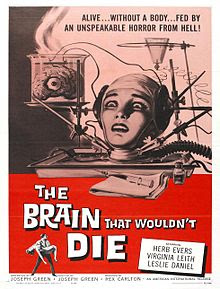
Not a brain, but a brain in a vat.  That's what won't die, at least in that part of the world (if there is one!) inhabited by philosophers.  "An unspeakable horror from hell!"  Indeed.

It's difficult to imagine a less serviceable avenue of thought than that indulged in by many philosophers for many centuries, relentlessly wondering if there is what is suggestively referred to as an "external world" and, if so, if it can be known by us. Worse, though, is their shameless tendency to write on the subject, if indeed it can be called one.  The consideration of the "question" is singularly purposeless, not merely because it's incapable of resolution, not indeed merely because it's questionable there is a "question" to be addressed, but because its consideration along with any possible resolution makes no difference to us, or to our lives.

It can't be disputed that we always act as if there is an "external world" and for the most part that our belief in it and its characteristics is substantially justified.  Anyone who seriously questions it could be accused of deliberately and thoughtlessly disregarding his purported belief.  Such a person would have to be mentally ill--"There is no world, but I live in it" isn't a statement most would make, and if one would make it seriously one would be treated, justly, as not quite sane.  That is what's done by philosophers who chew on this old chestnut and do so verbally and in print, to the amazement and bewilderment of those who listen to them or read their words (assuming, of course, that they exist).

What's particularly curious about this fixation with our claimed ignorance is that it's sometimes asserted that our incapacity is established by "scientific evidence."  There is of course the problem that it's questionable whether there can be any evidence, scientific or otherwise, if we can't know the "external world."  But it would seem obvious that the scientific evidence indicates that we evolved over time through our interaction with the rest of the world and interact with it consistent with our expectations time and time again.  If the results of experiments are "scientific evidence" it's apparent that scientific evidence in support of the existence of an "external world" is overwhelming.

Why, then, is this fantastic subject one of continuing interest and effort?  Let's ask, following Cicero:  Qui bono fuisset?  Where we humans are concerned, it's always important to consider who benefits from a particular act, question or issue.  Benefit--ours in particular--is always uppermost in our minds.

Who would benefit from a belief that we can't know the world, that we're separate from it, that it isn't real, or less than real; isn't true or less than true?

Those who thrive on it, clearly.  Philosophers, of course, do so.  For some it's their bread and butter.  Most if not all of the religious, as well.  "My kingdom is not of this world"--so said Jesus or so said someone who said Jesus said it.  The clergy in particular.  What would they do if people didn't think there was a world beyond this one; a world better than this one, which is the "real world"?

Anyone who benefits from disregard of or disparagement of the world as it is conceivably gains from the perception that there's something fundamentally wrong with things, so we may have to include politicians and pundits as well among those who claim the world isn't as it appears to us.  

No wonder that Plato, who first wrote extensively of a reality not of this world, was a totalitarian at heart.  If the world isn't real, then clearly we should seek what is real.  If we can't, we should be made to do so, for our own good.

And so we see what metaphysics and epistemology can lead to, if untrammeled by the world!  Without weights or guide lines, they ascend uncontrolled into the air like the balloon of the Wizard of Oz, they render us inhabitants of that city in the sky, Cloud Cuckoo Land of Aristophanes.  No wonder, perhaps, that Heidegger was a Nazi.  
 

Monday, December 7, 2020

Homo Degeneratus


Most of us will recognize this picture from Kubrick's 2001: A Space Odyssey.  In this scene, one of our distant ancestors or another, encouraged or enlightened courtesy of the seemingly inscrutable monolith, has discovered that a bone may be used as a tool.  As a killing tool in particular.  After killing a tapir and one of his own kind from a different group or tribe, the new prototypical Homo Faber (Man the Tool Maker) celebrates his discovery by tossing the bone into the air, and it becomes through Kubrick's inspiration a tool of a different kind--a space vessel.  So, after that violent beginning, we humans progressed and came to create far more sophisticated tools, according to the movie.

And so we did, and do.  But more than making tools, we have managed now to be "tools" as that word is defined in slang, or in the invaluable Urban Dictionary.  We've become, in other words, jackasses.  We've devolved from being Homo Sapiens.  As it seems our devolution is continuing, we're more properly considered Homo Degeneratus.

What is remarkable is that not only do we devolve, we seem to have no interest in progressing, in being more than we are or better than we are, in thought or deed.  We want to have more than we do and have better than we do, however.  It's a significant distinction.  More money, more and better possessions are desired.  We take that selfishness for granted.  Thinking better and doing better aren't among our goals, though.  Indeed, judging from what we say and do it isn't clear we think we can or should think or do better than we do now.  We resent anything or anyone suggesting we're lacking in any respect when it comes to what we believe or what we want.  We reject anything suggesting that what we believe or want is untrue or unworthy.

How else do we explain what seems to be the widespread belief in absurd conspiracy theories and election fraud which abounds at this time, despite that there is no legitimate evidence supporting that belief?  How do we understand claims being made that fraud must be disproven rather than proven?  Why do so many of us simply assume that claims made are true; particularly, it seems, those made by people who are proven liars?

A possible explanation is that we've become Homo Degeneratus, and are increasingly stupid, dull and bovine as a rule.  So, we're easily led--herded as it were.  We're changing into the stereotypical caveman as portrayed in cartoons. Maybe we're regressing, rapidly, for some reason.  

Another is that we've reached the limits of our ability and/or desire to think and the world around us, indifferent to our incapacity, grows more and more complex and dangerous.  Because we cannot or will not think more than we have, we turn to thoughtless answers and solutions to our problems, in the hope we'll hit on something that works.  The worse things become the more our urge to grasp at even the most idiotic response, provided only that it satisfies our need not to think about what is happening and seems right.

Perhaps we're witnessing denial, as defined in psychology, but on a mass scale.  We simply refuse to acknowledge what takes place if we find it objectionable, unpleasant or threatening.  Certainly we're witness to a particularly gross form of denial at this time in the form of the rejection of the results of the recent election.  Is denial catching?  It might be, in the sense that hysteria is catching and can overcome groups of people, who come to accept an alternate version of reality and, unfortunately, put their delusions into action.

This all raises questions about the fate of representative government in these dark times of instantaneous communication and instantaneous acceptance of whatever is communicated if it is satisfying.  It's been known for sometime that we're all subject to manipulation.  Those in sales and marketing have known this, at least, and profited by it.  Add to it what seems to be a positive revulsion to critical thinking of the kind that infests so many of us, and a legitimate fear of what will become of representative government arises.

If we've become or are becoming a kind of herd, then we may be led.  We may even be led to the slaughter, as are other herds.  Then government becomes a matter of despotism, by one or by a group.  In that case, our best hope lies with the possibility of a benign, knowledgeable despot of the kind longed for by even such as J.S. Mill in his more Coleridge-inspired moments.  Or perhaps an intellectual elite of the kind envisioned by Plato, by which we'll be marched in dull, regulated ranks towards perceived perfection.

Will we come to provide proof for the dreams of elitists, tyrants, autocrats and despots throughout history?  Proof, that is to say, that we're incapable of governing ourselves and must be prodded, even compelled, to accept what those who consider themselves our betters, or divinely inspired, or otherwise destined, think are goals to be reached?  Stay tuned.


Sunday, July 21, 2019

Acropolis Now


Above is a picture I took of Athens, on a full moon night last month.  You can see the Acropolis in the distance.  You can see moonlight on the sea.  I'm rather fond of the picture, taken with a cell phone in the early morning.

I've been away from the blog for some time.  I've lacked the energy, perhaps, but also the interest.  It's difficult to be interested in these times, though they're no doubt interesting to some, and will be interesting to historians of the future.  I nearly wrote "if there is a future."

I'm being over dramatic, of course.  There will be a future.  We go on and on, and are none the better for it if I am any judge. There is something remarkable about us.  We don't change but we survive.  We don't adapt, we don't learn, we simply still are here, and will be here until our unchanging nature exhausts the world.

I've now been to many places.  I've walked where Cicero, Cato, Augustus and Caesar walked when I visited the Roman Forum.  More recently, I walked where Socrates, Plato, Aristotle, Diogenes and Zeno walked when I visited the Agora of Athens. It's unfortunate to live in this time, when there are no people comparable to those who went before.  Is anyone now living who can be described as great, or noble, or heroic?  Is there anyone who will be worth remembering or studying when this time is past?

If the Pythia was still sitting on her tripod at Delphi, which I was also fortunate enough to visit, perhaps she could answer such questions.  I suspect she could and even would, but in no clear manner, as it seems was her practice in ancient times.  She could also be quiet droll, as Croesus learned.  Any answer would do, comforting or not.  Delphi's magic is long gone but we still strive to learn the future in ways not all that different from consulting oracles.

In this disturbing, dull and shabby age, it's particularly pleasurable, to me at least, to see the ruins of the ancient world.  As unremarkable as we are, the achievements of the ancients were remarkable.  I cannot imagine how the Parthenon and the other structures were built on the Rock, as it was called by one of our guides.  Nor can I imagine how the great temples were built in the mountains at Delphi, or how it was that so many traveled so far and so slowly to reach the oracle.  Were they actually better than we are now, in many ways?  Perhaps we do change then....for the worst.

Moralists and the religious enjoy declaring that we become decadent over time.  I don't think we're more decadent than those who lived in the past, though.  I think that we're merely more stupid than they were.  How else explain how a prosperous people and nation have come to be ignorant, bigoted,  petty and cruel?  A certain degree of dullness is required.  The bovine are self-satisfied, fearful of change, content with what is, resentful of what is not, is different.

Well, let's carry on.  Stoicism is not a philosophy of the status quo, as some have said.  It is a philosophy, instead, which grants us a measure of peace and serenity when the status quo is deplorable.


Sunday, April 14, 2019

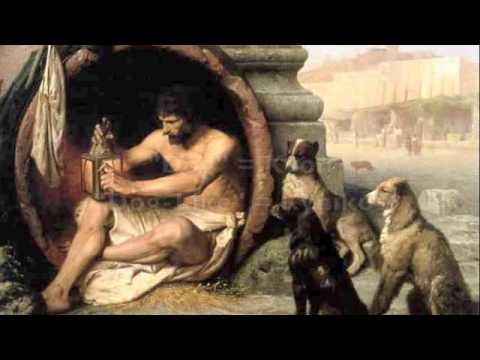
Diogenes the Dog


As the seemingly endless season of farce we call the presidential election begins, I think of Diogenes the Cynic.  I suppose I also think of Aristophanes, as he wrote farces aplenty and so would recognize one when he sees it, though he might, for a moment, be puzzled at the numbing length of this one in particular.  But Diogenes comes to mind primarily simply because he knew what a farce human life was then and mocked it incessantly, mocking even that high priest of the farce, Plato.

They say Diogenes walked about Athens with a lantern, looking for an honest man.  I've also read that he said he was looking for a human.  If that's so, I think he knew what Plato and others thought we were--truly homo sapiens, or that we could and should be wise--and set about looking for what such people thought we were in their foolishness, and of course found no such thing.

A farce our lives were, certainly, but just as certainly still are if we are what we seem to be; the same creatures we were in the time of Diogenes and no doubt were even before then.  It's hard to defend us and if we were put on trial I doubt we could find a lawyer willing to appear at our side...unless his/her doubtlessly high fee was prepaid, always a wise precaution when presented with a losing case.  We haven't changed.

We remain as greedy, superstitious, stupid, gullible, fearful and hateful as we ever were, as we always have been I suspect.  We may not sacrifice to the gods as we did, we may not worship the bones of saints as much, we may not en masse rely on chants and various plants to live healthy lives to the extent we have, we may not ignore the consequences of our actions quite as much as we did once upon a time, but we do it still to a significant degree, and there's no reason to think we'll stop until we've either eliminated ourselves or reduced ourselves to the point where we may start the same process all over again on an Earth less threatened by us than it is now.

There are many stories about Diogenes.  It's said he lived in a barrel, masturbated openly, ridiculed Plato and other worthies, flaunted conventions of all kinds, remarked that in the home of a rich man there's no place to spit but in his face.  Looking about him today he would still see no humans using even the most powerful flashlight available, let alone an honest man.  He would see the same he saw each day of his life and know now if he did not know then that we're unchangeable, and merely better equipped now than we were then to sate ourselves or wreck havoc depending on our moods and means.

The Earth is still no place for the man who called himself a citizen of the world.  In fact, especially here in this country, we are less and less inclined to think of ourselves as similar to any other people or as united in interest with them; certainly not equal to them, but altogether better than others, unique, the favored of God.  Just as the ancient Greeks believed they were, but sadly we're unable to produce men like Diogenes as they did.


Monday, December 17, 2018

Intolerance, Exclusivity and the Heirs of Abraham


A thread on a forum I frequent has motivated me to wonder something about the so-called Abrahamic religions, i.e. those which look back to the patriarch Abraham as a founder, directly or indirectly.  What I wonder about them may strike some as disturbing or even blasphemous.  I wonder whether there is anything peculiarly good about them; whether, in other words, they in themselves contain or preach anything good, that hasn't as it were been borrowed or assimilated in the course of their histories from elsewhere.

Above is a picture in stained glass, I think, depicting Abraham about to sacrifice his son in accordance with the will of his God.  I sometimes think of the God of the Old Testament as a kind of colossal, unsleeping cat, toying with his creation as a cat would a mouse.  A cat without a cat's usual charm and grace, though, and without its vast capacity to sleep, and doing no harm by doing so.  Whether urging the chosen people to destroy the Canaanites and take their land, laying waste to entire cities, flooding the world, or playing torturous games with Abraham and Job, he's perpetually doing something to us.  He seemingly made us to be the objects of his whims.

A particular belief in a particular God has been the cause of much violence and many wars, it's true.  But was it so, is it so, when one of the Abrahamic religions is not involved?  As far as I know, the pagans of the ancient Mediterranean didn't war against each other because one group worshipped Isis and one Mithras, for example.  Tolerance of religious beliefs was characteristic of the Greco-Roman world, except, of course, when it came to the Jews and Christians.

Greeks and Jews we know rioted against each other in Alexandria.  Roman suppression of the Jews in the two "Jewish wars" was ruthless.  The Roman state, periodically and with varying degrees of seriousness, persecuted Christians, but with nowhere near the seriousness depicted by Hollywood and others.  But violence against Jews and Christians was not motivated by the fact that they believed in Yahweh or Jesus as opposed to one or several of the pagan gods.  It was motivated by the fact that they believed themselves to be exclusively in possession of that which is right and good by virtue of the fact they worshipped their particular god and refused to recognize as right and good and indeed despised anything they did not think right and good--including pagans, the Roman state, and pagan institutions.  They were considered anti-social, as they were against pagan society and culture.  They appeared to subvert society, traditional religion and the government.

Jews and Christians were exclusive, sometimes militantly so, and intolerant.  Once Rome became a Christian Empire, it persecuted pagans far more relentlessly and effectively that the pagan empire persecuted Christians.  Islam, once founded, was similarly exclusive and intolerant, and engaged in great conquests in the name of its God.  Christianity was an imperial force as well.  All over the world, people were "saved" by being made Christian.

There are works of art inspired by religion, and they can be said to be goods peculiar to particular religious beliefs.  What of wisdom or ethics can be said to have resulted only by virtue of the Abrahamic religions, however? 

I would say nothing, not really.  All that was or could be said on those topics was said before Christianity or Islam existed, and developed independent of Judaism, primarily due to the ancient Greeks.  If one discounts unsubstantiated claims such as Plato or Solon got lessons from Moses, there's nothing to indicate the Greeks were influenced by Judaism in any significant respect.  That Christianity borrowed extensively from pagan philosophy is clear.

It's often claimed that Christianity brought with it the idea of love, something said to be absent from paganism.  Readers of Plato's Symposium might find that surprising.  But Christian love has much more often than not merely been given lip service.  If there was such a teaching, it's been ignored as a practical matter.  And arguably, the love touted by Christianity has never been capable of realization.  One simply does not love everyone.  Respect and dignity were accorded to all by the pagan philosophers; a much more achievable goal.

Well, that's what wondering can do.  But what can be expected from religions which hold themselves out to be the only way to God, the only way to worship God, but conflict in the name of God until all believe the same?

Thursday, September 27, 2018

Invincible Ignorance


"Invincible ignorance" has at least two meanings.  In Catholic theology, it refers to the state, or condition, of persons who are ignorant of Jesus because their circumstances are such that they are, or were, unable to know him.  Among those who possess invincible ignorance according to the Church are pagans who lived before him--especially worthy pagans such as Plato--and infants.  These necessarily ignorant, and thereby unworthy of heaven, are said by some to spend their afterlives (assuming the infants die before baptism) in Limbo.  Limbo is a kind of place which isn't heaven, but isn't hell either. There, it is to be presumed, Plato, Aristotle and other pagan greats debate and think great thoughts while changing diapers and otherwise tending babies.

Another meaning for "invincible ignorance" is the condition resulting from a refusal to accept evidence or argument.  This is referred to as a logical fallacy, sometimes.  It is the ignorance I address in this post, and was also I believe referred to by the man quoted above, a French physician and philosopher of the Enlightenment.

It is the refusal that characterizes ignorance of this kind.  You or I may be ignorant simply because we don't know something or other for perfectly acceptable reasons--acceptable in the sense that there is no deliberate effort not to know something or other.  Invincible ignorance is ignorance by choice.  The invincibly ignorant choose not to know.  Their ignorance is the result of their willing rejection of knowledge or the effort to know.

According to Julien Offray De La Mettrie, our happiness depends on this kind of ignorance.  Judging from the nature of the quote, he probably had ignorance of some thing or things in particular in mind.  But ignorance of anything which disturbs us can contribute to our happiness.  Ignorance is bliss in some circumstances if not all circumstances.

But the refusal to consider an assertion or an argument, or the evidence which supports them, is different from a refusal to know something in the sense of experiencing something.  You can have perfectly good reason, I would think, to refuse to know what it's like to murder someone or torture someone and can hardly be blamed for balking at having knowledge of what it's like to do so.  In some cases, then, the desire to be invincibly ignorant is quite understandable.  Some knowledge isn't good.

Sometimes an argument or assertion is so absurd there's no point in giving it any serious consideration.  Judgment must be exercised in determining absurdity, though.  Judgment is something we come to lack more and more these days, at least here in God's favorite country.

It strikes me we live in a time when people are less inclined than ever to consider any position that may challenge or undercut personal, political, religious or cultural views.  It may be that such consideration is too trying; the world is more complicated than it has been in the past, in great part because there are more of us needing and demanding limited resources.  It may be that the uncertainty of these times causes us to cling more than before to cherished and comfortable thoughts and customs, particularly where religion and politics are concerned, and to so dread what is different as to disregard it as much as possible rather than try to understand it.

But I'm concerned that fear and uncertainty and the desire for the happiness that results from ignorance aren't the only motivations behind invincible ignorance.  I'm concerned that many of us are invincibly ignorant simply because we have accepted the view that many intellectuals and academics have propounded for some time.  What I'm thinking of is what has been associated with the word "postmodernism" rightly or wrongly.  That is, an adverse reaction to the Enlightenment and the faith in science which dominated modern Western culture for two or three centuries, until the 20th century.

A skepticism regarding the extent to which science can cure all our ills and make the world a paradise is understandable.  But that skepticism has been associated with a distrust of reason and logic generally; with the view that they are mere constructs of a social and political tradition or culture, no more admirable or desirable, or worthy of respect, than any other construct.

If that's the case (not "true", of course), why is there any point in being anything but invincibly ignorant?  We can ignore, refuse to consider, anything we like.  There's no basis on which it can be said that assertions or arguments different from those we favor are to be preferred.  There's no reason to consider the evidence in their support.  There's no reason to think, in fact, or second-guess ourselves, when what others think or claim is no more worthy of respect or acceptance to what we believe and like already.

The invincibly ignorant are fruitful and multiply, and replenish the earth. 

Wednesday, August 1, 2018

Charged with Grandeur


The 19th century English poet, Gerard Manley Hopkins, had a remarkable way of using language in his poetry which sets him apart from other poets of the Victorian era, and from the English Romantics generally.  It's hard to describe, for me at least.  Hopkins' poems seem playful sometimes, sometimes erudite, sometimes philosophical.  Often philosophical, I think, and even more often religious.

The language he employs can be archaic, antiquated.  He was fond of alliteration.  He seems to have sought to use unusual words--unusual groupings of words--in his poetry, and I believe this sometimes saves him from the sanctimony which too often infuses the writings of the religious, and from being sentimental.  Sanctimony and self-righteousness was prevalent among the Victorians.  Sentiment was prevalent among the Romantics.  In a way, his poetry seems almost modern.

"The world is charged with the grandeur of God."  This is the first line of his poem titled, unsurprisingly, God's Grandeur.  It's an arresting opening line.  "Charged" suggests electricity, a force invisible but pervasive, empowering the world as it courses through all that it is, all that's in it.  "Grandeur" as in splendor, greatness, majesty, magnificence.  The world seethes with God's splendor; it's an embodiment of it.  It shines forth "like shook foil."

It seems a Stoic view, to me at least.  Perhaps a view of the world even older than that of the Stoics.  This can be inferred from another of his poems, one with a lengthy and somewhat awkward title, That Nature is a Heraclitean Fire and of the Comfort of the Resurrection.

Heraclitus was one of the pre-Socratic philosophers, and what we know of what he thought and taught is fragmentary.  Some of what he is said to have said is well known, like the statement that one never steps in the same river twice, and all is flux.  The fragments we have sometimes seem contradictory, and he is criticized for this by Plato and Aristotle.  The Stoics valued him, however, and it seems Cleanthes especially admired him.  The Stoics seemed to have admired his cosmology, particularly his view of the universe as being eternal and its basis being a kind of fire, divine it would seem as the Stoics conceived of it.  God to him and to the Stoics was immanent in the world.

It seems Hopkins thought well of him also, given the title of this poem.  Like God's Grandeur the poem begins with an artful, witty, even musical-sounding celebration of the world.  "Nature's bonfire" is referred to.  That's the only clear reference to anything like the fire of Heraclitus I can see in it.

In God's Grandeur, the celebration of Nature is followed by lines which express regret that the world has been sullied by man and his toils, bleared and smeared by it, in fact.  Then, hope and wonder is expressed that there remains something beautiful and divine in nature, nurtured still by God in his capacity as the Holy Ghost, or as that person of the triune God called the Holy Ghost.

In Nature is a Heraclitean Fire the celebration ends in sad reflection on the temporary nature of man:  "Man, how fast his firedint, | his mark on mind, is gone!"  But these broodings are ended by the knowledge of the Resurrection to come after death:   "In a flash, at a trumpet crash, I am all at once what Christ is, | since he was what I am, and This Jack, joke, poor potsherd, | patch, matchwood, immortal diamond, Is immortal diamond."

That's very impressive stuff, to me.  And perhaps it expresses and explains better than anything I've read the appeal of Christianity at its beginning to those who came to be called pagans, and its success even though the wisdom of pagan philosophy was acknowledged and admired.  It was an appeal the mystery cults may have had as well to an extent, but were the gods they extolled "what I am" as Jesus was, before his Resurrection, fully man?  But also fully God, it seems, inexplicably to me but perhaps this was, and is, of little concern to true believers, and pagan philosophy forgotten in the acceptance of mystery.

Monday, May 22, 2017

Our Ship of Fools


Plato, in the course of describing and justifying his frightening ideal state in his Republic, used as an allegory what's been called ever since the Ship of Fools.  The Ship of Fools was intended to reflect a democracy, where all thought they could captain the ship or where they would select as captain whoever best thought as they did or would advance their selfish interests.

Plato seemed to have been fond of the ship allegory, as he used it again contra democracy, noting that those who would charter a ship would want an expert captain at the helm.  No doubt that's true, but those who would do so would also, I think, instruct the captain on what the destination would be, rather than leaving it to the captain to determine where it is best for them to go.

I'm not as adverse to democracy as Plato was, and am quite adverse to the totalitarian state he thought best.  But the Ship of Fools is useful as a reference to a nation, or company, or group that is being significantly mismanaged or directed by fools.

The phrase comes to mind almost unbidden when we consider the state of our Great Republic.  Regrettably, it's a kind description under the circumstances.  I've always believed that the mistakes of government are more likely the result of incompetence than criminal conduct, but whether that is true in this case is unclear.

It's possible that the curiously senseless statements of the Chief Executive regarding the investigations taking place are merely the result of his incompetence.  No sensible person in his position would so blithely undercut the explanations offered by those he so memorably described as his surrogates, particularly when they're clearly offered to explain his own conduct as something which doesn't implicate him in wrongdoing.  Alternatively, they may be expressive of a remarkable ignorance of his position as president, which though one of power is also one of responsibility and for which he may be held accountable.   This I would guess is something he's not used to, never having in his privately owned businesses been accountable to shareholders or a board of directors.

But if incompetence and ignorance explain what appears to have taken place, it seems that the result is little different from what would be the case if it was intended.  Perhaps reports of what's been said and done are inaccurate.  But the president has little or no credibility on any subject, for which he has only himself to blame (though he would no doubt blame his unfortunate advisers), nor does his administration.

U.S. Grant was president of a notably corrupt administration.  Grant seems to have been a highly intelligent man, judging at least from his very well written memoirs.  It's not certain that he himself was corrupt, but he was certainly far too fond of his friends and neglectful in overseeing them.  He might be said to have been naïve.  This president, though, appears to be lacking in intelligence to the extent that implies the ability to reason closely and thoroughly.  His dislike for reading indicates he lacks patience and is inclined to do and say things off the cuff.  Indeed, it indicates he doesn't like to make the effort to think deeply and is entirely reactive.

So it seems entirely possible that the chaos we see is the result of a scatter-brained, impulsive, thoughtless man used to getting his way taking on much more than  he can handle.  But, if he demanded personal loyalty of an FBI Director, asked him to drop an investigation, accepted as a close advisor a man working as an agent of a foreign government, there's something more involved.  Now we learn that man is relying on the Fifth Amendment to avoid a Congressional subpoena.  None of this bodes well for the Republic.

Sunday, May 14, 2017

The Sin of Knowledge


It's an odd tale, that of Adam, Eve and the Garden of Eden.  Odd and disturbingly influential.  The doctrine of Original Sin has its basis in this peculiar story which, to some of us at least, is the word of God, literally or metaphorically true depending on the religious brand in question.  It's the stuff of various artistic works, psychological and philosophical theories.  I can understand why, because it is the foundational myth of great religions.

Just what it means is unclear to me.  Who can guess the intent of its ancient author, or authors? We read into it what we want; interpretation is a matter of convenience, or doctrine, one or the other. 

With that self-serving characterization in mind, I present my less than definitive, or for that matter less than definite, interpretation.  That's to say, what I think about it.   I think that it's language is clear enough and don't believe much in the way of interpretation is required, unless one is dismayed by the plain meaning of the words.  I think one should be dismayed.

What the supposed first humans did that resulted in their banishment from the Garden and, according to Catholic doctrine in any case, tainted the human race forever after (in saecula saeculorum), was disobey a command of God.  The wrong, as far as I can tell, was to disobey.  That in itself merited punishment.  Whether it was good or right or beneficial to eat of the Tree of Knowledge is not an issue--it isn't considered, even.  Regardless of the reasons for the command, even if it was unreasonable, failure to obey a command of God is an evil in and of itself.

Plato in his Euthypro dealt with the question whether acting as commanded by God is good because God commands it, or whether God commands it because it is good.  It can be argued that this story is an expression of the view that whatever God commands is good, not because it is good but because God commands it.  Knowledge, after all, wouldn't seem to be necessarily evil.  What is wrong with knowing? 

Perhaps it can be argued that knowing, or knowing some things, causes us harm.  In that case it may be maintained that God was trying to prevent us from being harmed.  In fact, God warns Adam not to eat the fruit of the Tree because if he does, he'll die.  It's not clear to me why eating of the Tree of Knowledge causes death, and this isn't explained in the text.  Perhaps the knowledge gained by eating the forbidden apple in fact led to our undoing, if not death.  We came to think, and came to think of ourselves as separate and apart from the rest of the world, rather than living with nature in blissful harmony in the Garden.

If God was trying to prevent us from harming ourselves, though, it would seem perverse of him to cause us significant harm because we harmed ourselves.  Expulsion from the Garden exposed us to a life of pain and misery; doomed us to it, in fact, rendered us subject to eternal punishment if not appropriately saved.   It seems a remarkably high price to pay assuming a God devoted to our well being.

It's said that the knowledge gained was the knowledge of good and evil.  This is puzzling, to me at least.  It seems that in the blessed state of inhabitants of the Garden of Eden, the parents of humanity possessed no such knowledge.  Not knowing good and evil, they didn't even know what those words meant.  They lived not only without knowledge but without judgment or thought, which would be necessary to distinguish good from evil.  They were, it seems, much like the rest of the animals.  Thoughtless.  The knowledge of good and evil renders us like God.

It's difficult not to conclude that the Sin for which we were punished was that of having the capacity to think and to make judgments and decisions.  That view of sin is one which an autocrat or elite might find useful.  If thinking is a sin, thinking is something to be avoided lest we suffer eternal damnation.  This would seem to suit those in positions of power quite well.  Those who don't think are easily manipulated.

I'm uncertain of the origin of the phrase "ignorance is bliss" but this would appear to be what we can infer is the moral of the tale if we accept the tale as written, as told.  I'm certain, however, that this inference has been avoided for quite some time and alternate explanations offered.  I'm always suspicious when interpretation is made so lavishly of easily comprehended language, however.

Tuesday, January 3, 2017

The Pertinence Maxim: A Matter of Time

While I was attending college, a new professor appeared on campus.  Although it was, and still is so far as I know, a small liberal arts college, that in itself wasn't extraordinary or significant.  Professors would appear now and then and some would leave after a time; some would not.  What was unusual in the case I recall here was that this particular professor was said to be a sociologist.  He was the first of his kind at my college.  At least, he was the first to be called a sociologist.

As a professor of philosophy I admired and respected thought him to be worthy, I signed up for one of his classes.  The class in question addressed Time.  If I remember correctly, the first thing we students were asked to do was submit a paper describing what we felt Time to be.  I think I wrote something to the effect that time was a concept by which we determined when certain events took place or should take place (planting crops, for example).  I thought, in other words, that we came to keep time because it was useful to do so for various purposes, especially as our societies became larger and more complex.  This I suppose was a kind of anthropological view.  Time was a method used in determining and defining what takes place or should take place.  Such was, and is, my guess, in any case.  But in all honesty I'm not sure just what I thought.  That was a long time ago. 

I confess I thought my view of Time to be superior to the views of others in the class who relied on Simon and Garfunkel (Hazy Shade of Winter) and others to arrive at a definition.  The professor, though, treated our views as equally deficient and dismissed them all in a rather cursory manner.  To this day I have no idea what he thought was the correct definition of "Time."  I know only he was almost contemptuous of what we thought ("Ah yes, this is the so-and-so. view of Time").  He may have declined to give us a definition.  He was one of those professors who thought that teaching consists of asking, not answering, questions.  I encountered a few like-minded professors in law school.  It may be there is or was a widespread belief that this style of teaching is the fabled Socratic Method.  I find it hard to believe that anyone who actually reads Plato can come to such a conclusion, as I think he carefully prepared his dialogues so that they would inevitably result in a position he thought appropriate through the device of questions; much as a lawyer prepares questions to put to a witness.

It happens that Time is a subject of philosophical analysis.  There are philosophers of Time and so must be a Philosophy of Time.  The ontological status of time is studied and debated.  Philosophers discuss the difference between the past, the present and the future.  They consider why Time seems to us to be an arrow.  They wonder whether there truly is anything but the present.  They wonder about fatalism.  They ask why Time seems to move swiftly in some cases or to certain people.

For my part, I wonder as I do in most cases whether these wonderings make any difference to how we live our lives, and am inclined to say they make no difference whatsoever.  Also for my part, I feel that if they make no such difference, debating them is futile.  This may well be a fault of mine.  There may be something lacking in me.

Perhaps the professor of sociology I encountered (or did I? It was in the past!) would have though that C.S. Peirce's pragmatic maxim would be of some assistance in defining Time; more assistance, even, than Paul Simon's lyrics.  It's hard to say.  The maxim has appeared in different forms, but I'll make reference to the form in which it appeared in Peirce's essay entitled How to Make Our Ideas Clear: 

"Consider what effects, that might conceivably have practical bearings, we conceive the object of our conception to have. Then, our conception of these effects is the whole of our conception of the object."

I can't remember whether I knew of this maxim when I studied under the eminent sociologist, but would have recourse to it now if recourse was required.  Happily, it isn't.  But I think the maxim would indicate that our conception of Time would be one which is made up of the uses to which we put that concept in doing things we do, e.g. eating, sleeping, working, taking vacations, parking cars, etc. 

I find myself baffled if I seek to define Time or even think of it in any other way.  Baffled, I say, in finding any reason to do so.  Clearly, we say there is a difference between what has happened and what is happening, and in identifying such things the concept of Time can be useful.  Should we say that there is such a difference?  Why not?  How do we err if we do?  Should we say there is no past?  Why? 

Won't we keep on living as we do, using Time, making Time, regardless of the ontological status of Time?   Won't we continue to distinguish past, present and future regardless of the differences there may be between them?  It seems we understand the differences between them well enough, and those differences hardly seem surprising or worthy of analysis.  Will we ever, seriously, claim that nothing happened in the past, that there will be no future?  Do we ever make the distinctions philosophers make or reach the conclusions they do as to Time while living our lives?  If we don't, doesn't that tell us something significant about the Philosophy of Time?

Perhaps another maxim along the lines of the pragmatic maxim would be useful.  Something like this:  "Consider what effects, that might conceivably have practical bearings, which may result from our study of the subject in question.  If there are no such effects, then our study serves no purpose."  Let's call it "the pertinence maxim." [Copyright Ciceronianus, 2017.]

It may be that there are aspects of Time that may usefully be subject to scientific study, e.g. the reasons why we perceive times' passage in different ways in different circumstances.  Of course, Time has also been a subject of study in physics.  It seems to me, though, that this kind of study is one best pursued by scientists, not by philosophers.


Thursday, September 8, 2016

The Benefits of Uncertainty

I doubt that it's possible to be certain of anything.

I don't want to say I know it's not possible to be certain of anything, of course, because in that case I can be accused of claiming I'm certain that we can't be certain of anything, thus contradicting my own claim through the magic of language.  And, in fact, I'm not certain it's not possible to be certain of anything.  Unfortunately, I'm certain that I'm not certain it's not possible to be certain.

There are problems in the use of the word "certain," then.  There are also problems in the use of the word "true."  For that matter, there are problems with the use of the word "know."  These problems may be usefully addressed by philosophers--I'm not certain that's the case, however.  John Dewey, as we know, maintained that "truth" was problematic and so, being inclined to awkwardness in the use of language, substituted for it "warranted assertability."

The problems caused by the word "certain" and its synonyms are not merely those which may befuddle philosophers, because the problems of philosophers can also be problems in what certain of them delight in calling "ordinary, day-to-day life (or existence)."  At least they can if we let them.  And to a certain extent I think we have, as we have come to accept that it's desirable to be certain, and even that we must be certain.

Certain of what?--you might ask, and I do ask, rhetorically.  Certain of anything of importance to us or to others.

Dewey wrote of the difficulties resulting from the desire or need for certainty in The Quest for Certainty.  One of those difficulties is that we convince ourselves that only what is certain can be considered true, or good.  Having done so, we necessarily despair of or denigrate what takes place in our lives, because very little of what does or will take place is absolutely certain.  So, we come to believe that we, and the world, are defective in some way, and true certainty lies elsewhere.  Or we come to doubt our senses, our judgments, our actions.

Even in ancient times, there were skeptics (who are, unsurprisingly, called "the skeptics" or sometimes "sophists") and they apparently would wander about Greece annoying people with their skepticism.  They were so annoying that certain philosophers, such as Plato, felt it necessary to rebut them.  In Plato's case, he did so through his character called "Socrates" who may or may not have espoused arguments which were similar to those of the actual Socrates.  It was, and probably is, thought necessary to do so because certainty is thought essential by many.

Speaking only for myself (which is all that I can do in this case) skepticism doesn't trouble me.  I'm unimpressed by the fact that we cannot know most anything with absolute certainty.  I see no reason why we should.  And, I'm quite content to make judgments based on the best available evidence, even if that means I cannot be certain those judgments are absolutely true.

In fact, I question whether any of us really doubt when we're not absolutely certain.  If our conduct is any guide, I don't think we can reasonably maintain that we do.  Though it's true we don't know with absolute certainty the sun will rise tomorrow, we don't harbor any doubt that it will; the possibility that it won't rise doesn't cause any worry or concern.  There are many things we take for granted even when we know there is a possibility they won't take place.  It's how we live, and we have no reason to doubt unless something arises which causes us actual concern or worry, or creates a problem.  We don't normally require certainty in "ordinary day-to-day life."

So certainty as Dewey addressed it isn't quite the issue it is in life as it is in philosophy.  We like being certain of things in life as well, of course.  But we like to be uncertain, especially as far as people we dislike or positions with which we disagree are concerned.  That is to say, we're selective in our demand for certainty. 

The controversy, such as it is, regarding climate change is an example of the demand for certainty.  The questioning of the theory of evolution is another.  Those who deny climate change face a problem in doing so, because it appears that the vast majority of those knowledgeable in the area believe it exists.  There are, however, a handy few who disagree.  Thus, it can be claimed there is uncertainty--it isn't absolutely certain that climate change is taking place, or that humanity has caused or exacerbated it, so it may be discounted.  It may as well be claimed to be a hoax, a kind of fraud being perpetrated for some reason by someone (what would motivate the hoax is unclear to me).

As to the theory of evolution, merely because it is overwhelming accepted by those knowledgeable and there is ample evidence for it, it can't be established with certainty.  So, it can't be said to be true; therefore, it's appropriate for other theories to be taught, such as creationism.  Uncertainty can have its benefits, for creationists in any case.

There may well be a quest for certainty, as Dewey proposed.  However, the demand for certainty is something which doesn't universally apply.  We don't need certainty to live, we disregard it in most cases.  We demand it when we find it useful to do so.  We find it useful to do so when we disagree with each other.

In that manner, the fact that people we disagree with can't establish their claims with certainty, and positions with which we disagree with can't be established with certainty, is a benefit for some of us.  It allows them to hold untenable opinions and make unreasonable decisions serenely, secure in the knowledge (so to speak) that it doesn't matter whether they can't be certain of them because nobody can be absolutely certain of anything. 

The idea that no belief can be criticized because nothing is certain can be reassuring, in some cases. 

Monday, June 27, 2016

About Cato the Younger

Marcus Porcius Cato, called the Younger to distinguish him from his grandfather, Marcus Porcius Cato the Elder, is not an easy man to like, a grim and dour personality, but has been one that is admired.  That was the case while he was alive and has remained true through the centuries since his death. 

It seems that he is more fortunate in his reputation than his censorious grandfather who, although he had a distinguished military career and also one as a senator and consul, is remembered primarily for a treatise he wrote on agriculture and for declaiming, after every speech he made in the Senate, that "Carthage must be destroyed."  It was destroyed eventually, in part due to his relentless urging.  Grandpa Cato wasn't a likeable fellow either, but was revered by his grandson as a representative of old Roman virtues, unlike the foppish patron of Greeks, Scipio Africanus, who was one of the targets of Grandpa's vindictive style of conservatism.

Cato the Younger was noted for his adherence to Stoic philosophy, and so it's difficult for an aspiring Stoic to be critical of him.  I'm critical of him nonetheless, but not entirely so.  Even his ally against Caesar, Cicero, was critical of him at times, for good reason.   Though Cicero admired the Stoics, he wasn't above ridiculing them and Cato for their extremes--at least as part of a case, in the course of advocacy.  Cicero was a lawyer, after all.

Cicero also was critical of him for his obstinacy and refusal to compromise.  But Cicero admired him as have many others for his refusal to submit to Caesar's rule of the Roman Republic, soon to be the Roman Empire.  When Caesar portrayed Cato as a drunk in his triumph after his victory over Pompey and the optimates, Cicero responded with a kind of panegyric in his praise.  Caesar found it necessary to reply to it; Caesar was never able to forgive Cato as he forgave many others, even after Cato's suicide to avoid submission--perhaps even because of it.

Cato is admired as a hero in the ongoing battle against tyranny.  He was admired as such by the Founding Fathers of our Republic, all of whom looked to Rome in its creation.

Cato's commitment to freedom, however, is more accurately seen as a commitment to custom and Roman traditional virtues and institutions (the mos maiorum).  Individual rights and freedoms were not a concern to Roman government or society generally.  Romans, at least traditional Romans, served the state, not themselves.  Romans were not libertarians; Cato certainly wasn't one.  Cato wanted Rome to be ruled as it had been; by an oligarchy making up the Senate, with some powers held by the plebs and their tribunes as created over time.  Rule by one man or a few by virtue of their control of the legions and catering to the people is what Cato fought against.

I have no reason to doubt Cato's commitment to Stoicism, but it strikes me that his very ostentatious displays (walking barefoot, wearing a simple coarse tunic), railing against clothing and conduct which was not similarly rustic and simple, isn't Stoic.  It's posturing and prideful.  No doubt it had a political purpose and was a kind of propaganda.  But it reflects a concern with what should be indifferent, with appearances--with impressing others.   Living simply, foregoing luxury is appropriate, but vocally condemning those who do otherwise doesn't seem to me to be something advocated by the Stoics.  Perhaps Cato, in this, was more Cynic than Stoic.  Diogenes enjoyed flaunting his simplicity, much to the annoyance of Plato.  But nobody doubted the honesty and integrity of Cato, not even his enemies.

I think what can be doubted was his wisdom--his practical wisdom, in any case.  There is an argument that his refusal to compromise in any respect played a part in ending the Republic and creating the principate.  And certain warnings are self-fulfilling.  Political and military chaos creates opportunities for the ambitious, and Cato contributed to the chaos, and perhaps even invited it.

Those interested in Cato may want to read Rome's Last Citizen:  The Life and Legacy of Cato, Mortal Enemy of Caesar, an interesting book written by Rob Goodman and Jimmy Soni, which I plug here despite their annoying use of diminutives in their names.

Sunday, March 13, 2016

Mencken the Prophet? Democracy and the Moron

Hearken to the words of H.L. Mencken, the great Sage of Baltimore:

“As democracy is perfected, the office of president represents, more and more closely, the inner soul of the people. On some great and glorious day the plain folks of the land will reach their heart's desire at last and the White House will be adorned by a downright moron.”

I suppose some would say that day has already come and gone.  I'm uncertain about that, but if it has not one can make a good case that it will, soon enough. 

Mencken had little or no faith in democracy, as may be expected from a lover of Nietzsche.  Democracy was for Mencken what Christianity was for Frantic Freddie, I believe; that is to say, an institution the purpose of which is to impede and restrict as far as possible the "superior man."  Mencken's regard for the preening Nietzsche, that relentless purveyor of exclamations, pronouncements and rhetorical questions, was his great fault in my opinion.  But in a way his elitism was understandable then and still is now. 

Ultimately, in politics and other things, we get what we deserve if not what we want.  So if elect a moron we will most certainly deserve him.  Are we destined to elect one?  Was Mencken right about democracy?

The question whether democracy is a desirable form of government has been asked for quite some time.  Democracy was of course rejected by Plato.  He preferred that we be led on a grim, dreary death-march to perfection, unfettered by art and amusement, grouped in closely regulated ranks separated one from the other though we would be able to advance if we show promise in our steps, perhaps even attaining, eventually, the ranks of the Guardians marching before us.

An enlightened despotism has been the dream of many intellectuals, and was even for a time at least favored by such a friend to liberty as J.S. Mill.  As I recall, he thought that this happy dictatorship would represent a stage in our development.  Our ignorance and brutish character would be limited while molded by a despot or despotism of an elite until that glorious day when we would be able to think for ourselves.  Then, I think, we might be able to vote, even, though certain votes would count for more than others.

There have been relatively few democratic nations over time; perhaps there have been none, really, since the days of the Greek city-states.  Even God's favorite country, the United States, is not a democracy, nor was it intended to be one.  It is a republic.  The Founders didn't want a true democracy, fearing the tyranny of the majority, fearing more the mob, the common folk.  They would have been horrified by universal suffrage. 

So, Mencken wasn't right, strictly speaking, to think of this nation as a democracy.  The shrewd lawyers and merchants, and rich farmers, who created this nation were careful in their efforts to make certain that there would be no democracy so long as the Constitution and institutions they created persevere.  The fabled checks and balances we learned of in school (or learned of once, in any case) are there not only to limit the powers of any one branch of our government, but also to prevent majority rule.

Thus we may take heart from the fact that the moron we may be fated to elect as president won't be entirely a moron unleashed.  We may want the moron to have the power to ignore Congress and the courts and, perhaps more importantly, the special interest groups who carry politicians around in their pockets like Don Corleone, but much as we would like this to happen  (or think we do), it will not.  The moron may think it will happen, being a moron, but that won't make it so.

Someone like Mencken may say that republic or not, we elect morons at all levels.  Our representatives are morons as well as our President, or will be.  And so our judges will be morons.   The ascendancy of morons is inevitable, eventually, whenever election outcomes are based on majority vote.

Well, that may be.  But in that case we'll tire of the morons, and start all over again, running through the various forms of government.  Perhaps democracy is a kind of end of government.  It may lead to chaos, which will lead us to impose an autocracy, thence to an oligarchy, and etc.  We will be a phoenix rising from the ashes, then burning, then rising again.

Friday, May 1, 2015

"I Will Destroy the Wisdom of the Wise"

St. Paul quotes these words in a letter to "the Corinthians"; those Christians residing in Corinth.  It appears the Corinthians were being unduly quarrelsome, or at least too quarrelsome for Paul, who modestly described himself as "called to be an apostle of Jesus Christ through the will of God."  But I wonder just what was going on, in addition to quarrels, as in this letter Paul indulges in something of a tirade against wisdom, something not normally the subject of anger or disdain.

The words used by Paul which make up the title of this post are borrowed from the cheerful works of the prophet Isaiah, and are attributed to God.  God, it seems, wants to destroy the wisdom of the wise.  It's unclear why he would.  Paul adds to this, stating that God made foolish the wisdom of the world, apparently because the wise failed to understand Jesus was God before Jesus was born and that failure continues as Paul writes.

According to Paul, the wise did not come to God through wisdom, and God choose instead to save those who believe through the "foolishness" of his message.  Greeks, says Paul, seek wisdom, and think the preaching of "Christ crucified" is foolishness.  But the foolishness of God, writes Paul, is greater than the wisdom of the wise.

It's possible I suppose that Paul was being ironic in his use of "foolishness" here, though the Christians of that time and for centuries later were (and are now) not notably ironic in their proselytizing of, or apologies for, Christianity.  They were generally in grim earnest.  So, it's at least possible that Paul thought God's message, and Christ crucified, as establishing the existence of the true God or as signs of it, were ostensibly foolish.  This is a remarkable claim for a believer to make, or at least for a thinker to make.  Wisdom is inadequate to bring us to God--it's foolishness that does the trick, or at least that which is to all appearances foolish.

Given this curious use of language on Paul's part, I'm given to suspect that his supposed encounters or debates with pagan philosophers may not have gone as well for him as we've heard.  Perhaps he was unable to rebut claims that Christian beliefs were foolish, and so was compelled to take the position that if they are in fact foolish, that's the way God wants it.  Being God, the fact that he choose foolish means to bring the truth to fools, rather than the wise, has the result that fools and foolishness are greater than the wise and wisdom.

Regardless, though, such language and such claims regarding the wisdom of the world and the wise, when taken to be the words of God or God's agents, doing his bidding, can have serious consequences.  I think they did have serious consequences indeed when the religion which adopted such claims came to dominate the Roman Empire, as it became part of the doctrine of the state as well as the prevailing religion that the wisdom of the world and of the wise was nothing, the "foolishness" of God everything.

Perhaps it began with the repression of paganism and persecution of pagans during the reign of the Christian emperor Theodosius I.  It's said that Justinian closed the last surviving pagan schools of philosophy some 200 years later.  Perhaps the "triumph" of Christianity wasn't entirely at fault, and that the view that the world is insignificant and truth to be found outside the world which we find in Plato prompted the Western world to turn away from life and the first efforts towards science we see among the ancient Greeks.

It's been maintained that what are called the Dark Ages weren't nearly as dark as they've been claimed to be, and I'm willing to believe that is the case.  But it seems beyond dispute that little in the way of new knowledge was acquired in Europe during those times, and that what passed as knowledge was primarily if not exclusively what was found in the Bible or in the works of the Church Fathers.  The standard of living fell far below that of the Roman Empire, even as to the great of the time.  And why not, the world in which we live being without value?   In a way, the Church if not God did indeed destroy the wisdom of the wise, if that wisdom related to how to live well and flourish in the world, and to the value of learning of the world and its wonders.

For a time, at least.  It's true that Europe gradually became aware of the wisdom of the ancient wise, and even valued it after a fashion.  The Church, which was at the time the only institution having any interest in books and writing, is to be thanked for the dissemination of the old knowledge it has so ruthlessly suppressed.  That began to take place, though, roughly 600 years after Justinian.  And the Church was grudging, even miserly, in its disclosure of what was lost.  It was another 200 years or so before the Renaissance was possible.

It's fun to speculate what would have happened had wisdom not been destroyed.  But we seem to live in a time when the pursuit of knowledge of the world is once more mistrusted and even under attack in some parts of the world.  Religion is once again involved in this, or at least religious fanaticism.  Let's hope historians of the future won't refer to a "New Dark Ages."

Monday, April 20, 2015

Scipio's Dream and Life in the World

Cicero wrote a dialogue called De Re Publica, which has sometimes been referred to as his Republic a la that of Plato, but is more properly translated as "Of the Republic."  The Republic in question was  that of Rome, still in existence at that time but shortly to be extinguished by the civil war leading to the dictatorship of Julius Caesar, which in turn was followed by another civil war leading to the establishment of the Empire by his grand-nephew and adopted son, known to history as Augustus.

Cicero's work may be distinguished from that of Plato both because it dealt with an actual nation and government (though justice and ideal government is addressed) and because it was written by an astute practical politician and thinker--someone who actually governed, as a senator and consul of Rome.  He also had an axe to grind.  He wished to point out that good government is contrary to the cult of personality surrounding Caesar, and that Caesar sought power merely through ambition and for the satisfaction of his pride.   Plato, of course, was speculating regarding an ideal state, though some like me may think his ideal to be deplorable.  It's unclear whether Cicero's work was ever finished and that we know all he wished to say; it has come to us in fragmented form.

Within those fragments is a description of a dream itself described as "The Dream of Scipio" (Sonium Scipionus).  The Scipio in question is not the Scipio who defeated Hannibal at Zama, who we know as Scipio Africanus, but rather his grandson, who we know as Scipio Aemilianus.  The grandson in turn was given the honorific Africanus as he was Rome's general in the Third Punic War in which Carthage was finally annihilated by Rome (he had the name before then as it was a hereditary title, but subsequently earned it as well).

Scipio Aemilianus was notable not only as a general but as a friend of philosophers, known to converse with them regularly.  This practice earned him the public dislike of the dour censor Cato, who thought him far too Greek and frivolous.  It may have been his fame as a philosophical sort of Roman which led Cicero, another philosophical sort of Roman, to provide a fictional account of a dream Scipio Aemilianus supposedly had before the destruction of Carthage by the Roman legions.

In that dream, the grandson finds himself in the presence of his grandfather, gazing down on the Earth from a great height, among the stars.  They converse, one Africanus to another.  Grandpa Scipio tells his grandson of his victory over Carthage two years away, and of his future in general, but also invites him to consider how small the Earth is--a tiny part of the universe.  Rome, of course, is even smaller; a small part of the Earth which is a small part of the universe.  The living Scipio is asked to reflect on the insignificance of the Earth, of life, of we humans, and understand that our true nature is divine and does not end in death, and we should hold dear only that which is eternal in us and in the universe.

Perhaps this dream is intended to function much as the slave's reminder to those granted a triumph.  "Remember you are mortal" are the words supposed to have been repeated to the honored victor by the slave riding with him in his triumphal chariot.  The message that all glory is fleeting, soon forgotten, seems to be one which can be derived from the dream.

But it seems something more was involved.  Cicero was a lawyer and politician who tried to be a philosopher as best he could.  He studied with philosophers and wrote philosophy.  We owe a great deal of our knowledge of ancient philosophy to him, as he wrote of books no longer available to us, lost in time.  He seems to have been making the point that we should not consume ourselves over worldly matters like fame, victory, conquest and power, but devote ourselves to wisdom, virtue, and ascertaining the laws of nature and through nature, God.

Cicero knew Stoicism well and was sympathetic with it, though we know he did not consider himself a Stoic.  This is a Stoic perspective.  The quest for fame and power and what goes with them is a quest for things not in our control.  When we read Marcus Aurelius we find that he often points out that the great of the past are long forgotten as we will be forgotten after we die, and that which concerns us so much now is insignificant.  I think the great schools of philosophy which existed in ancient times agreed on certain things, and that most if not all of them emphasized that the universe is vast and we and all we do is small in comparison; our petty fears and hatreds and desires all mean nothing, and we should concern ourselves only with eternal truths.

But if our world is insignificant, and we are even more insignificant, what do we matter?  Why should we try to do anything with our lives?  We know now the universe is much larger than any of the ancients could even imagine.  From the cosmic perspective, we aren't even noticeable.  We may as well not exist.  Our pretensions are laughable; our concerns less than trivial.

We know how this question was addressed by Christianity, which denigrated this life and even delighted in its denigration.  It profits a man nothing if he gains the world, as our lives, here, are not only unimportant but are sinful.  It is only the next world that is significant.  So, certain Christian sects even accepted the view that "good works" in this world mean nothing.

That doesn't seem to have been the response of ancient pagan philosophy, though.  Stoicism's "things not in our control" were what is of no concern, and the view from above the Earth granted Scipio Aemilianus confirmed this fact.  What saved us from insignificance according to Stoicism, it seems to me, was its pantheistic conception of Nature and the belief that we as rational creatures shared in the divine.  Christianity held that we and the world in which we live are evil; the Stoics believed we, and the world, are part of and partake in the deity and so cannot be evil.  We escape the trivial by virtue of being part of Nature itself, and acting in accordance with the divine reason in which we share.

By acting according to reason, or Nature, we naturally (pun intended) do good works and our actions are thereby significant, one might almost say inherently so.  It's when we act inconsistently with Nature that we become trivial.

This seems to me a far nobler and more satisfying response to the vastness of the universe. 


Thursday, August 14, 2014

A Citizen of the World

The claim that one is a citizen of the world has been attributed to both Socrates and Diogenes.  If Socrates made the claim, he did so before Diogenes who as a Cynic was a follower of Socrates as were the Stoics.  It was the man Socrates, though, they followed and not the creation of Plato--the character appearing in Plato's dialogues.  It's said that Socrates was concerned primarily with philosophy as a guide to how to live, and eschewed epistemology and metaphysics which, alas, meant a great deal to Plato.

The idea of being a citizen of the world instead of a citizen of a city-state evidently horrified many at that time.  It seemed to denigrate the city of one's birth, the significance of one's county.  This was deemed unpatriotic then and is still thought to be now, particularly it seems in our Great Union.  For the Stoics, however, being a citizen of the world, the cosmos (thus cosmopolitan), was something of great worth and followed from the desirability of being virtuous.  It emphasized the common nature of man and fostered the ideal of a brotherhood of man encompassing the world; ideally a world which functioned according to natural law.

Those who believe in American exceptionalism sometimes think it appropriate to proclaim this fact in a rather prideful manner.  We are proud to be Americans and feel ourselves in some sense better than those who are not.  But pride, for me, when we apply it to ourselves, is something which we're entitled to feel when we, personally, have achieved something.  We who are born Americans did not achieve that status properly speaking and what our country does isn't necessarily our personal achievement.  It would seem more appropriate to be grateful we're Americans in that case, and this in turn would seem to make it less likely that we would indulge in the chest-pounding we like to engage in when patriotism is invoked.  But instead we boast of our country rather as we do our favorite team in sports, which diminishes our country and I think ourselves.

But we are not alone in our pride and our belief in our superiority and exclusivity.  In fact, the world seems more tribal now than it has in the past; indeed, it seems violently tribal.  Religious extremism, racism, ancient grudges perceived or actual, political disagreements, nationalism, all seem create divisions among us.  Curiously, the fact that the world is for other purposes "smaller" than ever before due to technological advances hasn't mitigated these divisions.  It seems to enhance them in certain senses, in fact.  We live in a time where we can learn most anything we want about what is transpiring throughout the world in real time, and the opinions of others are readily available if we care to discover them.  Perhaps we are intimidated by this rather than enlightened. 

The wisdom of the Stoics and others is in any case disregarded.  It may be this is due to the fact that we resort to the most comforting, simple beliefs when confused or uncertain, even if those beliefs sanction barbarity.  Anything to avoid thinking.  It may be we're fundamentally irrational creatures regardless of our knowledge and sophistication.  It may be we wait for a god to save us like the unfortunate Heidegger (the Fuhrer having failed him), and in the interim are willing to do anything that will assuage us.

I'm more inclined to believe that selfish concerns, the pressure of cultural and religious beliefs long ingrained in us and an unceasing desire to master or possess things which are not in our control are at fault, but must confess that I despair of this ever changing unless we take the time to train ourselves and others to think rationally and understand the insignificance of the things which dominate our conduct and desires.  This training, though, may be something which can't be imposed on others in any useful manner.  It would seem to be worth a try, though, as nothing else has worked in the past.

One sees why education has been considered so important to certain philosophers.  How to think is something which should be taught as early as possible, but parents fear this and may not tolerate it as part of their children's education.  This is because they're inclined to want their children to think and act as they do, and fear that their children won't be taught to think as their parents do, which would likely be true.

This has been recognized, and since Plato those who think they know what is best for all have dreamed of education as a process by which those being educated are dragged to the truth as it were, screaming and kicking if necessary.  It's why totalitarian, fascists and other authoritarian governments insist so often that children be taken from their parents to be trained in the Right Way.

We're in trouble I fear, and the question is how and whether we'll work to get out of it.  I doubt if circling the wagons is the way to go, but am having problems coming up with workable solutions.

Wednesday, February 26, 2014

Comparing Stoicism and Christianity

Anyone who does some reading about Stoicism has encountered books in which it is compared, unfavorably, to Christianity.  These books seem to have been written, at the latest, in the 19th and early 20th centuries.  More recent books about Stoicism don't make the comparison, and I wonder whether there simply is no longer an interest in doing so.  Sometimes, the comparisons that were made seem to be in earnest, and even thoughtful.  Sometimes they seem quite partisan, and far less than impartial.  They all seem to have certain claims in common, however.

I've sometimes wondered whether Christian thinkers have resented Christianity's great debt to pagan philosophy.  Christianity hasn't benefited merely from Stoic influence, of course.  It incorporated the thoughts and works of Plato and Aristotle as well; Christian mystics and ascetics spoke and conducted themselves much as the ancient Cynics did.  The influence of the school of Epicurus is not as evident, as may be expected.

The early Christian Fathers didn't share in such resentment, though, nor does it seem to have been prevalent in medieval times, or during the the Renaissance when Aristotle was "the Master of All who Know" and he and other pagan thinkers spent their time in Hell in its relatively comfortable first level, according to Dante.  Certain of the Fathers, at least, spoke of Plato and others as having approached the truth, a remarkable concession from an otherwise highly intolerant crew.  Seneca was considered a kind of Christian, and Marcus Aurelius was said to have regretted or to even have been ignorant of the persecution which took place during his reign.  It was in a sense assumed that people who wrote and thought and acted so wisely, as these figures did, could not really have been all that unchristian; indeed, must have been proto or quasi-Christians.

Perhaps this kind of hat-tipping to the pagan thinkers began to disappear as it became clear that such fabrications as the correspondence said to have taken place between Seneca and St. Paul was established as being forged, and other myths such as Plato's friendship with Moses were found to be contrived.  I suppose it may have been easier to acknowledge the extent to which Christianity borrowed from the ancients when it was at least arguable that Christianity or "proper" Judaism influenced the works of the old philosophers in some respect.

It seems clear, though, that the New Testament doesn't indicate that Jesus and his disciples discussed or were much concerned with the fundamentals of pagan philosophy which became the fundamentals of Christian theology.  So some justification was required when the equivalent of Plato's forms and Aristotle's First Mover and natural law and universal law began to appear in defenses and explanations of the Christian religion.  Perhaps the acknowledgement simply became more grudging or reluctant.

We see Stoicism sometimes described as the noblest of the moral codes pagan antiquity managed to formulate.  But there is always something wrong with it according to these writers, something which, they maintain, caused it to dissipate though it was at one time the preferred philosophy and even religion of the thoughtful Roman upper and mid-to-upper classes.  It was, of course, Christianity that satisfied the need Stoicism could not.  Stoicism's subsequent revivals over the centuries in, for example, Justus Lipsius are acknowledged by these writers, but they seem to consider these events as similar to fits or fads. 

As might be expected, Stoicism's failure is ascribed to the fact that it's tenets are too stern, cold, abstract, unrealistic.  It's claimed that the Stoic view of the emotions and passions was too negative.  Most of all, it seems, it's claimed that Stoicism failed to acknowledge or recognize love--which is to say Christian Love.  And it's claimed the Stoic view of God was materialistic and distant, despite the efforts of Seneca and Epictetus to portray God as more the personal God of Christianity (more personal, at least, when that characteristic fits the apologist's purpose; the God of the famous proofs is notably vague and abstract).

What Christian Love is supposed to be is an interesting question.  The Gospels were written in Greek by men who could not have known Jesus personally.  Was the "love" referred to in the Gospels or St. Paul the kind of "love" we may read about in the works of the pagan philosophers?  Was the "love" presumably referred to by Jesus the same, or something different?

There are quotes from the early Stoics which seem to support the claims the writers make.  However, more recent thinkers have found the Stoic view of the emotions to be far more sophisticated than previously believed, and the therapeutic effect of Stoic practice to be far more effective than previously believed.

It's possible Christianity may be waning now, or that the personal God posited by it an other established religions may be considered less and less credible the more we know of the universe.  Stoicism is not so limited, however, though there also seems to be nothing prohibiting the Stoic from suspecting that God is, in a sense, concerned with human beings and "personal" in that sense.  Perhaps it is this flexibility that is one of the reasons it keeps appearing.  It's by no means defunct, and I suspect it never will be.