Showing posts with label Philosophy. Show all posts

Wednesday, September 27, 2023

Philosophy as Affectation


Gertrude Stein made the remark shown at the head of this post in connection with the death of the dancer/choreographer Isadora Duncan.  Duncan loved to wear long, flowing scarves.  She was wearing one while driving on September 14, 1927.  The scarf became entangled in one of the wheel wells of the car she was in (the wheels were open-spoked), pulling her from the car and breaking her neck (even, it seems, decapitating her or nearly doing so).  Gertrude Stein could be sardonic.

According to the Merriam-Webster Online Dictionary, "affectation" is "a. speech or conduct not natural to oneself: an unnatural form of behavior meant especially to impress others" or "b. the act of taking on or displaying an attitude or mode of behavior not natural to oneself or not genuinely felt."

It isn't clear to me that wearing long scarves is an affectation according to that definition.  It may be conduct intended to impress others, but I don't think it may properly be called "unnatural."  Still, we can infer what Gertrude meant in making her rather gruesome witticism without concluding wearing scarves of any sort is somehow an unnatural form of behavior.

I've remarked before in this blog that I'm annoyed by the metaphysical and epistemological efforts of some philosophers to question what is "real" and what we can "know."  Perhaps it would be kinder to describe those efforts as attempts to ascertain how or whether we can determine what is "real" and what can be "known."  It may be kinder to do so, but I think those efforts would in that case be no less annoying.

I think the fact that the claims of these philosophers are without merit has been shown by other philosophers, such as Wittgenstein and J.L. Austin.  But here I address the annoying nature to those claims; I propose that we may, reasonably, characterize their thought as irksome affectations. 

The source of my annoyance arises from a simple fact.  These philosophers, while spending their time and that of others foolish enough to read their works debating what is real and what can be known, and in creating and entertaining arguments in support of the position that we can't know anything, and in particular can't know if anything is real, blithely conduct themselves and interact with others and things in the world, treating them just as they would if they were, in fact, real and known by them.  Their conduct belies their claims, in other words.

I've always thought them to be in some sense disingenuous or dishonest as a result.  "I don't know if this chair exists" I imagine them saying "but I'm sitting on it and sit on it every day, just as I would if I knew it exists.  But I don't.  And in fact can't."  It seems rather harsh to call them brazen hypocrites, though.  We usually reserve that term for those who claim certain conduct is wrong and nonetheless engage in it all the time.  The philosophers I refer to probably aren't acting dishonestly or immorally.  

But, I think it's clear that they're saying, and behaving, in an unnatural manner.  "Unnatural" because the claims they make are plainly at odds with what they do, think and say naturally, as human beings, in the course of their lives.  For the same reason, their speech and conduct is not genuine.

I think it's also clear that their speech and conduct in this respect are intended to impress others.  After all, they purport to tell us all that we can't know what's real, or can't really know anything.  They seek to encourage doubt of things with which we interact at every moment.  They maintain, in other words, that we're foolish to think and act as we do, and we would understand that if only we were as intelligent as they are.

This kind of philosophy, which purports to doubt what is real and what can be known, is therefore an affectation.  And would be dangerous, if anyone actually took it seriously.


Monday, November 29, 2021

Brains in Vats and the Untrammeled Mind


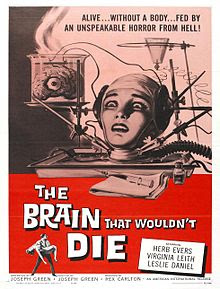
Not a brain, but a brain in a vat.  That's what won't die, at least in that part of the world (if there is one!) inhabited by philosophers.  "An unspeakable horror from hell!"  Indeed.

It's difficult to imagine a less serviceable avenue of thought than that indulged in by many philosophers for many centuries, relentlessly wondering if there is what is suggestively referred to as an "external world" and, if so, if it can be known by us. Worse, though, is their shameless tendency to write on the subject, if indeed it can be called one.  The consideration of the "question" is singularly purposeless, not merely because it's incapable of resolution, not indeed merely because it's questionable there is a "question" to be addressed, but because its consideration along with any possible resolution makes no difference to us, or to our lives.

It can't be disputed that we always act as if there is an "external world" and for the most part that our belief in it and its characteristics is substantially justified.  Anyone who seriously questions it could be accused of deliberately and thoughtlessly disregarding his purported belief.  Such a person would have to be mentally ill--"There is no world, but I live in it" isn't a statement most would make, and if one would make it seriously one would be treated, justly, as not quite sane.  That is what's done by philosophers who chew on this old chestnut and do so verbally and in print, to the amazement and bewilderment of those who listen to them or read their words (assuming, of course, that they exist).

What's particularly curious about this fixation with our claimed ignorance is that it's sometimes asserted that our incapacity is established by "scientific evidence."  There is of course the problem that it's questionable whether there can be any evidence, scientific or otherwise, if we can't know the "external world."  But it would seem obvious that the scientific evidence indicates that we evolved over time through our interaction with the rest of the world and interact with it consistent with our expectations time and time again.  If the results of experiments are "scientific evidence" it's apparent that scientific evidence in support of the existence of an "external world" is overwhelming.

Why, then, is this fantastic subject one of continuing interest and effort?  Let's ask, following Cicero:  Qui bono fuisset?  Where we humans are concerned, it's always important to consider who benefits from a particular act, question or issue.  Benefit--ours in particular--is always uppermost in our minds.

Who would benefit from a belief that we can't know the world, that we're separate from it, that it isn't real, or less than real; isn't true or less than true?

Those who thrive on it, clearly.  Philosophers, of course, do so.  For some it's their bread and butter.  Most if not all of the religious, as well.  "My kingdom is not of this world"--so said Jesus or so said someone who said Jesus said it.  The clergy in particular.  What would they do if people didn't think there was a world beyond this one; a world better than this one, which is the "real world"?

Anyone who benefits from disregard of or disparagement of the world as it is conceivably gains from the perception that there's something fundamentally wrong with things, so we may have to include politicians and pundits as well among those who claim the world isn't as it appears to us.  

No wonder that Plato, who first wrote extensively of a reality not of this world, was a totalitarian at heart.  If the world isn't real, then clearly we should seek what is real.  If we can't, we should be made to do so, for our own good.

And so we see what metaphysics and epistemology can lead to, if untrammeled by the world!  Without weights or guide lines, they ascend uncontrolled into the air like the balloon of the Wizard of Oz, they render us inhabitants of that city in the sky, Cloud Cuckoo Land of Aristophanes.  No wonder, perhaps, that Heidegger was a Nazi.  
 

Tuesday, October 26, 2021

The Coarsening of Stoicism


Stoicism is ubiquitous.  All want to be, or profess to be, a Stoic, or so it seems.  Stoicism is touted as the guide to a good life; but not merely a good one, a successful one.  After all, the ancient Stoics maintained that we may live a good life without being successful.  But who now would want to be good without being successful?  There are books, lectures and no doubt podcasts on how Stoicism may benefit entrepreneurs; may make us leaders; make us rich and powerful, make us efficient.  Marcus Aurelius is the Dale Carnegie of these times.  Reading him, we learn how to win friends and influence people.  

Stoicism is said to be desirable even when shorn of what was thought by ancient Stoics to be essential to it.  For example, the Stoic belief in a Divine Reason that is the generative and guiding force of the universe is said to be unneeded by the modern Stoic, according to Lawrence Becker and Massimo Pigliucci.  Mr. Becker goes so far as to refer to himself and others as Stoics despite the fact he (and presumably the others he refers to when stating what "we" Stoics think) don't accept the divinity of the ancient Stoics.

As Stoicism is claimed to exist without a divinity, without Providence, why should it be necessary that it retain the other characteristics of ancient Stoicism?  Why should the modern Stoic disdain the acquisition of wealth and power, which requires that we pursue things beyond our control, and concern ourselves with them closely?  Why shouldn't the modern Stoic seek fame and fortune by making use of the skills which are developed through Stoic practice?  Why try to act virtuously--why, indeed, think that virtue is the only good, and the only thing needed for happiness?

Those of us who admire Stoicism as taught and practiced by the ancients may feel gratified that it has become so popular.  Stoicism is a form of practical wisdom, and can help us in many respects just as CBT may be of assistance in addressing disquiet or psychological difficulties.  But is there a point where its popularity debases it?

Stoicism has seen resurgences in the past, but I doubt there has ever been a time before this when it was considered beneficial and admirable for reasons which seem to me to be at best tangential, at worst contrary, to what it was developed to be; a philosophy of life.  A way of achieving tranquility and equanimity.  Not a method by which to be successful in business or in other pursuits which are unrelated to virtue.  

Perhaps it's the case that coarseness is an essential component of our culture and society.  What is arguably good because it achieves virtue is accepted only to the extent that it serves another purpose, one worldly.  That's necessary to popularity, here and now.  That's been the case with Christianity for quite some time, in fact.  The moral teachings of Jesus are honored in word, but it's claimed that Jesus will assist us in this life by making us prosperous.  He'll take care of his own.  

So will Zeno, or Chrysippus, or Cleanthes, Epictetus, Marcus Aurelius, Seneca and others, perhaps.  But I'm inclined to think that most of Stoicism will fade away as it increases in popularity, and it will become yet another self-help craze, but one which those who popularize it (and make money doing so) can claim is entitled to added dignity as being based on ancient philosophy.  


Monday, February 15, 2021

Angst Misbehavin'


How have philosophers, and others, come to dwell on such phenomena (if they may be called that) as angst, dread, nothingness, anxiety and other such foreboding--what, exactly?  Feelings? Things? States?  It seems to me a good question, as by my understanding these woeful conditions of mind are said to exist separate from any particular object.  That's what distinguishes them from fear, for example.  We fear something or someone in particular.  The angst, dread, etc. written of by philosophers, usually existentialists, have no particular object as they refer to life, living in general, or the world in general, all their constituents conspiring, as it were, to make us miserable in some profound sense.

Angst seems to have been created by that most melancholy of all Danes, Soren Kierkegaard.  Kierkegaard makes Hamlet seem positively jolly.  The author of such works as Fear and Loathing and Sickness unto Death wouldn't be the life of any party, except perhaps a burial party, at which he could, I suppose, cheer others present by making comments regarding the good fortune of the deceased to be quit of this vale of tears.

Kierkegaard was a (very sad) man of the 19th century, and it seems the concept of life and the world as full of woe and the relentless urge to expound on that subject in painful though not useful detail developed during the 19th and 20th centuries, at first at least through the efforts of Europeans.  I wonder why, and here provide a modest effort at an explanation, or the beginnings of one.

I think of ancient Western philosophy, and I know of no instance where the followers of Plato or Aristotle, the Stoics or Epicureans, or philosophers of any ancient school of which I know felt or described anything even nominally similar to angst, dread, anxiety or any other items in the cornucopia of woe posited by existentialists or nihilists, let alone anti-natalists who go them one better by not only decrying the world but contending it's so full of suffering that it is immoral to have children.  Even the Platonists and Neo-Platonists, who thought there was a realm beyond the imperfect world, to my knowledge didn't dread it as a whole.

Something must have happened to change this perception of the world so completely.  Ancient Western philosophy, like so much else, was stopped cold by the onset of Christianity, which later tried to assimilate it, though not all of it.  Christianity famously condemned the world and all that's in it, including we humans, as sinful and wicked.  Like certain ancient philosophers, they thought there was a higher realm.  But they thought that realm was available only to Christians, and very good Christians to boot.  The ancient pagan philosophers didn't think that the higher realm was available exclusively to any follower of any particular religion.

Christianity began to lose its grip on thinkers and intellectuals from about the 18th century on.  Many, like Voltaire, accepted a kind of Deism.  But subsequently, those no longer able to accept Christianity or a Christian god found it impossible, for some reason, to accept the world.  "Without God, anything is permissible" are the words used by Dostoyevsky in The Brothers Karamazov.  Despite the fact that the ancients accepted the world as good, or at least not dreadful, without the need for believing in a personal deity like the one endorsed by Christianity, the intellectuals of the 19th and 20th century could not do so.  And so, for them, anything was possible.  There was no longer a guide for conduct, no standards to be applied, nothing good or bad, no purpose to life; we're deposited in the world for no reason, only to suffer.

If this hypothesis has any basis, it's striking the extent to which the absence of God, of standards, of morals derived from a creator, rendered the intellectuals of formerly Christian Europe hopeless and in despair.  The reaction to the Death of God was dramatic, even melodramatic.  The search for alternatives began, but these thinkers had been so convinced of the need for absolute knowledge and standards of conduct that the probable, the likely, the well established didn't suffice to assuage their concerns.  

And so nothing quite worked.  Nothing replaced Christianity.  Existentialism, nihilism, were unsatisfactory and fostered melancholy at best, angst, dread and anxiety at worst.  Some became mystics or quasi-mystics, seeing some form of redemption through nationalism and racist ideologies and belief in leaders amounting to demigods.

The result is many of us see the world as not only separate from us, but deadly to us.  We're outsiders without hope or function.  We have no place to go.  For everything, we're out of tune.  

Separate from the world, but not beyond it in any permanent sense.  Subject to it but incapable of remedying our lot or making things better for us or others, there being no God to tell us that's what we should do.  It seems a remarkably self-pitying, futile way to live.  If it is the result of a disenchantment with a particular religious view which became rationally unsupportable, however, there are ways to overcome that disenchantment, as the ancients knew but we have forgotten.

Wednesday, July 22, 2020

The Philosophical Fallacy


Let's retire, for a moment, from the turbulence of these wretched times, and consider philosophy.

John Dewey thought that the most pervasive problem of philosophical thinking is neglect of context. He thought it so pervasive that he called it "the philosophical fallacy."

According to Dewey, the philosophical fallacy, in general, "consists in the supposition that whatever is found true under certain conditions may forthwith be asserted universally or without limits and conditions."

"The philosophical fallacy" is a part of a general critique of philosophical thinking that anticipated, I believe, the criticisms made by later philosophers. Dewey felt that philosophical thinking in large part involves abstraction, reification, and a tendency to treat as insignificant, and perhaps even as less than real (not really real)--or even unreal, that which is non-cognitive or pre-cognitive. (Here I'm paraphrasing Gregory Pappas' interpretation of Dewey on this). It's a form of intellectualism, an emphasis on knowing and what can be known, which is a limited view of our experience. Says Pappas, interpreting and later quoting Dewey: "In fact, we have a qualitative appreciation of our surroundings that precedes, underlies, and cannot be reduced to knowledge. Our intellectual activities always operate within the more general context of the world as encountered, lived, enjoyed, and suffered by humans. In primary experience ‘things are objects to be treated, used, acted upon and with, enjoyed and endured, even more than things to be known. They are things had before they are things cognized.’ (LW 1:27-28)"

I have no idea whether Dewey used the good ole pencil/stick in water chestnut as an example of this fallacy, but I think it is one. You know it, of course. The pencil/stick appears "bent" when placed in water but, in fact, it isn't bent. Therefore, our senses "deceive" us. We can't rely on them to know what is really the case. And that, of course, means....and on we go.

I tend to agree with Dewey. But apparently unlike him I wonder whether the philosophical fallacy and its variants are not merely pervasive in philosophical thought, but an inherent characteristic of it. In other words, is it inescapable? What is philosophy but abstraction, and what is abstraction but, if not the neglect of context, the disregard of it? And if that's the case--whither philosophy?

"Abstraction" is defined as dealing in ideas, not events, of being withdrawn into the mind.  Of course it can be maintained, as I think Dewey would maintain, that ideas occur, and thinking takes place, in context; that one doesn't withdraw into the mind at all as mind is a part of the world just as we and everything else is, and I would agree that's the case.  But while thinking takes place "in context" philosophy at least as traditionally conceived isn't addressed to any particular, specific context, typically.  In saying as he did that philosophy restores itself when it addresses the problems of men rather than the "problems of philosophy" Dewey may have been urging that philosophers apply the tools of philosophy to particular circumstances, to address specific problems.

Well and good.  But that would seem to make philosophy something different from what it has been for centuries.  The problems of philosophy generally aren't problems at all, in that sense that they aren't problems actually encountered in life, i.e. in context.  Who actually doubts their existence in a way that such doubt is reflected in one's conduct in the world?  Who is concerned whether what they see and touch and smell and hear is really what it is and does, to us?  Do I drive my car wondering whether it is in fact a car, and not something else?

But Dewey's criticism of traditional philosophy seems not merely regarding its choice of problems or perhaps more properly creation of problems which are not problems.  It seems to arise from the fact that Dewey believes that what we experience is in large part pre-cognitive and cannot be reduced to knowledge, and that this is ignored by philosophers.  That may mean that philosophy, or at least traditional philosophy, is so fundamentally misguided that it cannot lead to an understanding of the world.

Education is a real problem or involves real problems, and perhaps Dewey was vitally concerned with it because he thought a philosopher could address real problems and not merely philosophical problems by reflecting on education and how to educate.  What else could philosophers do, if indeed they were willing to consider problems outside those of the problems of philosophy?  What would the curriculum of a philosophy department involve, include?

Useful methods of addressing what takes place in a specific context, intelligently, perhaps.  How to think critically.  Perhaps even practical wisdom of the kind the ancient philosophers tried to address.  

Abstraction would certainly be involved, but it would be abstraction employed in addressing problems and issues of the kind which arise in real life, in particular circumstances.  Dewey's awareness of "the philosophical fallacy" may be what led him (in my opinion) to focus on the method of thinking, of inquiring, investigating and making decisions.  It may have influenced him to believe that all conduct and beliefs are subject to revision based on further inquiry.  This has made him a boogieman to those who seek the solace of unquestioned certitude, but his reliance on the scientific method and the similar application of intelligence to non-scientific problems saves him from being a relativist.

Tuesday, January 8, 2019

There are Monsters, and then there are Monsters


Now and then, and in any case too often, I find myself drawn to discussions, of a sort, concerning Heidegger in a philosophy forum I frequent.  I don't think I can say I'm irresistibly drawn to such discussions, as I've managed to avoid some of them.  In this particular case someone asked for assistance in understanding a paragraph from Being and Time.  I found the paragraph so obscurely written, so crammed with what seemed to be jargon, that I succumbed to the unworthy desire to mock it.  This led one helpful poster to provide what I think must be called a translation...a surprising one to me as it seemed only vaguely related to the topic apparently being addressed in the paragraph in question.  Having helped me, though, the poster then scolded me, saying that I should learn the meaning of the vocabulary used by Heidegger if I wished to criticize him.

I personally think that a person should not have to learn the meaning of special words in order to read and understand a philosopher's work, or that of anyone else for that matter.   I think philosophical and most other points can be made without recourse to arcane language.  There should be no code one is required to discover (the "Heidegger Code"?) before the meaning is revealed.  Be that as it may, though, this post is inspired by a statement made by another poster after the word "Nazi" was brought up (I wasn't the first to do so).  That statement was to the effect that in assessing (with admiration, it apparently goes without saying)  Heidegger's philosophy we shouldn't get "bogged down" in the fact the man was an absolute monster.

This statement interests me, and not just because it acknowledges Heidegger was a monster.  Most of his apologists admit, as they must, that he was a member of the Nazi party.  Most know of the speeches he made in support of National Socialism and Hitler.  Most know, or should know, that he was a party member until the end of the war, that he never criticized the Nazis, or Hitler; that he never mentioned the Holocaust; that he never expressed regret for being a member of the party.  It's no longer possible to maintain he was not an anti-Semite after the publication of the Black Notebooks and his letters to his brother.  It's increasingly difficult for an apologist to maintain, reasonably, that Heidegger was not an enthusiastic Nazi, though some try to do so still.

So, instead, one hears from apologists that it doesn't matter.

I find the statement interesting because it speaks to the title of this post.  When we say someone is a monster, what do we mean?  Does someone who is a monster cease being a monster in some circumstances?  If Heidegger (or someone else considered a monster) was a monster, was he a monster when "doing" philosophy (or something else considered worthwhile)?  Does/should it matter if a monster does something worthwhile--does/should it make the person less of a monster?  Or, is a monster still a monster when doing something admirable, but that fact does not reduce the merit of what was done?  If that's the case, do we admire the monster or what the monster did?

The picture at the beginning of this post is an illustration used in the 1831 edition of Mary Shelly's Frankenstein.  It doesn't depict the monster as most of us know him.  Men, women, children can be monsters, but they need not be evidently a monster, a monster by appearance.

Do we, can we, say of someone "he/she is a monster, but a great philosopher/artist"?  When it comes to art, I don't think we usually distinguish between the creator and the created in any definite or significant sense when we understand that the act of creation was intended, and admire what was created, nor do I think it reasonable to do so.  We admire an artist who creates a great work of art because he/she creates it.  Nobody but the artist could so; the work of art is essentially a product of the artist as a person.  It isn't the work of just a part of the artist, i.e. the good part.

Nor do I think we make such a distinction in the case of a philosopher whose philosophy we admire.  If we admire Heidegger's philosophy, we admire Heidegger as well, for the same reason as we admire the artist.  Only Heidegger could write his philosophy, and Heidegger is a person.  But, we can't intelligibly say that we admire Heidegger the philosopher, not Heidegger the Nazi, as they're the same person.  Heidegger intended to be a Nazi and intended to write philosophy.

Say that's the case.  Can we nonetheless say the work of art/philosophical work can be considered apart from the artist/philosopher?  Can we say the fact Heidegger was a Nazi isn't important to his philosophy, or that we cannot or need not get "bogged down" in the fact he was a Nazi in reading or assessing his philosophy?  Well, I don't think we can deny or explain away the fact that if we admire Heidegger's work, we admire what the Nazi did and thought; we admire the Nazi's philosophy.  That Nazi sure was a hell of a philosopher.

Some have argued that Heidegger's philosophy encouraged or justified, or led to, Nazism.  What I've read of him indicates to me that he believed in the superiority and special destiny of the German language and people and did so for quasi-mystical, quasi-philosophical reasons, and this oddness is found in Nazism and other "isms" based in German romanticism.  But as to his ontology, his metaphysics, I will probably never know.  I'm not keen to learn, or discover, or decipher the Heidegger Code. 

Sunday, July 1, 2018

Meet the Nothing

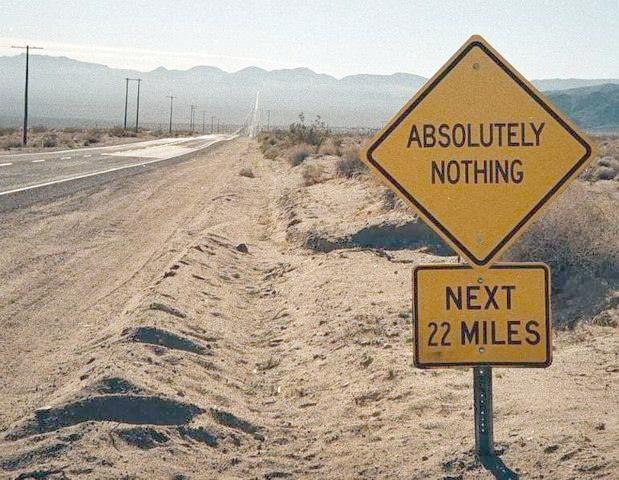
There's something called "the Nothing."  There's something called "Nothingness."  They are (are not, perhaps) a concern to certain philosophers of a certain kind.  Apropos of nothing, Cicero once said (I paraphrase) that there is nothing so absurd that some philosopher has not already said it.

"Nothingness" I suppose represents the state of being nothing, or perhaps is characteristic of nothing, or is the quality of nothing or is characteristic of "the nothing."  Nothing is, apparently, the opposite of Being, or its negation.  I may be mistaken though.  I know nothing of the Nothing.

Heidegger the Great and Powerful wrote of the Nothing in his inaugural address on becoming rector at Freiberg, where he infamously made some speeches praising and indeed glorifying Hitler as, among other things "the future of Germany and its law."  I spent some time asking questions about this speech in a philosophy forum I frequent, and eventually was duly accused of bad faith for doing so and, I would think, also because I didn't understand what he was saying.  Which was nothing?  I still don't know.

I think Heidegger is something of a sacred cow in some philosophical circles and his followers eagerly leap to his defense whenever he is questioned or mocked.  They may be all the more avid in his defense because there's no doubting the fact that he was a member of the Nazi party, and never publicly expressed any remorse over that membership, nor to my knowledge did he ever publicly express criticism of the Nazi regime before, while or after it was in power.  As a result, those who defend him are defensive in doing so.

But I've been told many times, sometimes sternly, that his misdeeds in life have nothing to do with the merits of his philosophical works, and I would say that it's likely his fondness for Hitler and the Nazis at the least did not arise due to his writings regarding "the Nothing."  Had, in other words, nothing to do with the Nothing.

I think Rudolf Carnap said all there is to say about "the Nothing" as it is referred to in the inaugural address.  What he says essentially is that "nothing" shouldn't be spoken of as if it is something or used as if it is a name for something, and if it is so used it leads to meaningless propositions.  But Heidegger seems to understand this and indeed says he does in the address.  Nevertheless, he says this is a defect in logic, not in use of the word "nothing" or indeed in "the Nothing."  "The Nothing" is encountered only when one is "suspended in dread" (or anxiety).  It's only this encounter which allows us to understand Being.  "Being" apparently refers to that which is.  That or those which is or are have "Being."

"Being" and "nothing" are concepts, names, or something which fascinate many philosophers, I'm sorry to say.  "Being" seems to me to suffer from some of the same problems as "nothing" or "the Nothing."  It may be used as a noun or name, and is treated as if it is something, a quality possessed by that which is, as opposed, apparently, to "that "which is not.  But at least unlike "nothing" or "the nothing" it actually refers to something which exists; indeed, everything that exists.  "Nothing" doesn't refer to any thing.

The fascination with "nothing" seems to be related to a question which in turn is a fascination of some philosophers.  That question is:  "Why is there something instead of nothing?"

Now some, like me, would say that there are problems with that question.  That problem as I see it is that it also is premised on an assumption that there is something that would exist if something didn't exist, called "nothing."  One can ask if one wants to "Why there is something?" but one can't then refer to anything that is "instead of" something.   Nothing would exist, true, but "nothing" doesn't replace something.

I think the question when posed as, "Why is there something instead of nothing?" or "Why is there something?" isn't one that can be answered by philosophers.  If it can be answered at all, it would be an explanation of the fact that things exist, and that explanation would seem to be one that would formulated by science, not philosophy.  That is, unless one is satisfied by an answer which is merely speculative.

It is a question which invites not merely speculation but the use of words in the fashion used by Heidegger and others when it comes to "nothing" and so invites confusion and what Carnap calls "pseudo-statements."

Carnap suggests such statements by philosophers may serve to do what poetry and art does, or music.  For me, that means that such statements may be evocative, and evoke a kind of knowledge or appreciation of the true or correct.  That may be generally true, but as I think Carnap observes the poets, artists and musicians or composers do a better job in this respect that do philosophers.  Some of the most profound feelings I've experienced arose from reading poetry or listening to music.  But "the Nothing" inspires nothing in me, I'm afraid.  Don't tell anyone, though.  This is between you, dear reader, and me.

Tuesday, November 7, 2017

Sancta Mater Ecclesia


Holy Mother Church, or Sancta Mater Ecclesia in Latin.  The One Holy Catholic and Apostolic Church, just as it's said, also in Latin, in the interesting picture above.  Or, according to the inscription at the Basilica of St. John Lateran in Rome, built at the order of the Emperor Constantine and dedicated in 324 C.E. by Pope Sylvester I, omnium urbis et orbis ecclesiarum mater et caput, the mother and head of all the churches in the city and the world.

Old Mother Church, in truth.  Quite old, really, as age is measured in human history.  As I've posted before, I have a sentimental fondness for it as it was at one time, during my youth.  It gave a certain joy to my youth, as we as altar boys said its God did as we went to God's altar, or if not joy a kind of distinction. 

It's curious how we refer to institutions, particularly those we look back upon in fondness, as "mother."  We call our old schools Alma Mater.  I suppose we can call Mother Church the same, as it can be said to have nourished us Catholics for a time.  But nourished us in what exactly?

It must be admitted that one thing Mother Church encouraged, probably throughout its long history, is reason, or more particularly reasoning, as it was developed before the Church came to exist.  That may seem an odd thing to say, given that the beliefs of Catholicism, taken literally, seem unreasonable.  That's likely why they often are not taken literally, particularly by those believers who reason or employ reason in its defense.

Regardless, though, I think it fair to say that the Church has always honored reason and reasoning.  The Church Fathers employed reasoning in condemning the pagans.  Tertullian, a lawyer, knew reasoning in the form of rhetoric at least.  That was a lawyer's tool, particularly in those times.  The Church Fathers, like Augustine, knew their philosophy (pagan, of course) well, and were educated in the manner in which ancient pagans were educated and had been for centuries.  The great pagan philosophers didn't take pagan religion literally, either.  Why should Christian philosophers?

So, I think the early Church soon abandoned the position seemingly taken by Paul, rejecting the "wisdom of the wise."  Instead, it accepted it; assimilated it, in fact, and made it serve the purposes of the Church.

I think its also fair to say that the Church has always honored culture, education, history.  It kept the wisdom of the ancients alive, through the work of its monks, even if they functioned as mere scriveners, patiently copying the great works of the past.  As a result it fostered great thinkers even during what are called the Dark Ages; Abelard, Duns Scotus, Aquinas, Bonaventure, William of Ockham; it's an impressive list.  It borrowed from the heathen as needed in order to do so, and so rediscovered Aristotle via learned Moslems.  Aristotle so impressed churchmen he was called "The Philosopher."  Thomas Aquinas famously modified Aristotelian thought so as to make it the foundation of Catholic philosophy--known as Thomism.  It still has its adherents today.

For these services Mother Church deserves honor.  I wonder, though, if in inculcating its sons and daughters with a love or reasoning, culture, history and education Old Mother Church gave her children the learning needed to lead them to think her cupboard of reason was, ultimately, bare, as that of Old Mother Hubbard was bare of nourishment.

Learning can be dangerous to a religion, especially when learning involves fostering the capacity to reason, to think logically, to ask questions.  Eventually, those questions address the fundamental premises of Catholicism and Christianity, e.g. the divinity of Jesus, Original Sin, Heaven and Hell, the Trinity, the redeeming character of the sacraments, transubstantiation.  What could be their justification?  How can they be justified, in modern times?  How could Jesus be both God and man?  What sense does the seemingly endless list of sins, so specific to human beings, and a belief in a God-man, make given the vastness of the universe and given that our world is such a tiny, tiny part of it?

To someone trained to reason, recourse to revelation and faith is unpersuasive.  It's a kind of resignation.

Mother Church certainly has managed to survive for centuries, so perhaps it hasn't arranged its own destruction after all.  Perhaps it hasn't undermined the fundamental beliefs which make it distinctive.  But it seems to me that it does, necessarily.  And so a choice must be made, to be Catholic by disregarding reason or accepting that fundamental beliefs or premises are not to be "taken literally."  But that, it seems to me, is to accept a Catholicism, a Christianity, which has lost all which makes it distinctive.

Monday, September 18, 2017

"Let Be Be Finale of Seem"


These are famous words from a famous poem.  No doubt they've been explained already by many, or at least analyzed; perhaps even by the poet himself.  Wallace Stevens was a poet who wrote of poetry.  Perhaps the lawyer in him, or the student of Santayana that he was, still within him, compelled him to be a critic as well as an artist.  I will give them my own interpretation, though.

The sunset is a kind of finale, though not one as final as death.  It's the finale of a day, which may indeed be remorseful as A.E. Housman wrote but need not be.  Remorse is understandable at the end of a day, or a life, to one who is thinking at the end of one or the other, because it's not uncommon to feel remorse for what was done or was not done which could have or should have been done.  Humans being what they are chances are excellent that they should have or could have done something and that something they did was wrong.

What seems to be isn't necessarily what is.  To be is to exist.  What exists may seem not to exist.  You get the picture (or at least you get what the picture seems to be).

"Let be be finale of seem."  Let the end of our efforts to determine what seems to be, be?  Let what seems to be, to us, be?  Or, let it be, in the sense of give it up, forget about it?  Give it up, this tendency we have to distinguish appearance from reality, to insist on a thing-in-itself that we cannot know?  Give up the belief that what seems to be reality isn't really reality (the really real)?

I'm impatient with metaphysical and ontological concerns, i.e. the issue of Being and, that other favorite, Nothingness.  That may be a failing on my part.  I'm unconcerned with questions regarding what it is, in all cases, to be or not to be (was Shakespeare having a bit of fun with philosophers when he wrote this speech of Hamlet?  I find myself hoping so).  The fact that we make mistakes sometimes leaves me unimpressed.  It hardly seems grounds on which to question all we interact with naturally, by living, with considerable success, much less envision some kind of place apart from the world on which all truth and beauty depends.

So, I would interpret Stevens as saying that what is, is in the end what seems to us to be.  In the end of the day, in the end of us, you and me.  Let it be so.

"Things Merely Are" is the title of a book by Simon Critchley about philosophy in the poems of Wallace Stevens.  It seems a less than hopeful phrase, but it's an assertion that renders a good deal of speculative philosophy superfluous.  And, if that was what Stevens was attempting to say, in his poetry, it's something few other poets have said, I think.  Yet there's unquestionably beauty in his poetry, just as there is unquestionably beauty in things of all kinds.

Consider sunset, especially as pictured above.  The sunset merely is, of course, but though we don't cause the Earth to revolve or the sun to exist it is what it seems to be to us, the end of a day, and though it can seem to be, to us, a splendid end or a dismal, dull one, it's nonetheless an end of something.

We're edging into Autumn, now, and in that part of our Great Republic in which I live the leaves will turn glorious and then wither and fall.  Crops will be harvested, vegetation of all kinds will stop growing, weather will turn cold.  As we've known since ancient times, we wither and die like other things in the world do.  But some of the most striking sunsets I've ever see have been winter sunsets, when the world seems, and is, dead.  Those sunsets merely are as our deaths merely are.

Friday, January 20, 2017

Constructing (Deconstructing?) Constructivism

I pause in mourning the advent of this peculiar new presidency and its even more peculiar president to consider the philosophical view called, I believe, "Constructivism."  If I understand it correctly, it is an epistemological view, and roughly speaking is the belief that our knowledge is "constructed" because it is contingent on human perception, conventions and social or cultural experience.  As a result, it's claimed, our knowledge isn't of an external world or reality.


As you might expect, those who accept Constructivism are disinclined to believe there is any objective truth or knowledge of what is real, because what we consider to be reality is, in fact, and necessarily, constructed reality.  I confess I have a tendency to maintain that such a view is a difference which makes no difference and is thereby not a difference at all.  (I paraphrase, and forget who said this, but believe it was either William James or Mr. Spock, or perhaps even both of them).  That tendency has its basis in my feeling that if we can't know what reality is it's foolish to dwell on that fact; we'll never know what it is and so our time is better spent in dealing, as we must, with constructed reality.


But I also think that the use of the word "Constructivism" and the claim that we "construct" reality as a result of our interaction with the (presumably but it seems unknowable) real, is misleading.  We certainly can construct things, but when we do so we act intentionally to do so.  We construct a bridge, a building.  However, when we see, feel, hear, etc., we construct nothing at all.  If I see an apple I'm not constructing it, nor even am I constructing what I see if it is in the "external world" or unconstructed reality something different that I can't know (just what that might be we can't say, because we can't know what it is according to Constructivism).  I am, instead, seeing.  I'm doing part of what we do as living, human, organisms which are part of the world.  I'm living.


It seems to me Constructivism partakes of the same kind of duality as certain other theories of knowledge which are committed to the belief that we're separate from reality; apart from it rather than a part of it.  At least, our minds are thought to be separate from it if not our bodies.  Our minds are constructing reality being as they are dependent on our senses, our society, our culture.


If we don't construct a reality (if we don't make it) separate from the "really real"--if in other words we merely live as humans do given our characteristics as living creatures, see as humans must do, hear as they do, eat as they do, feel as they do, etc. as parts of the world--it strikes me there is neither the need nor the inclination to maintain that the environment in which we do those things, the world of which we're a part, is in any way disconnected from us or unknowable.  We aren't different from reality, or observing reality, or studying reality.  We're a part of reality.  We're reality just as much as everything else is.  There is no reality without us because reality would in that case not be reality; it would be something different.


It happens we humans, as part of what we do while living in the world (as constituents of reality) congregate, form bonds with others, form tribes, nations, societies, cultures.  They're likewise parts of the world, the real.  What we do as members of nations, societies, cultures are naturally influenced by them, but there's nothing unreal about this.  They may be different from one another as a result of what takes place with humans in different parts of the world, but they're all parts of reality as well.  This doesn't mean that we're incapable of knowing what the "really real" is, it means we're living in the "really real."  It doesn't follow from this that there is some external world unknowable to us.


Submitted for your consideration, some thoughts I have while avoiding what I'd rather not think about.

Tuesday, January 3, 2017

The Pertinence Maxim: A Matter of Time

While I was attending college, a new professor appeared on campus.  Although it was, and still is so far as I know, a small liberal arts college, that in itself wasn't extraordinary or significant.  Professors would appear now and then and some would leave after a time; some would not.  What was unusual in the case I recall here was that this particular professor was said to be a sociologist.  He was the first of his kind at my college.  At least, he was the first to be called a sociologist.

As a professor of philosophy I admired and respected thought him to be worthy, I signed up for one of his classes.  The class in question addressed Time.  If I remember correctly, the first thing we students were asked to do was submit a paper describing what we felt Time to be.  I think I wrote something to the effect that time was a concept by which we determined when certain events took place or should take place (planting crops, for example).  I thought, in other words, that we came to keep time because it was useful to do so for various purposes, especially as our societies became larger and more complex.  This I suppose was a kind of anthropological view.  Time was a method used in determining and defining what takes place or should take place.  Such was, and is, my guess, in any case.  But in all honesty I'm not sure just what I thought.  That was a long time ago. 

I confess I thought my view of Time to be superior to the views of others in the class who relied on Simon and Garfunkel (Hazy Shade of Winter) and others to arrive at a definition.  The professor, though, treated our views as equally deficient and dismissed them all in a rather cursory manner.  To this day I have no idea what he thought was the correct definition of "Time."  I know only he was almost contemptuous of what we thought ("Ah yes, this is the so-and-so. view of Time").  He may have declined to give us a definition.  He was one of those professors who thought that teaching consists of asking, not answering, questions.  I encountered a few like-minded professors in law school.  It may be there is or was a widespread belief that this style of teaching is the fabled Socratic Method.  I find it hard to believe that anyone who actually reads Plato can come to such a conclusion, as I think he carefully prepared his dialogues so that they would inevitably result in a position he thought appropriate through the device of questions; much as a lawyer prepares questions to put to a witness.

It happens that Time is a subject of philosophical analysis.  There are philosophers of Time and so must be a Philosophy of Time.  The ontological status of time is studied and debated.  Philosophers discuss the difference between the past, the present and the future.  They consider why Time seems to us to be an arrow.  They wonder whether there truly is anything but the present.  They wonder about fatalism.  They ask why Time seems to move swiftly in some cases or to certain people.

For my part, I wonder as I do in most cases whether these wonderings make any difference to how we live our lives, and am inclined to say they make no difference whatsoever.  Also for my part, I feel that if they make no such difference, debating them is futile.  This may well be a fault of mine.  There may be something lacking in me.

Perhaps the professor of sociology I encountered (or did I? It was in the past!) would have though that C.S. Peirce's pragmatic maxim would be of some assistance in defining Time; more assistance, even, than Paul Simon's lyrics.  It's hard to say.  The maxim has appeared in different forms, but I'll make reference to the form in which it appeared in Peirce's essay entitled How to Make Our Ideas Clear: 

"Consider what effects, that might conceivably have practical bearings, we conceive the object of our conception to have. Then, our conception of these effects is the whole of our conception of the object."

I can't remember whether I knew of this maxim when I studied under the eminent sociologist, but would have recourse to it now if recourse was required.  Happily, it isn't.  But I think the maxim would indicate that our conception of Time would be one which is made up of the uses to which we put that concept in doing things we do, e.g. eating, sleeping, working, taking vacations, parking cars, etc. 

I find myself baffled if I seek to define Time or even think of it in any other way.  Baffled, I say, in finding any reason to do so.  Clearly, we say there is a difference between what has happened and what is happening, and in identifying such things the concept of Time can be useful.  Should we say that there is such a difference?  Why not?  How do we err if we do?  Should we say there is no past?  Why? 

Won't we keep on living as we do, using Time, making Time, regardless of the ontological status of Time?   Won't we continue to distinguish past, present and future regardless of the differences there may be between them?  It seems we understand the differences between them well enough, and those differences hardly seem surprising or worthy of analysis.  Will we ever, seriously, claim that nothing happened in the past, that there will be no future?  Do we ever make the distinctions philosophers make or reach the conclusions they do as to Time while living our lives?  If we don't, doesn't that tell us something significant about the Philosophy of Time?

Perhaps another maxim along the lines of the pragmatic maxim would be useful.  Something like this:  "Consider what effects, that might conceivably have practical bearings, which may result from our study of the subject in question.  If there are no such effects, then our study serves no purpose."  Let's call it "the pertinence maxim." [Copyright Ciceronianus, 2017.]

It may be that there are aspects of Time that may usefully be subject to scientific study, e.g. the reasons why we perceive times' passage in different ways in different circumstances.  Of course, Time has also been a subject of study in physics.  It seems to me, though, that this kind of study is one best pursued by scientists, not by philosophers.


Thursday, October 27, 2016

God's Image and Likeness

As most if not all of us know, it's written in the Book of Genesis that God made us in his image and likeness.  Somewhat strangely, God's portrayed there as speaking to himself prior to our creation.  "Let us make man [or mankind, or human beings, depending on the translation] in our image, in our likeness" God muses, or suggests to himself.

It happens that there were (and are) others besides the Hebrews and their successors in interest in Genesis who believe that we're the image and likeness of God or the gods, or at least believed that God or the gods resemble us to a startling degree.  The ancient Greek and Roman pagans, for example.

Certain of the ancients portrayed their gods as being hybrids, odd mixtures of humans and animals.  The ancient Egyptians did this, of course.  Certain cultures conceived of them as being particular animals.

It's interesting to speculate on the reasons for our tendency to worship divinities so like ourselves (at least, I find it interesting); our tendency, in other words, to worship ourselves.  The observation that this is what we do is so commonplace that it's thought perfectly natural or to be expected.  So we say things like "if horses had a god, it would be a horse."  Very well, then.  In that case, why do we so think and expect?

The simple fact is that physically, we're not particularly godlike.  If physical attractiveness or ability are worthy of worship or are considered to be aspects of divinity, a human god would seem unworthy.  There are animals far more graceful, more beautiful than we are as a rule.  There are animals faster, stronger than we are; animals that fly though we cannot; animals that are physically superior to us in many ways.  Why would anyone think that God or the gods would look like us, appear to be like us or resemble us, i.e. that we're the image or likeness of a deity?

The belief that humans are the image of God would appear to require a level of self-regard which is baseless almost to the point of lunacy.  Nonetheless, that has been and may even remain the belief of many.  Perhaps the apparent silliness of such a conceit led the religious to maintain that God or the gods were, in effect, super-humans, that is to say exceedingly beautiful, powerful and knowledgeable humans who are also better than normal humans in that they're not mortal.

That may have been the case with, e.g., the ancient Greek and Romans, but wouldn't seem to include the ancient Hebrews, who weren't inclined to picture God as having the physical form of a human being, portraying God variously as a burning bush or column of fire, etc.  But the God of the ancient Hebrews had various human characteristics nonetheless, if not physical attributes.  He was a jealous God, and could be an angry and vengeful one as well.  These characteristics are not those one would expect an almighty being to have, but are uniquely those of humans among the creatures of God, as far as we know.  The ancient Greek and Romans similarly portrayed their gods as having these human emotional characteristics and others, such as lust. 

So it appears that at least in recorded history, there's been a tendency to anthropomorphize the divine in one way or another.  Perhaps this came about due to the fact that animals came to be domesticated and we came to employ technology to alter our environment and so came in our opinion to dominate and tame the world.  Genesis of course indicates this was God's intent, to give us authority over the world and its other, lesser, creatures.  Not knowing much of anything else about the world, we may have come to believe that we were the supreme beings of creation, and thought that the Lord of creation would necessarily be like us, only grander.  Such a view would also be consistent with what came to be the hierarchical nature of our societies; as we typically had kings or oligarchs, so would the world in general.

Even so, it's difficult not to think the supreme being would be limited by being or appearing to be human in any significant manner.  This seems clear enough now, given our knowledge of the vastness of the universe and the resulting knowledge that we humans and our planet are almost unimaginably insignificant in comparison.  The creator or intelligence inherent in the universe probably would not be something which looks like us or is like us.  Perhaps our gods were in the past not considered to be supreme in the sense which is common at this time.  They had limited authority and power, peculiar to believers and their place in the world (universe) rather than authority over the entire universe.

We know that pagan philosophers in the West came to think the Olympian gods were not in fact real, but were meant to be representatives of the deity or aspects of the divine portrayed in a way comprehensible to the common people.  The "god of the philosophers" wasn't peculiarly human or like a human.  The philosophers were largely Deists or pantheists, like the Stoics.

The notion of God as perfect, all-good, omnipotent, omniscient is so unlike any notion we can reasonably have of ourselves that it's plainly unreasonable to think that we're created in God's image and likeness.  As that notion was entertained by pagan philosophers and as early Christians were eager to accommodate Christianity to philosophy, the Christian doctrine that God became man generated problems it took centuries to resolve.  Whether they were actually resolved is questionable.  The claim that Jesus was at one and the same time fully human and fully divine is unsatisfactory, but it was necessary for the heresies which maintained that he was not fully divine while human to be quashed, and quashed they were, though in a most mysterious way.

It seems unsurprising that particularly in ancient times, we worshipped gods which were strangely similar to ourselves.  But it also seems clear that an almighty God of the universe wouldn't be like us, wouldn't be especially or exclusively concerned with us and our affairs and how we act, or what we eat, or who we have sex with, or whether we keep holy the Sabbath day.  Christopher Hitchens claimed that religion is a relic of the selfish childhood of our species.  I don't think that's the case as I don't think a belief in the "god of the philosophers" for example can be considered childish, but religions which make the claim humans are significantly like God and our affairs God's special concerns may be.

Tuesday, June 21, 2016

In Dreams

I know little about dreams and their interpretation.  Some, I know, have studied them; perhaps most famously, or infamously, Freud and his not entirely faithful student, Jung.

They were of course thought to be a great importance in ancient times, but it's hard for us, now, to see them as divine or demonic visitations or visions of the future.  Some of us still do, of course.  We never learn, really, regarding certain things; sometimes because we choose not to do so.

I see them as peculiar little snippets of the real or the imagined, mostly disjointed in nature.  Mine can be spectacular, in a way, as to their landscapes or dreamscapes.  Colossal and complex cities figure often in my dreams, I don't know why.  Sometimes I'm lost in them.  Sometimes they're background to some purpose of mine or others who vaguely appear and disappear.  Sometimes, I can make things happen in them--change the dream, the "location" or set in which they play out, or have the characters do things I want them to do.  I know I'm doing that when I do it.

I find it difficult, though, to see them as significant beyond the fact that they can make one feel a particular emotion strongly; too often regret, in my case.  They provide me with no special insight into anything, myself included.  It seems other animals dream as well, judging from the movements of their bodies while sleeping.  It doesn't seem to be something peculiar to we humans.  Having them seems not to distinguish us as particularly wise or privileged.

I find it odd that seemingly intelligent people seriously consider the possibility that what we think of as real may, in fact, be a dream.  If my own dreams are any indication, the real is nothing at all like a dream.  First, I can't control the real as I control a dream (sometimes).  More typically, though, dreams are disconnected, may quickly change unexpectedly, involve people dead, are hazy and unclear.  They're quite different from the real.  so much so it seems fatuous to claim they're similar in any significant sense.

I therefore find arguments that the existence of dreams somehow support skepticism incredible; also arguments that they indicate that our senses are in some way untrustworthy.  Dreams are strikingly peculiar.  As such, it makes no sense to maintain that we can infer anything from them regarding what is or is not real or whether we can perceive what is real.  It makes even less sense to speculate that we're living in a dream, as if we were we certainly would not have the experiences we have.  It would have to be a very special kind of dream.  One, in fact, which isn't a dream.

Despite this, philosophers have taken such claims seriously.  Descartes did, of course.  But as he claimed to doubt, or have the capacity to doubt, in philosophy what he so clearly did not and could not doubt in life, it's unsurprising that he would purport to question whether the real is a dream.  The kind of "doubt" Descartes claimed to have while philosophizing was a very unreasonable doubt; it required no reason to doubt.

The fact that one doesn't know that one's dreaming is said to support such claims.  In fact, that's not always the case, as in so-called "lucid dreams."  Otherwise, though, it would seem perfectly reasonable to maintain that we don't know we're dreaming when we dream because we're asleep.  Being asleep, we're not as reflective or intelligent as we are when awake.  We generally don't know much of anything going on when we're asleep, yet things happen while we are.

It sometimes strikes me that we must purposefully disregard what we know, or at least have no reason to doubt, in order to entertain certain philosophical positions.  It takes a real effort to do so in certain cases.  Shouldn't this lead us to question the wisdom of these positions?  It doesn't seem so.

Wednesday, February 3, 2016

The Unbearable Triteness of "Being"

One finds the word "ontology" referred to quite frequently.  So frequently, in fact, and in such varied and disparate ways, that poor wanderers through the vast halls of intellectual history such as your charming and delightful old Uncle Ciceronianus find it hard to determine just what it is, and indeed whether it is anything at all.

Ontology you must understand is no longer the concern merely of philosophers, which would of course make it of no concern to most.  The word, at least, is thrown about in discussions of all kinds, as carelessly as one might throw a Nerf Ball, secure in the knowledge that nothing of significance will result or subject one to blame.

If we gather our strength enough to consult a dictionary, we'll find that "ontology" is said to be a branch of metaphysics concerned with the nature or relations of being, or a theory regarding the nature of being or the kinds of things that have existence.  If you're anything like me, this definition raises all kinds of questions, but none which have to do with the apparent subject matter of ontology.  Instead, those questions would involve whether anybody actually devotes time to the study of ontology, and if so why they do.

If the nature of being refers to the nature of existence, we all seem to have some idea of the fact that we exist, and may even be said to know we exist.  No great effort is involved in arriving at these conclusions.  We may indulge in faux doubt as did Descartes, but that is futile and tiresome.  We may indulge in the same kind of doubt as to the existence of other people and things if we really want, but nobody does that sort of thing in fact, i.e. we do what we need to do to live and living involves interaction with other things and people; if conduct is any kind of guide to what we in fact think, it's silly to maintain we think they don't exist.

Are there (still) people who seriously wonder whether they exist, or whether other creatures or things exist?  Perhaps there are, but if so I question whether there are enough of them to make "ontology" the kind of buzz word it seems to be.  Are there people who seriously ponder what it is for them or other creatures or things to exist?  It's likely there are more of such folk than there are those who seriously wonder whether they or others exist, but think that if they ponder this "question" in the abstract, without addressing it in a particular context or set of circumstances, their habitat is the university, i.e. the academy.

What it means for us to exist, or for other things to exist, may be something which presents questions which actually require or may result in answers in certain circumstances.  We may have reason to describe what is taking place and what we do in interacting with other things and people, which may be said, speaking rather awkwardly and in a contrived fashion, to relate to the nature of our/their existence or being.  Even then their being/existence isn't an issue.  But to refer to being as an attribute of all things and define just what that attribute is as to all things and in isolation (without addressing a particular situation) clearly isn't something we do or would seem to have reason to do in ordinary circumstances.  Nor does it seem there is any reason to inquire what it is for anything to be, though it may be something we do when drunk or high or in a philosophy class.

We say something exists, has being, when it's present in time and space.  We consider or recognize the characteristics of what is present in time and space when we interact with it, which we may do for various reasons, or when we encounter it, interact with it.  Sometimes we do that for a reason or for a particular purpose, sometimes we don't (we may, for example, bump into something accidently).  But existence isn't an issue unless whether something exists is unknown and it's important in some manner to know if it does or does not.  Ontology won't answer this question, however.  I don't think it's intended to answer it.

We may, if we really want to, engage in the study of what it is for anything to exist, unconnected with any circumstance or context, what "being" is, but in doing so I don't think we can do more than say, e.g., that it must have substance, be part of the universe, not be something which only one person can see, touch, etc.; in other words, we would only come to conclusions which are obvious and trivial, which achieve nothing.

So I think that what is referred to as ontology or ontological so often these days has nothing to do with "being."  The existence of something or some person isn't being studied or analyzed, in and of itself.  That existence, or being, is taken for granted.  What we are doing in fact is ascertaining the characteristics of something we know has being, determining how we should or can interact with it, generally for a particular purpose.  Our concerns may be practical, scientific, instrumental, economic, religious or otherwise, but our concern is not being, not our being or that of any other thing or creature.  Instead, we accept being and concern ourselves with the consequences of being.

Why we choose to call this ontology, or describe it as the study of being, I can't say.  I'm reasonably certain, though, that we gain nothing by doing so, and have concerns that in doing so we merely render obscure matters which may usefully be considered if only we refrain from indulging in what Dewey liked to call "The Philosophical Fallacy"; roughly speaking, the neglect of context.

Wednesday, November 11, 2015

Tempus Fugit

The title to this post is also that of one of my favorite Miles Davis tunes.  It means, of course, "time flies" but may have been derived from a line in Virgil's Georgics--Fugit Irreparabile Tempus.  That line has a darker meaning.  Time passes swiftly, and once it passes, is irretrievable.

The past is the great and inaccessible storehouse of our lives, and contains all our mistakes, our achievements, our actions, thoughts, and too often loved ones and friends.  It is the quintessential thing not in our control; there's nothing we can do about it.  Yet it haunts us, rides us like a hag.  It also, though, has made us what we are.  If we can control ourselves, why can't we control our past?

Well, because it's not here, though we are.  What we may say, employing metaphor, "made us" need not be here with us.  We remember the past; we don't possess it.  Remembering the past doesn't consist of living the past.  We did that already.  We can, in a sense, repeat the past, which is merely to say make mistakes we made before.

Just what the past consists of is, like so much else it seems is apparent, a subject of philosophical debate.  I doubt if it can be intelligently claimed to be anything but things that happened.  Nobody thinks the past is taking place now; nobody confuses it with what takes place now.  There seems little need to debate this, but it has been made a subject of debate.  The past isn't the books, films, sounds about the past we read, see and hear.  Again, this is an obvious conclusion.  We know the past can be misrepresented.  So can what takes place now.  There is no reason to believe the past is or is not exactly what common sense indicates is the case.  For some, of course, this only makes it a more attractive subject for consideration, common sense being prima facie deficient to certain of us.

The past is a concept regarding which I think it would be useful to apply the pragmatic maxim:  "Consider what effects, that might conceivably have practical bearings, we conceive the object of our conception to have. Then, our conception of these effects is the whole of our conception of the object."

Peirce, the maker of the maxim, seems to have reconsidered it over time, and there have been those who have different ways of looking at it just as Wallace Stevens noted we may have thirteen ways of looking at a blackbird.  But it appears to me that Peirce thought of it most consistently as a method by which to make ideas clear; particularly ideas that are bandied about in philosophy.

The "past" has practical bearings to the extent it is thought of, studied, used by us, here and now.  There are various ways in which it can have practical bearings, on us and on others and on the rest of our world, which is to say that it has consequences.  There is no need that it be defined any further than that requires.  To the extent we define it otherwise, we're engaged in flights of fancy.  Such flights of fancy usually involve our tendency to think in terms of things.  Thinking of the past as a thing naturally leads one to treat it as a thing, an object regarding which we speak.

What has practical bearings is not the thing which is past, it's what happened in the past and its effects we encounter today. 

We need no flights of fancy in order to acknowledge the significance of the past.  The past is hugely significant, as it effects how we think, feel and act.  Our past, though, is in particular irretrievable and because it necessarily involves things we did or did not do, those we knew but no longer see, it is inevitably a source of regret though it may also, sometimes, be a source of be a source of fondness.  There are good memories as well as bad.  But we humans tend to do or not do more that we regret than we are proud of, and when we regret what we did or did not do that regret arises from our sense of responsibility.

What's done cannot be undone.  This is the tragedy of the time-bound.  We can't avoid the mistakes we've already made and the consequences of those mistakes can only, at best, be mitigated. 

Wednesday, August 12, 2015

Preliminary Thoughts on an Ethics of Qualified Respect

I suppose I should make it clear at the outset that I refer to a practical ethics.  "Practical" of course implies an ethics which is intended to apply to the way we live.  Ethics in philosophy, unfortunately, seems to have little to do with our lives and how we should live them (though there seems to be a resurgence of virtue ethics and, most fortunately, stoicism even among professional philosophers).  But those who are still debating whether there is an independently existing world can't be expected to concern themselves seriously with what we should do in such a world, if indeed it exists.

They nonetheless do so concern themselves, of course; perhaps in what they would consider their free time.  Even so, making the focus of one's intellect the raising and debating of questions which either have no answer at all or have no answer which makes any difference in life is indicative of a character which thrives on the abstract and academic rather than the resolution of real-life problems.  There's nothing necessarily wrong with that, of course, but such a character is not helpful in resolving real life problems.

For some time, I've thought the suggestion, or command, that we love one another an impractical one, and so no basis on which life can be lived well and morally. I think it indisputable that we love, truly, only very few people, and that the prerequisites for love simply do not obtain in most cases.  A certain intimacy with and knowledge of the loved one is required, and we don't have that with most people.  The injunction that we love one another, therefore, is foolish.  It will not happen; it clearly hasn't happened.  As a result, it doesn't serve as a foundation for a practical ethics.

I think we can, though, respect one another without great effort, ceteris paribus.  Respect may be a basis on which a "living" ethics may be based.  Such respect has a prerequisite as well, however, but that prerequisite is knowledge of others but especially of ourselves.

Self-knowledge doesn't require self-love.  In fact, it's inconsistent with excessive self-regard and egoism.  Respect is an informed attitude; it's based on reasonable assessment.  It's clearly unreasonable to regard oneself as especially and inherently favored, remarkable, significant, unique, when one inhabits a tiny world in an unremarkable galaxy in a vast universe.  It's arguably delusional. 

Even on a much smaller scale--focusing on our planet alone--it's unreasonable to think of oneself as remarkable merely because one exists.  Billions of others of the same kind exist as well.  If I am remarkable and significant simply by virtue of being, those like me are equally remarkable.  There is no reason to think of oneself as more worthy than any other person, ceteris paribus, as a consequence.  Or, for that matter, less worthy than any other person.  We begin from a position of equality when it comes to worth.  Respect involves the consideration of worth, it's based on the worth we accord someone or something.  If we are entitled to respect, others are entitled to it as well (again, ceteris paribus).

We are beings having very similar basic characteristics and needs, even desires.  We have the ability to think, and to act in certain ways.  "Know thyself" said the Delphic Oracle.  The more we know ourselves, the better we are able to determine what we are and are not capable of, what harms us and what benefits us.  By knowing ourselves we know the same as to others, again in a basic but very fundamental sense.

There are basic needs, desires, abilities, emotions, characteristics we all share, and we can and should respect them in others just as we respect them in ourselves, and prefer others to respect them in us.  This is something which is to be acknowledged, and once acknowledged this is something with which we may address questions relating to whether our needs and desires are to be given preference over those of others, which require the consideration of circumstances on a case by case basis.  The questions become complex, of course, but this simple position may be used as a guideline.  All to be worked out over time, of course, and subject to revision.

Why respect others if we respect ourselves?  Stoicism offers reasons to do so which I personally accept, e.g. the fact that we all partake in and are part of a universe worthy of reverence, for example.  From that premise, I think the ethics of respect follows with some celerity.  But there obviously are those who don't accept such a premise, so I will try to take an approach which doesn't depend on such a belief.

Respect being the result of reasonable assessment, it must be reasonable not merely in self-assessment but in the assessment of others.  We should have a reason for not respecting others.  If we cannot reasonably maintain that we are entitled to respect more than others, then there is no reason not to accord them respect.  A reason is required in order to withhold respect.  We may irrationally claim that we're worthy of respect and others are not, due to a mental condition or because our assessment of our own value and those of others is uninformed, or because we are born in more favored circumstances than others, but these aren't reasonable bases on which to withhold respect, as they are not reasons for others to be respectful of us, nor are they reasons supporting self-respect.

Why be reasonable; why not do things without any reason, without thinking?  Having reasons to act serves us well generally, much more than having no reasons.  If such considerations don't suffice, ask me as well whether there is an independently existing world, while you're at it. This is, as I indicated, practical ethics.

While we start at a position of equal worth, and equal entitlement to respect, that of course may change.  Some may through their conduct become the subject of greater or less respect, though basic respect must still be accorded to all.

What does this entail?  Well, these are preliminary thoughts, after all.


Monday, May 25, 2015

Adhering to What is Real

"The imagination loses vitality as it ceases to adhere to what is real."  So said Wallace Stevens, a poet.  What is true for a poet, one would think, should be true for those of us who indulge in pontificating regarding what is real.

But if true it is ignored by many of those who advertise themselves as being in the business of reality, which is to say some of those we call intellectuals.   Especially, it seems to me, those who hold themselves out as such but seem in purporting to know what is "really" real make a point of not adhering to it.  This is because of their disregard of the ordinary, the everyday; the what, where, why and how in which we live, in favor of an imagined realm of their own creation.

Sadly for them, and for us as they live among us, albeit grudgingly, their imagination perforce lacks vitality, as Stevens noted.   This is due in part I think to the fact that their imagination is wholly academic, not merely in terms of its pertinence (given its disassociation from our lives) but in its source, i.e. the Academy.  That place seems less and less real itself.  The further away from it one gets, the less one even thinks of it.  Of course, I'm rather far away from it now.  But it seems in some way a part of one's childhood, which is a curious thought but strikes me as unsurprising. 

That particular thought brings on others.  Do those who devote their life to it prolong their childhood, after a fashion?  Probably not.  There is a difference between being a teacher and being a student, and it's difficult to think of teachers as children.  But it was questionable even in the far off days of my youth whether teaching is the goal of those in higher education, at least in the larger universities.   Research, and publishing, seemed even then to be of primary concern, though happily not in the smaller school I attended.

Even law school has little or nothing to do with the practice of law, I've found.  I suspect it's the same with medicine, and the other professions.  What accounts for this disconnection between our schooling, and school men and women, and our lives?

I think it results from the fact that other people and their problems, and their impact on us and our problems, are more of a concern in life than they are in school.  The school is a very simple, limited environment and is peculiarly focused on issues and concerns which are temporary for most of us and have little relation to life in the world.  

In life we encounter problems which are sometimes sources of desperation and despair.  They must be dealt with, one way or another.  They can't be made the subject of mere speculation; people and their demands cannot be dismissed in real life, or usefully pigeon-holed in such a manner as to render them of only a kind of literary interest.  They intrude on us constantly and can do so violently.   They can cause physical harm.  There is little opportunity for abstract contemplation, and little cause for theorizing, in the real.

So I think it regrettable that a distinction is drawn between the everyday and the "really" real or significant.   From that distinction we get such musings as--that's all well and good for ordinary life, but not profound enough otherwise.   We see this attitude sometimes among those very strange bedfellows who are willing to accept that science and reason provide the best guides for everyday life or knowledge, but otherwise insist that God, or cultural construction, provide the better way to understand what is truly the case.  The strange alliance of religious fundamentalists and academics in the denigration of reason and the fostering of the irrational has been noted before, of course, and cannot be said to be a new insight.  But I think there may be more involved than mere science-baiting.

Of greater concern is what I feel is an impulse to avoid the hard work of thinking about the problems we encounter in everyday life.  This impulse can be gratified by relying on God to solve our problems or thoughtless adherence to well known divine decrees, or by the comforting belief that no one way of addressing problems is necessarily better than another. 

There is something medieval, scholastic, about the disassociation from the everyday which  is disturbing in itself.  Far more disturbing, though,  is the attitude that everyday life is simply not worth thinking about, or that thinking is not required as God has and will provide.  We have so many problems, and it's at least possible they can be resolved intelligently if we were willing to recognize that everyday reality is the only reality we have, and that all else is a diversion at best, a delusion at worst.

Tuesday, May 19, 2015

Sweet Clarity

Clarity.  The quality or state of being clear.  Lucidity.  The quality of being easily understood.  From the Latin clarus; claritas.

This quality or state is generally considered desirable, and not just in communication.  It's believed fortunate for some of us to experience a moment of clarity or lucid interval.  In medicine, a lucid interval may be considered a period of time in which the patient is suddenly alert and responsive; in the law, someone demented may during a lucid interval have the capacity to sign documents such as a Will which are accorded legality despite the fact that they are often non compos mentis.

That's all it takes, really; one doesn't have to be knowledgeable or aware at all times.  It suffices to know what you're doing while doing the act which is significant in the law.  This is why it can be most difficult to establish someone was incompetent at the time a Will or other document is executed.  Someone must testify to that incapacity obtaining at that time.  Few are willing or even able to do that except where the incapacity is apparent and is observed at the time of execution of the document.

Surprisingly, (to me at least) it seems to be the case that clarity in language is not accepted as preferable, or worthy, or good in all cases, and that this is true in particular in the case of certain circles in philosophy.  Perhaps I should say that this is alleged to be true.  It is claimed, even, that certain philosophers practice obscurantism; i.e. they are deliberately ambiguous, they try to be incomprehensible.

I find this hard to believe.  I can't understand why a philosopher would want to incomprehensible.  The charge of obscurantism seems to come from those philosophers of the analytical tradition and is applied to those of the continental tradition, and this itself renders it suspect as far as I'm concerned.  Analytic philosophers are inclined to consider continental philosophy obscure by nature, I suppose.  But why would anyone want to be obscure?

It's difficult for me to imagine being against the clear, the lucid.  It strikes me as similar to worshipping a god who delights in or is intent on destroying the wisdom of the wise.  It makes no sense, unless there is a particular purpose in mind, and such a purpose would seem to me to be necessarily contrary to reason.  But proponents of the irrational would see this as desirable, no doubt. 

There's no denying that I find it very difficult to read continental philosophers.  I don't find them hard to read as I find Dewey hard to read.  I find Dewey hard to read because he writes badly.  It's difficult to read his work as a result, but I'm reasonably certain I know what he's saying (or trying to say) in most cases.  I don't think I know what continental philosophers are saying, or trying to say.  The words they use are often unfamiliar to me, as they are used, and they seem excessively inclined to metaphor.  This isn't necessarily to say they write badly, though.  Rather, they substitute metaphor for explication.

There's a danger is this method, though.  Metaphor may be essential in evoking certain thoughts and feelings, but to use language as needed to achieve evocation of this kind is a rare talent.  One sees it only in great poets, in my experience.  Philosophers are dreadful poets.  When they try to be poets or artists, I don't think they create great philosophy. They create bad art. 

It's quite possible to write obscurely without intending to do so.  To claim that philosophers deliberately try to be obscure seems to me the equivalent of claiming that they commit a fraud, and a claim of that kind shouldn't be made without evidence.

Obscurantism would be something engaged in by those who wish to limit or restrict knowledge to a certain group, already possessing that knowledge.  When knowledge is intended to be hidden from others, it may take on occult characteristics.  The knowledge becomes secret, a kind of gnosis open only to a few, the initiated.  Certain words or phrases are used which have meaning only to the initiates.

A difficulty arises, though, when complaints that writing is unclear are met by claims that it is unclear only to those unable or unwilling to comprehend, or that the meaning is so sophisticated that it cannot be expressed in everyday, ordinary language.  That kind of response implies that the meaning is open only to those capable of transcending language; those who no longer need to have meaning explained to them. 

From that point on, it becomes an open question whether obscurantism is at work.  Clarity simply is not something one would want to dispense with or avoid if there is a desire to communicate thoughts and ideas.  When it is dispensed with it must be presumed that it cannot be obtained, which suggests that there is nothing worthwhile to be communicated, or that it is undesirable, which suggests much the same.