Showing posts with label History. Show all posts

Sunday, December 10, 2017

The Quest for Ancestry


It seems that in these unnecessarily interesting and unnerving times, many of us have become fascinated with our ancestry.  We investigate it not only in the old fashioned way--search of records--but are now able to do so by analysis of our DNA.  DNA presumably provides a far less detailed picture of our lineage than would a careful record search, but this hasn't prevented the marketing and sale of DNA kits.  People, or some people, long to know what groups of people have combined to produce them if not their individual ancestors themselves.

Why have many of us become inclined to investigate our ancestry?  The ancient Romans, or at least the patricians among them, valued their ancestors considerably.  Portrait masks of ancestors were made and displayed by them.  Actors would don those masks and famous ancestors would thereby make an appearance at important occasions like a triumph or games given in honor of a particular member of a great family.  None of these masks have survived, but we know of them from sculptures like the one appearing above.  The devotion of the Chinese to their ancestors is well known.  Ancestors were also important, and may still be, to some of noble descent, to kings and queens that remain.

This is a concern which hasn't been of much concern to most of us, however; not at least to the extent that it seems to be now.  But we have resources available to us now our ancestors didn't have.  Has this made a difference in our desire to investigate from whence we came?

Perhaps it has, but there may also be other factors at work.  We live rootless lives in a rootless time, I think, and seek roots as a result.

I say "rootless times" because it strikes me that what has rooted us in the past here in our Glorious Republic and perhaps the West in general no longer does so.  Traditional religion is uninspiring to many.  Liberal democratic values provide little support or comfort.  How could they, now, when it seems our democratic system, which was never all that democratic to begin with, is apparently failing?  We have gone from electing such as Washington, Adams and Jefferson to electing an ignorant and often incoherent buffoon, and have matched him with a venal, oafish crew of legislators lacking the intelligence needed to legislate and utterly without principles.

"Rootless lives" seems apt as we seem to lack the steadiness required to think intelligently ourselves.  Instead, we grasp at anything or anyone providing a simple answer to questions we face which in turn demands only the most thoughtless response to any problem.  In a sense, ignorance of anything new or different is indeed bliss, though, perversely, it is what we are quick to accept unthinkingly which demands new and different answers.

There's a certain comfort in being able to say my ancestors were so and so or such and such.   An association is created which we can use to provide ourselves with an identity, a character, ancestral customs, ancestral values, which already existed and perhaps have existed a very long time.  We have them ready-made, as it were; there's no need to manufacture them ourselves.

And it may be that we look to the past as it's unusually difficult, or maybe even disturbing, to look to the future.  There are times when many will have few expectations, and rightly so.  This, it seems, is one of those times for most of us.  There may be a "happy few" but their happiness becomes more and more extraordinary.


The past can be an escape, as many historians and fans of history have found.


Perhaps we seek hope in our pasts as we can have little hope in our futures.  That's a troubling consideration, but it's likely that as it is such, few will take note of it.

Saturday, August 19, 2017

Statues and History


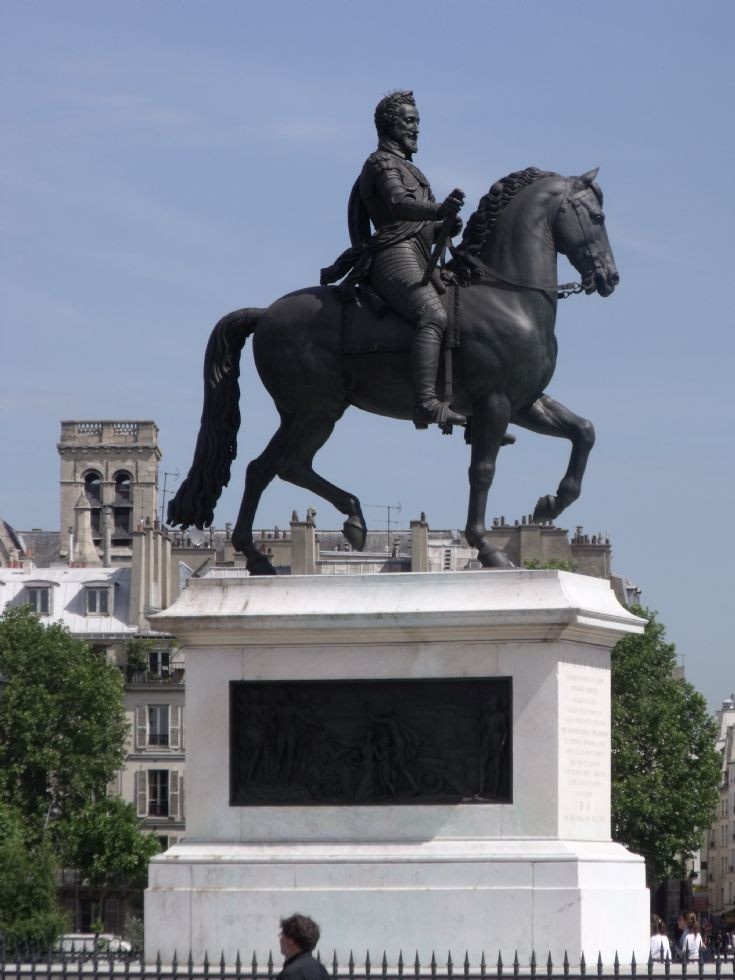
Statues have been much in the news, lately.  Not the one pictured above, but others.  The one pictured above is of Henry IV of France.  Not very popular among his people while he lived, he was honored after his death for his achievements.  His statue as well as those of other kings was torn down during the French Revolution.  It was rebuilt, however, in 1818, and continues to stand where it stands now, as pictured.

I've never been much inspired by statues, or even interested in them, except as works of art or as historical artifacts.  I mean by "historical artifacts" in the case of statues those which tell us something about a period of history.  Those are generally ancient, and sometimes religious.

The statues in the news these days, which people are inclined to remove or destroy, and which other people wish to preserve and keep in situ, are statues which are of Confederate generals or heroes. Like statues of Union generals and heroes, they themselves tell us nothing significant about history.  Neither are they works of art.  They depict people who lived, who are considered significant figures of history by those that erect them.  They're generally meant to honor those they depict.

Those like our increasingly tiresome president who consider them part of our history are mistaken, I think, unless they mean to say that they've been in place for some time, which is so trivial a statement I assume that it isn't intended.  When we speak of the history of the United States, I don't think we refer to statues.

For good or ill, I tend to ignore such statues.  I know they're there when I encounter them, I may know without encountering them that they stand in certain places.  I'm not interested in them.  They may be taken down for all I care, or they may remain for all I care.  They don't inspire any kind of emotion in me, or at least have not in the past.

For my part, I think there's nothing admirable about the Confederacy.  So, I find it hard to understand why such statues exist.  Those who are depicted by them may have been skillful military commanders; they may have been brave.  But, they used that skill and courage in the service of a rebellion against their country, and in the service of a regime which had as its purpose the preservation of a horrible, contemptible, institution. 

I therefore am not in the least concerned by their removal.  And I think it unreasonable to claim, as some apparently do, that it's important that they remain.  To the extent they have any significance, they are significant only as symbolic of a pro-slavery rebellion against lawful authority.  Those who think that should be honored are unworthy.  Those who think it should not be honored are right.

It interesting to note, though, that these statues may come to have historical significance depending on what happens now that there's an outcry against them.  If they're torn down or removed, it may reflect a change in our perception of our history, which will in itself be historic.  On the other hand, it they're permitted to stand or their removal is prohibited, it may reflect a perpetuation of what has been--in my case--indifference and what has been in other cases an admiration of, and perhaps nostalgia for, a hateful institution or a fundamentally racist ideology.

Does the history of the statue of Henry IV suggest, however, that statues will be erected, removed, and re-erected as times and people change?  Does our idea of what is or is not honorable or admirable change over time?  It certainly has in the past.  In this case, it should not.

Monday, March 20, 2017

History and Anachronism


Behold, above, "a chronological misplacing of persons, events, objects, or customs in regard to each other"; in other words (or more properly word) an anachronism.  In the case of this altered photograph Abraham Lincoln appears to be holding a boom box.  The image is amusing, as such things can be, because we all know that Lincoln could hold no such thing.  The thought of him carrying one blaring around the White House is funny, though, or at least is to me.
 
History, according to Napoleon, is a fable agreed upon.  I've read that he made other comments about it as well that were not quite as dismissive.  For example: "History is the version of past events that people have decided to agree upon."  "Past events" sounds somewhat more respectable than "a fable."  Another quote attributed to him is this one:  "Skepticism is a virtue in history as well as philosophy."
 
Skepticism certainly can be appropriate in history, I think, provided it is a healthy skepticism.    Doubt is appropriate when there is reason to doubt.  It happens that with respect to past events, particularly events long past, we can have reason to doubt, sometimes many reasons.  The extent to which we have reason to doubt depends on the circumstances, the sources available--the evidence.  That at least seems to me a sensible way to approach history.
 
I've noted before in some past post that it seems these days that authors of works of history take the time in lengthy "Forwards" to apologize for what they've done.  They acknowledge that they've dared to write about, and perhaps even draw conclusions regarding, another time, another place, people who lived then and events which seemingly transpired.  This, they confess, is not really possible, because we can't "really" know what happened nor can we "really" opine about it because we weren't there, we live in a different society/culture, etc., nearly ad infinitum.
 
I'm not as inclined as others are to maintain that we can't make reasonable inferences about other people, places, times and events.  But I think it's fair to say that those who make claims regarding history--people who lived, events which took place--have a responsibility to be as certain as possible, given the evidence, that what they claim is correct, or appropriately qualified.
 
Anachronism may be employed deliberately in order to be amusing, or by artists, composers and authors, creatively in pursuit of some entertaining or artistic purpose.  The most prominent current example I can think of is the musical Hamilton, which (I haven't seen it) apparently depicts the Founding Fathers of our Glorious Republic rapping, and uses in some cases black actors to play historical figures we know to have been white.  Of course nobody (yet?) believes that George Washington, for example, was black, and incongruous as it is to watch him rap it would also be incongruous to watch him sing at all.  But this use of anachronism in itself does no disservice  because it's safe to assume that it will be recognized as such; nobody will think that Washington and it seems all the Founding Fathers were rappers, or that the slave-owner Washington was himself black.  Anachronism can be harmful, though, when it is confused with history or purports to be historical.
 
Unfortunately, we see this now and then.  Oliver Stone's movie JFK comes to mind.  Stone may have been trying to make some point regarding the implications of sealing records, but in doing so he actively depicted as true conspiracy theories which have no significant basis.  Regrettably, people believe such theories and films and other works of art can demean history, reasonable efforts at relating history in a responsible manner, and contribute to the perversion of history.
 
We seem to be especially vulnerable to the misuse of history and even the description of current events now that everyone can purport to be not only a historian but a journalist, even an expert, simply by being able to type and download or upload information on  a computer.  If we take liberties with history, we change our perception of the past, which is to say that we don't know it and so can't learn from it.  
 
As George Orwell wrote:  "Who controls the past controls the future.  Who controls the present controls the past."  We live in a time where the ability to shape perception of the present and the past is omnipresent, and where there is a widespread belief in the malleability and of facts and their significance; not just absolute, objective facts, but even of the reasonably probable.  The more we treat history carelessly, the more we'll be careless in the here and now.


Thursday, October 20, 2016

A Heritage of Torment

It's difficult to believe this blog has been around for so long a period, but six years ago I wrote a post regarding the decision made by the people of Catalonia in Parliament to ban the practice of bullfighting.  Proponents of the practice evidently reacted by petitioning the courts of Spain for relief, and now something called the Constitutional Court of Spain has determined that the ban is illegal.  From what I read, the basis for its ruling is that bullfighting is a part of Spanish heritage, and therefore can only be banned by Spain's central government, not a regional government.

It apparently took the court six years to decide that bullfighting is a part of Spain's common cultural heritage.  Regardless, it seems that under Spanish law, the central government alone has jurisdiction over this heritage, and so the regional government exceeded its authority by implementing the ban.

I can't help but wonder what this common cultural heritage may be and how and why the central government of Spain may alter it, if indeed it can.  "Heritage" by definition involves the history of a nation, and presumably no government of any kind can modify the past.  It could certainly modify how the past is perceived or understood, but banning bullfighting not only does nothing at all that impacts bullfights held before the ban; it likewise doesn't require that bullfighting which has taken place be thought of at all let alone in any particular way.

Presumably, the court hasn't ruled that only Spain's central government has the authority to do what can't be done, however.  It must be inferred that the court has, instead, determined that only the central government may ban something which has happened in the past from taking place now or in the future, provided it is a part of Spain's common cultural heritage.

Spain being no better generally than most other nations, its common cultural heritage may be said to include some less than admirable things, e.g. fascism, civil war, slavery, the Spanish Inquisition (which nobody expects) and, some would even say, genocide in the Americas.  Is it therefore the case that only its central government may prohibit such things?  Probably not.

So, it must be the case that only certain historical practices which took place in the Spanish nation constitute a part of its common cultural heritage, and so are inviolate unless and until its central government decides otherwise.  Bullfighting is one of them, it seems.

I think it's entirely fair to say that bullfighting consists of the highly stylized (even ritualized) process by which a bull is slowly tortured and killed by men on horseback and on foot through the use of sharpened metal weapons.  To some of us, it has special significance due to the fact that those torturing the bull, and particularly one of them, place themselves at some risk of being killed or seriously wounded by the animal being tortured.  The experience of observing the spectacle is said to be enhanced if the torture is engaged in a particular way, e.g. by controlling the animal's movements by the use of some cloth in a certain fashion, or striking the animal in a particular pose.

Assuming this is part of Spain's common cultural heritage (and setting aside the fact that if it is, it's not something some of us would take pride in), there remains the question why a particular part of Spain may not decide to prohibit bullfighting.  This question seem especially appropriate given the fact the court decided that Catalonia may "regulate the development of bullfighting" and "establish requirements for the special care and attention of fighting bulls."

What exactly are the powers to regulate the development of bullfighting and establish requirements for the special care and attention of fighting bulls?  If they're extensive enough, Catalonia can likely ban bullfighting for all practical purposes.  It could, for example, adopt a law that bulls may be fought, but only without the use of weapons of any kind.  Matadors may punch the bull, or attempt to wrestle it, but can't stick it with a sword.  Perhaps picadors would have to ride their horses sitting on them backwards, or could not ride horses, but instead could only ride other men.  Possibly, a very large tax on bullfighting may be imposed (not as satisfying an option, but far less silly).

Catalonia may explore these option and others, I would think.  Also, if the animus against this practice is particularly strong in any case, they could simply ignore it, and the practice die out for lack of interest and money.

The problem, of course, is that in the interim animals will continue to be tormented and killed as part of a grisly display for the delight of those humans who find such things enjoyable, and those who adopted the ban or supported it will be outraged.  It may be possible to continue to impose the ban regardless of the court's ruling, and force those who want to kill bulls or see them killed to have recourse to whatever remedies the law provides.  And this may be effective itself.

It may be the court's ruling is motivated at least in part by the perception the ban is an effort at Catalan independence.  It may be, in other words, that the court's ruling is purely political, and that it's felt the ban must be found legally invalid in order to avoid seeming to admit such independence.  If that's the case, there may little effort to enforce the ruling for fear of provoking a reaction.

Regardless, though, I wonder whether the Spanish people are well served by a court ruling that bullfighting is part of their common cultural heritage.  A heritage of gaudy, gruesome torment of animals wouldn't seem something to be proud of.

Thursday, May 12, 2016

Apologetic History

I've noted what I think is a disturbing trend, or tendency, in modern works of history I've been reading lately (mostly regarding ancient Rome, with which I'm fascinated).  Each book I read sports a preface or introduction of on average some twenty pages in length, in which the author in tedious detail explains and justifies the approach he/she takes towards history in general and the subject of the book in particular.  This requires that many other authors, presumably of some note, be referenced and quoted.  In addition, the regrettable excesses of past historians are described.  The grave difficulties involved in analyzing ancient cultures and peoples is detailed.  A painstaking explanation of the approach adopted and support for the approach is provided.  Finally, the nearly impossible task engaged in by the author is acknowledged but nonetheless accepted in the hope of providing some insight.

I find myself longing for historical works which are not so studiedly timid and defensive.  I suppose such apologetics are deemed necessary in academic circles to circumvent criticism, and it may be that these exercises are intended only for that purpose.  Perhaps such introductory excursions are history professors writing exclusively for other, rival, history professors.

However, I suspect that they are also indicative of a realization on the part of historians that their efforts will always be considered unworthy in some sense by non-historian colleagues and intellectuals.  It's possible that the efforts of postmodernists to render dubious all efforts at obtaining or purporting to obtain anything resembling knowledge, even such knowledge as is not absolute and contingent, has had this effect--that any work which might be even thought accurate or valid must be accompanied by a kind of penance.  The creator of such a work must be seen to don a hair shirt and beat his or her breast while reciting caveats and qualifications, or at least with many a wink and nod demonstrate that he or she knows that the work cannot be "true" in any sense.

Regardless of their source or cause, these extended attempts to explain and justify are dreary and uninspired.  In fact, they discourage anyone, or at least me, from reading any further.

I personally don't read works of history believing them to be absolutely true accounts of past events, peoples, societies or cultures, and am uncertain even absent a prolonged apology that the authors of such work purport them to be such accounts.  I think it is nonetheless possible to identify and relate certain information regarding what has taken place, and to indicate what if any evidence there may be that they have taken place.  That's all I require of a history; that should, I think, be all that anyone requires.  That's indeed all that can be done. 

It strikes me as counterproductive and even poisonous to so vilify any effort at studying or analyzing the past as to make it appear that it's unworthy of consideration or in effect a waste of time to read; a mere expression of opinion necessarily tainted by all sorts of socio-cultural conditions which make it suspect.   I think that's what takes place, though, as part of the diminishment of all human endeavor which it seems is the particular object of our current intellectual class.  Perhaps it isn't all human endeavor that is mere pretense, though--only those endeavors engaged in by others, particularly those which have taken place in the unknowable past.

I wonder sometimes whether postmodernism is in its own way as insistent that humanity is as fallible and corrupt as the Catholic Church has been in the past, for different reasons.  But that should be the topic of another post.