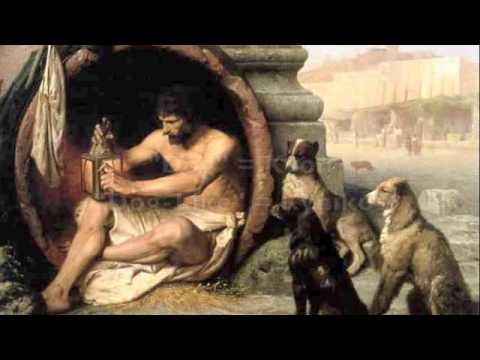
Showing posts with label Diogenes. Show all posts

Wednesday, April 6, 2022

Homage to Saint Simeon


The Saint that is the subject of this post, and homage, is that Simeon who is described as a "holy fool."  I don't give homage to that Simeon who is known for the length of time he lived on a small platform atop a pillar, though it must be admitted that this is a remarkably stupid thing to do.  Homage is inappropriate in the case of that Simeon.  Homage is, I believe, due the Simeon who apparently lived in the 6th century C.E. or A.D. and was considered, justly it appears, to be mad.

That particular St. Simeon famously dragged the corpse of a dog behind him in his travels.  He would blow out candles in churches.  He was also known to throw nuts at the clergy during masses, and also at women.  I'm uncertain why he threw nuts at both.  If there is a connection between them, and them and nuts, it escapes me.  He was known to skip and dance his way around the arena during public performances or games.  On feast days calling for fasting he would eat huge amounts of food, particularly beans, and then proudly indulge the effects of eating that "magical fruit."

He is shown in the picture above, apparently doing a kind of summersault for the delight of those waiting along his path.  The dog appearing with him is presumably dead.  He's known as the patron saint of puppeteers, and pictures of him sometimes show him brandishing a puppet of some kind--probably an angel.

In the peculiar logic of religious belief, his bizarre behavior is claimed as evidence of his saintliness.  Sometimes, it's maintained that he acted like a lunatic in order to demonstrate that life on earth was a farce, and only the Kingdom of God important.  Perhaps he is meant to be a kind of Christian version of Diogenes.  After all, according to Plato, Diogenes was Socrates gone made.

But I confess that I suspect he was mentally ill.  I also confess that it delights me that such a person was made a Saint.  A crazy Saint is worthy of reverence.  I must see if there is a St. Simeon the Holy Fool medal.  I'd gladly wear it.

And, although it seems this Simeon isn't the patron Saint of fools, it's appropriate that there be one, particularly given the prevalence of fools here in our Great Republic and elsewhere.  Those who believe in such things as a worldwide conspiracy of powerful pedophiles should have someone they may ask to intervene with God on their behalf, and who better than the nut-throwing St. Simeon?  Though it seems they've lost their minds, they wouldn't pray to St. Anthony being uninterested in finding them.


Sunday, July 21, 2019

Acropolis Now


Above is a picture I took of Athens, on a full moon night last month.  You can see the Acropolis in the distance.  You can see moonlight on the sea.  I'm rather fond of the picture, taken with a cell phone in the early morning.

I've been away from the blog for some time.  I've lacked the energy, perhaps, but also the interest.  It's difficult to be interested in these times, though they're no doubt interesting to some, and will be interesting to historians of the future.  I nearly wrote "if there is a future."

I'm being over dramatic, of course.  There will be a future.  We go on and on, and are none the better for it if I am any judge. There is something remarkable about us.  We don't change but we survive.  We don't adapt, we don't learn, we simply still are here, and will be here until our unchanging nature exhausts the world.

I've now been to many places.  I've walked where Cicero, Cato, Augustus and Caesar walked when I visited the Roman Forum.  More recently, I walked where Socrates, Plato, Aristotle, Diogenes and Zeno walked when I visited the Agora of Athens. It's unfortunate to live in this time, when there are no people comparable to those who went before.  Is anyone now living who can be described as great, or noble, or heroic?  Is there anyone who will be worth remembering or studying when this time is past?

If the Pythia was still sitting on her tripod at Delphi, which I was also fortunate enough to visit, perhaps she could answer such questions.  I suspect she could and even would, but in no clear manner, as it seems was her practice in ancient times.  She could also be quiet droll, as Croesus learned.  Any answer would do, comforting or not.  Delphi's magic is long gone but we still strive to learn the future in ways not all that different from consulting oracles.

In this disturbing, dull and shabby age, it's particularly pleasurable, to me at least, to see the ruins of the ancient world.  As unremarkable as we are, the achievements of the ancients were remarkable.  I cannot imagine how the Parthenon and the other structures were built on the Rock, as it was called by one of our guides.  Nor can I imagine how the great temples were built in the mountains at Delphi, or how it was that so many traveled so far and so slowly to reach the oracle.  Were they actually better than we are now, in many ways?  Perhaps we do change then....for the worst.

Moralists and the religious enjoy declaring that we become decadent over time.  I don't think we're more decadent than those who lived in the past, though.  I think that we're merely more stupid than they were.  How else explain how a prosperous people and nation have come to be ignorant, bigoted,  petty and cruel?  A certain degree of dullness is required.  The bovine are self-satisfied, fearful of change, content with what is, resentful of what is not, is different.

Well, let's carry on.  Stoicism is not a philosophy of the status quo, as some have said.  It is a philosophy, instead, which grants us a measure of peace and serenity when the status quo is deplorable.


Sunday, April 14, 2019

Diogenes the Dog


As the seemingly endless season of farce we call the presidential election begins, I think of Diogenes the Cynic.  I suppose I also think of Aristophanes, as he wrote farces aplenty and so would recognize one when he sees it, though he might, for a moment, be puzzled at the numbing length of this one in particular.  But Diogenes comes to mind primarily simply because he knew what a farce human life was then and mocked it incessantly, mocking even that high priest of the farce, Plato.

They say Diogenes walked about Athens with a lantern, looking for an honest man.  I've also read that he said he was looking for a human.  If that's so, I think he knew what Plato and others thought we were--truly homo sapiens, or that we could and should be wise--and set about looking for what such people thought we were in their foolishness, and of course found no such thing.

A farce our lives were, certainly, but just as certainly still are if we are what we seem to be; the same creatures we were in the time of Diogenes and no doubt were even before then.  It's hard to defend us and if we were put on trial I doubt we could find a lawyer willing to appear at our side...unless his/her doubtlessly high fee was prepaid, always a wise precaution when presented with a losing case.  We haven't changed.

We remain as greedy, superstitious, stupid, gullible, fearful and hateful as we ever were, as we always have been I suspect.  We may not sacrifice to the gods as we did, we may not worship the bones of saints as much, we may not en masse rely on chants and various plants to live healthy lives to the extent we have, we may not ignore the consequences of our actions quite as much as we did once upon a time, but we do it still to a significant degree, and there's no reason to think we'll stop until we've either eliminated ourselves or reduced ourselves to the point where we may start the same process all over again on an Earth less threatened by us than it is now.

There are many stories about Diogenes.  It's said he lived in a barrel, masturbated openly, ridiculed Plato and other worthies, flaunted conventions of all kinds, remarked that in the home of a rich man there's no place to spit but in his face.  Looking about him today he would still see no humans using even the most powerful flashlight available, let alone an honest man.  He would see the same he saw each day of his life and know now if he did not know then that we're unchangeable, and merely better equipped now than we were then to sate ourselves or wreck havoc depending on our moods and means.

The Earth is still no place for the man who called himself a citizen of the world.  In fact, especially here in this country, we are less and less inclined to think of ourselves as similar to any other people or as united in interest with them; certainly not equal to them, but altogether better than others, unique, the favored of God.  Just as the ancient Greeks believed they were, but sadly we're unable to produce men like Diogenes as they did.


Monday, June 27, 2016

About Cato the Younger

Marcus Porcius Cato, called the Younger to distinguish him from his grandfather, Marcus Porcius Cato the Elder, is not an easy man to like, a grim and dour personality, but has been one that is admired.  That was the case while he was alive and has remained true through the centuries since his death. 

It seems that he is more fortunate in his reputation than his censorious grandfather who, although he had a distinguished military career and also one as a senator and consul, is remembered primarily for a treatise he wrote on agriculture and for declaiming, after every speech he made in the Senate, that "Carthage must be destroyed."  It was destroyed eventually, in part due to his relentless urging.  Grandpa Cato wasn't a likeable fellow either, but was revered by his grandson as a representative of old Roman virtues, unlike the foppish patron of Greeks, Scipio Africanus, who was one of the targets of Grandpa's vindictive style of conservatism.

Cato the Younger was noted for his adherence to Stoic philosophy, and so it's difficult for an aspiring Stoic to be critical of him.  I'm critical of him nonetheless, but not entirely so.  Even his ally against Caesar, Cicero, was critical of him at times, for good reason.   Though Cicero admired the Stoics, he wasn't above ridiculing them and Cato for their extremes--at least as part of a case, in the course of advocacy.  Cicero was a lawyer, after all.

Cicero also was critical of him for his obstinacy and refusal to compromise.  But Cicero admired him as have many others for his refusal to submit to Caesar's rule of the Roman Republic, soon to be the Roman Empire.  When Caesar portrayed Cato as a drunk in his triumph after his victory over Pompey and the optimates, Cicero responded with a kind of panegyric in his praise.  Caesar found it necessary to reply to it; Caesar was never able to forgive Cato as he forgave many others, even after Cato's suicide to avoid submission--perhaps even because of it.

Cato is admired as a hero in the ongoing battle against tyranny.  He was admired as such by the Founding Fathers of our Republic, all of whom looked to Rome in its creation.

Cato's commitment to freedom, however, is more accurately seen as a commitment to custom and Roman traditional virtues and institutions (the mos maiorum).  Individual rights and freedoms were not a concern to Roman government or society generally.  Romans, at least traditional Romans, served the state, not themselves.  Romans were not libertarians; Cato certainly wasn't one.  Cato wanted Rome to be ruled as it had been; by an oligarchy making up the Senate, with some powers held by the plebs and their tribunes as created over time.  Rule by one man or a few by virtue of their control of the legions and catering to the people is what Cato fought against.

I have no reason to doubt Cato's commitment to Stoicism, but it strikes me that his very ostentatious displays (walking barefoot, wearing a simple coarse tunic), railing against clothing and conduct which was not similarly rustic and simple, isn't Stoic.  It's posturing and prideful.  No doubt it had a political purpose and was a kind of propaganda.  But it reflects a concern with what should be indifferent, with appearances--with impressing others.   Living simply, foregoing luxury is appropriate, but vocally condemning those who do otherwise doesn't seem to me to be something advocated by the Stoics.  Perhaps Cato, in this, was more Cynic than Stoic.  Diogenes enjoyed flaunting his simplicity, much to the annoyance of Plato.  But nobody doubted the honesty and integrity of Cato, not even his enemies.

I think what can be doubted was his wisdom--his practical wisdom, in any case.  There is an argument that his refusal to compromise in any respect played a part in ending the Republic and creating the principate.  And certain warnings are self-fulfilling.  Political and military chaos creates opportunities for the ambitious, and Cato contributed to the chaos, and perhaps even invited it.

Those interested in Cato may want to read Rome's Last Citizen:  The Life and Legacy of Cato, Mortal Enemy of Caesar, an interesting book written by Rob Goodman and Jimmy Soni, which I plug here despite their annoying use of diminutives in their names.

Thursday, August 14, 2014

A Citizen of the World

The claim that one is a citizen of the world has been attributed to both Socrates and Diogenes.  If Socrates made the claim, he did so before Diogenes who as a Cynic was a follower of Socrates as were the Stoics.  It was the man Socrates, though, they followed and not the creation of Plato--the character appearing in Plato's dialogues.  It's said that Socrates was concerned primarily with philosophy as a guide to how to live, and eschewed epistemology and metaphysics which, alas, meant a great deal to Plato.

The idea of being a citizen of the world instead of a citizen of a city-state evidently horrified many at that time.  It seemed to denigrate the city of one's birth, the significance of one's county.  This was deemed unpatriotic then and is still thought to be now, particularly it seems in our Great Union.  For the Stoics, however, being a citizen of the world, the cosmos (thus cosmopolitan), was something of great worth and followed from the desirability of being virtuous.  It emphasized the common nature of man and fostered the ideal of a brotherhood of man encompassing the world; ideally a world which functioned according to natural law.

Those who believe in American exceptionalism sometimes think it appropriate to proclaim this fact in a rather prideful manner.  We are proud to be Americans and feel ourselves in some sense better than those who are not.  But pride, for me, when we apply it to ourselves, is something which we're entitled to feel when we, personally, have achieved something.  We who are born Americans did not achieve that status properly speaking and what our country does isn't necessarily our personal achievement.  It would seem more appropriate to be grateful we're Americans in that case, and this in turn would seem to make it less likely that we would indulge in the chest-pounding we like to engage in when patriotism is invoked.  But instead we boast of our country rather as we do our favorite team in sports, which diminishes our country and I think ourselves.

But we are not alone in our pride and our belief in our superiority and exclusivity.  In fact, the world seems more tribal now than it has in the past; indeed, it seems violently tribal.  Religious extremism, racism, ancient grudges perceived or actual, political disagreements, nationalism, all seem create divisions among us.  Curiously, the fact that the world is for other purposes "smaller" than ever before due to technological advances hasn't mitigated these divisions.  It seems to enhance them in certain senses, in fact.  We live in a time where we can learn most anything we want about what is transpiring throughout the world in real time, and the opinions of others are readily available if we care to discover them.  Perhaps we are intimidated by this rather than enlightened. 

The wisdom of the Stoics and others is in any case disregarded.  It may be this is due to the fact that we resort to the most comforting, simple beliefs when confused or uncertain, even if those beliefs sanction barbarity.  Anything to avoid thinking.  It may be we're fundamentally irrational creatures regardless of our knowledge and sophistication.  It may be we wait for a god to save us like the unfortunate Heidegger (the Fuhrer having failed him), and in the interim are willing to do anything that will assuage us.

I'm more inclined to believe that selfish concerns, the pressure of cultural and religious beliefs long ingrained in us and an unceasing desire to master or possess things which are not in our control are at fault, but must confess that I despair of this ever changing unless we take the time to train ourselves and others to think rationally and understand the insignificance of the things which dominate our conduct and desires.  This training, though, may be something which can't be imposed on others in any useful manner.  It would seem to be worth a try, though, as nothing else has worked in the past.

One sees why education has been considered so important to certain philosophers.  How to think is something which should be taught as early as possible, but parents fear this and may not tolerate it as part of their children's education.  This is because they're inclined to want their children to think and act as they do, and fear that their children won't be taught to think as their parents do, which would likely be true.

This has been recognized, and since Plato those who think they know what is best for all have dreamed of education as a process by which those being educated are dragged to the truth as it were, screaming and kicking if necessary.  It's why totalitarian, fascists and other authoritarian governments insist so often that children be taken from their parents to be trained in the Right Way.

We're in trouble I fear, and the question is how and whether we'll work to get out of it.  I doubt if circling the wagons is the way to go, but am having problems coming up with workable solutions.