Showing posts with label Religion. Show all posts

Friday, July 31, 2026

Religion and Poison


I


I'm reading Christopher Hitchen's God is not Great: How Religion Poisons Everything.  As I expected, it's full of examples of the poisonous effects of religion, which is to say those of the Abrahamic religions, primarily. 

Thus far, at least, those religions with more than one god haven't been subject to much in the way of ridicule or used as examples of nonsense, except those of the mesoamerican civilizations whose gods were quite literally bloodthirsty.  Nor have those involving a deity which isn't a personal deity, intervening in nature, granting favors, requiring exclusive worship and pretending to absolute knowledge.  The deists of our history are treated with a certain respect, or at least as harmless.

So I think there may be limits to the criticism of religion he makes, but even then he notes the ways in which religion manages to thwart free inquiry and critical and scientific thought merely by insisting that we be ignorant and accept certain doctrines as true even if we refrain from compelling others to adopt them.  This devotion to maxims adopted unthinkingly and never questioned is itself harmful.

To his credit, he refuses to join one of his fellow atheists (Dennet I think) in referring to those who don't believe on God as "brights." There's ridicule and mockery, as well as anger, but not condescension.

It's difficult to contest his claims given his many examples of often idiotic and malicious conduct on the part of the faithful. I confess I wonder what he would, or would have, thought of the religious characteristics of Stoicism. I suspect he'd have thought it based on a hypothesis for which there is no need, to paraphrase Laplace in responding to Napoleon.  But its conception of God as immanent in Nature rather than apart from it avoids the problems associated with a creator God, and its emphasis on treating things beyond our control as indifferent makes it less liable to the urge to impose itself on others.  You don't forcibly convert others to Stoicism or persecute thise who aren't Stoics.

Which brings us to the question which it seems concerns believers in their argument with atheists most of all.  That is--if there is no God, how do we determine what's right and what's wrong?

One might reply that many of  those who purport to believe in God seem incapable of distinguishing right from wrong, or if they can don't care which is which and are fully able and willing to do wrong, to be evil rather than good.  Or one might mention the Euthypro dilemma.

In that dialogue the question addressed was whether what is good is good because God commands it, or good regardless of whether God commands it.

Clearly, if what is good isn't determined by God, then God isn't required to determine what is right or wrong.  In Stoicism what is good is what is according to nature. It isn't a matter of command by God or anyone.

Perhaps part of the poison of religion or which is caused by it is our dependence on it.  If we require a command to do what is right we needn't bother with thinking.  Nor need we take responsibility. We need only follow orders.

Saturday, March 21, 2026

A Convenient God


Humanity and God.  God of love, God of peace, God of war.  We take our pick.

Is there some causal relation, or perhaps a correlation, between substance abuse and religious belief of the showy "Praise God!" and "pray with me!" and salvation- show variety?  I think so.  Those who think themselves saved indulge in a kind of exhibitionism; they enjoy being noticed and watched; even admired, as someone God saved.  They also seem determined to see to it that others are similarly saved or at least pretend to be saved, and are certainly TOLD they should do as the saved do.

Humanity's God, though so often described as loving and merciful, is also often a God of war.  The God described in what's called the Old Testament, for example, exuberantly urges his chosen people to kill the men, women, children and even domesticated animals of those various peoples occupying the Promised Land before them.  He himself obliterates the sinful very dramatically, and in one famous instance even kills nearly the entirety of the human race.

In fairness, it should be noted that other ancient nations or at least their leaders delighted in describing the destruction they caused in war against their enemies and their domestic animals (killing the livestock of enemies seems to have been important then, judging from the frequency with which it's noted).  I've mentioned the lavish detailing of their wars by the Assyrian kings in this blog before.

It's not as easy to find support for or approval of war in what's called the New Testament as it is in the Old Testament, but no matter.  Christians have waged war since Christianity began.  In fact, they've waged war against each other far more than they've waged it against non-Christians.

We've been engaged in war throughout our history.  It's something we do.  We can't claim that we're less warlike than we were in the past.  There always seems to be some war going on somewhere, as there is now.

So, naturally enough, and quite conveniently, our God is almost always a God of war.  Sometimes, God is considered the reason why wars take place.  Wars have many causes, but religion is so often one of them if not the primary cause of them, and God so frequently evoked by wars' participants (though the God of the warring parties may differ) that it may fairly be said humanity's God is a God of war, when we want God to be a God of war.

And that's what we have wanted, and some want now.  

The claim is regularly made that belief in God is needed for us to be moral; indeed for morality to exist.  If that's the case, though, it appears that causing death and destruction through war is moral, i.e. that we should wage war. It's difficult to think of any war in which religion wasn't involved or in which God wasn't invoked by those at war as justifying it or as favoring the victory of one side or another.


Friday, October 17, 2025

Between You And God Only


The philosopher Ludwig Wittgenstein made several pithy statements I admire.  One of them is: "Make sure that your religion is a matter between you and God only."

That's as it should be, I think.  I'm not an atheist.  I don't find the fact that someone believes in God in itself distressing, offensive or incredible.  I don't accept any of the arguments which have been made over the years claimed to prove God's existence.  Neither do I rush to contest them.

But I wish, oh how I wish, that those who are religious would would make their religion a matter between them and God only.  

I don't mean to say that believers should not worship together.  It's not something that appeals to me, however. Reverence for the divine is something I can express without the presence or assistance of others.  I don't think the God I revere demands that worship be a group affair, or that it's required. I find the thought that God needs or wants anything from us incredible. Similarly, I think it demeaning to us and God to believe that God will grant our wishes if we ask for them in an appropriate manner.  Nor can I accept a God who demands that adults have sex only in certain ways. To paraphrase an author whose name I can't recall, such a God seems to me to be too small.

What I find disturbing is when believers try to foist their beliefs on others.  They have a long history doing so, of course, if they are the kind of believers who believe that their beliefs are the only true beliefs and their God the only true God, and all others should believe as they believe.

In doing so, they've caused a vast number of people to be killed in various ways, or savagely oppressed, or forcibly converted, for thousands of years.  Intolerance is a necessary feature of such religions.  One is fortunate if the members of such religions content themselves with merely trying to persuade nonbelievers and, if they fail to do so, think them damned for all eternity.

It would seem a simple thing to make your religion a matter between yourself and God only, but it's clear that too many believers are inclined to proclaim their faith publicly even if they refrain from demanding that others do so as well.  Do they think this will impress God?  Do they hope to impress us with their piety?  Do they think this religious exhibitionism persuades anyone, or is it for their own satisfaction?


Monday, February 3, 2025

Augustine vs. The Stoics


Let's try to ignore for a time the ugly and lunatic caperings of our politicians, including those of the elderly bully at the head of our government's Executive Branch.  [Is there anything more pathetic than an elderly bully?]  Instead let's consider some of the attacks made by the querulous Bishop of Hippo against the ancient Stoic philosophers.

Augustine, considered by some a saint, is a very significant figure, but I maintain was a very peculiar person.  I've noted several times in this blog that I think he was a kind of exhibitionist, flaunting his sins supposedly for our benefit, to demonstrate that even so great a sinner may be saved by Jesus.  Thus his life serves to demonstrate how desirable it is to be a Christian.  On the other hand, it's possible his conceit was that he was so great a man, so worthy of God's blessing, that he was saved even though he sinned so extensively.  In any case, this belief that Christianity provides salvation is the basis for for his claim it's superior to Stoicism, or at least that one of his arguments against Stoicism on which I'd like to focus.

Of course, the long-standing argument that the Stoic Sage held out by the Stoics as their ideal cannot exist is employed by Augustine.  He and others maintain that no human being could be as serene, detached, and so in control of human emotions as the Sage.  But it isn't clear that the Stoics thought the Sage to be anything but an unapproachable ideal we should seek to imitate.  If so, the fact that the Stoics used the Sage as a standard of thought and conduct should no more condemn Stoicism than Christianity should be condemned because  Christians are urged to imitate Christ, as suggested by Thomas a Kempis.  No Christian could be as good as Jesus, obviously, but it doesn't follow Christians shouldn't try to be like him to the extent possible.

Augustine also, however, thought the Stoics were prideful; guilty of Pride, one of the seven deadly sins.  That's because the Stoics dared to believe it was possible for humans to achieve happiness without the assistance and intervention of a personal god.  Without grace, in other words.

The Bishop of Hippo essentially created the cruel concept of Original Sin.  He proclaimed if he did not originate the pernicious belief that humans were tainted by the sin committed by Adam and Eve when they were persuaded to eat of the Tree of Knowledge despite the fact that God had told them not to do so.  For that sin, they were cast out of the Garden of Eden and condemned to die, to labor, to bear children, but to not merely do what human beings do to survive and thrive.  All human beings thereafter were sinful by nature.  They sinned merely be existing.  They need not do anything wrong.

Because we're naughty by nature, as it were, only God could absolve us of Original Sin and any subsequent sins, and did so through the sacrifice of Jesus as to the First Sin and by bestowing grace as to all others.

As Augustine rather proudly stated in his Confessions, because he was a great sinner he could not be happy, could not be wise, until Jesus saved him.  Not even the great Augustine could achieve what the Stoics said was achievable without divine assistance.  If Augustine required divine assistance, all others must require it as well.   So, the Stoics must be sinfully prideful for even making that claim.

Just as the doctrine of absolution serves to encourage sin or assuage our concerns when we act wrongfully, as I suggested in a prior post, so the doctrines of Original Sin and Grace serves to discourage our efforts to control our own conduct and achieve happiness or equanimity through the use of our reason and development of our character.  Each doctrine in essence renders us helpless to help ourselves, and yet promises that we will flourish and be saved if only we don't try to help ourselves but rely on God to do so on our request for forgiveness or assistance.  

Perhaps belief in a personal god necessarily requires that we take a dim view of the world and our place in it.


Friday, June 21, 2024

Ideology, Morality and the Law


I've been a lawyer for many years.  A practicing lawyer has little time to devote to a review of the status of the law in general, being concerned with its application to certain circumstances.  So, my focus on the law and the legal system has usually been narrow--what law applies to a given matter, what does it say, how is it to the advantage or disadvantage of the client, is the judge experienced with such cases?

In order for the status of the law or legal system in general to rouse the concern of the practicing lawyer, some significant event must take place which "shocks the conscience" of an attorney.  That's a legal phrase used for the most part to refer to something egregious which provokes someone or something, usually a court, to call for or provide a remedy.  

It may be that the technology of our times, which allows for the communication of information and opinions instantly and in a ubiquitous fashion, brings such events to our attention more frequently than in the past, but I think that there are more and more instances of conduct on the part of lawyers and judges that shock the conscience than there have been in the past.

Consider the many lawyers who pursued baseless claims of fraud related to the 2020 election.  Consider the conduct of Justices of the Supreme Court which have been mentioned in this blog, news of which seems to appear on almost a daily basis, which raise questions of ethics and impartiality.  Consider the actions of a novice Federal District Court Judge ignoring the recommendations of senior judges that she should recuse herself from a matter in which the defendant appointed her to the federal bench, and the eagerness with which she delays the trial of the matter to the benefit of the defendant.  

Unfortunately, it's likely that corruption based on financial inducement has always been a feature of the legal system.  The extent of that corruption varies with time and place, but it would be foolish to think it has never been a factor.  It's also likely that the legal system benefits the rich and powerful more than it does others, and has always done so.

But I don't recall ideology (including religious ideology) playing so large and obvious a part in the law while I've been a lawyer, until lately.  There were complaints aplenty by conservatives regarding liberal judges, particularly during the 1960s, but ideology then wasn't broadcast, and indeed flaunted, like it is now. I suspect this is the case because the law is being treated by some of us more and more as enforcing and imposing a religious code of conduct, or at least one which purports to impose moral standards by law.  When that isn't expressly stated to be the motivation behind laws and legal decisions, those political agents perceived to favor particular moral standards are favored by them.

More and more we see reference made by legislators and judges to religion, and most especially the Christian religion.  Most recently, the State of Louisiana, admittedly never known for its tolerance or respect of minorities or their opinions in most instances, required by law that the Ten Commandments be displayed (if not brandished) in every public school room.  As noted elsewhere in this blog, a Supreme Court Justice has said he considers the function of the law to return the nation to godliness.  The Chief Justice of the Alabama Supreme Court justified a 19th century law banning abortion on the fact that the people of that State justly feared the wrath of God.  

H.L. Mencken, the legendary Sage of Baltimore, noted in the quote appearing atop this post that whoever attempts to impose moral conduct on others through the law is most likely a scoundrel.  I think this is true.  Those who claim that the law should be used to impose morality, I would maintain, don't do so because they wish to promote morality, but because they seek to impose rules which favor them, their beliefs, their property, their power, and control the conduct of others who may threaten them--including that of their children.  

History is full of moral hypocrisy; the self-proclaimed holy and self-righteous who are found to violate the code of conduct they claim should apply to humanity in general are common.  But the corrupt won't hesitate to question the morality of those who stand in their way or disagree with them.  

So the statements made by legislators and judges are more and more essentially a shrill condemnation of conduct they oppose on moral grounds, rather than a reasoned consideration of the rules of law and the circumstances, and the civil rights of others.  


Tuesday, June 11, 2024

When Judges are Pharisees


A Pharisee is defined by Google's Dictionary source identified as Oxford Languages as "a member of an ancient Jewish sect distinguished by strict observance of the traditional and written law and commonly held to have pretensions to superior sanctity."  The words "a self-righteous person" and "hypocrite" are also used in the definition.

When thinking of a Pharisee as so defined, I can't help but think of certain judges who at least purport to strictly observe traditional and written law and are sanctimonious.  Certain Justices of the Supreme Court as well, I blush to admit.

Recently. two of the Justices, and the spouse of one of them, made some remarks at a gathering of some kind of something called "the Supreme Court Historical Society" which were surreptitiously recorded by someone "posing as a conservative."  I'm not sure what's involved in posing as a conservative, but in this case it seems making statements against abortion and supportive of (Christian, presumably) religion sufficed for that purpose.  

The statements sufficed, at least, to elicit remarks from the Justice to the effect that the nation should be restored to "godliness" and was doomed to be ruled by the left or the right, no compromise being possible.  The Justice's spouse was more voluble, bemoaning the controversy over flags flown at the Alito properties, which she seems to find incomprehensible if not maliciously intended, and expressing condemnation of the LGBT community and Pride month.  She expressed the hope of flying a flag featuring the Sacred Heart of Jesus, evidently in response to those in the LGBT community or those who support them.

I don't know why anyone would consider the emblem of the Sacred Heart an expression of condemnation of the LGBT community or of anyone, for that matter.  By my understanding, it's used to represent Christ's love and compassion.  It takes a peculiar kind of person to believe it represents intolerance and exclusion.

But Pharisees are peculiar.  At least, the Gospels indicate Christ thought them to be.  The picture at the top of this post shows the Pharisee and the tax collector, who figure in a parable from the Gospel of Luke.  In that parable, the Pharisee thanks God for making him a good man, unlike the tax collector and other mean and sinful folk.  The tax collector confesses his sins to God, and begs for his mercy.  The Pharisee is full of pride and is self-righteous, and is condemned by Christ as a result.

Like Pharisees, there are judges (and others) who believe they know what godliness is, and think themselves uniquely qualified to know what it is and impose it on others.  They ascribe their own limitations of intelligence and character to God.  Their vision is a narrow one, their sympathies are congested; there are no questions that are open to inquiry; all has been answered.  Oddly, such judges abhor judging.  What's to be judged?  It's merely a question of knowing what's already been decided (though not if it was decided anew--what's been decided was decided long ago and cannot be improved upon.

The other Justice was intelligent enough to resist the temptation to be pharisaical, and it may be hoped even that he isn't a Pharisee.  Pharisees, as we see from the parable, like to expound on their own godliness.  Pharisees like some judges and others, are exhibitionists of a sort.  They are shamelessly good.  They're so convinced of their righteousness they think it should be displayed, exposed to all.


Wednesday, February 21, 2024

Oh, He Comes From Alabama With A Bible On His Knee


Once again, I'm unable to resist giving a silly title to a post.

A great deal is being written and said about the recent decision of the Alabama Supreme Court in the case of Burdick-Aysenne et al v. The Center for Reproductive Medicine, et al,  involving frozen human embryos.  This post relates to the opinion in that case, but not in any significant respect to the majority opinion, concurring opinion or that of the dissent.  Far more interesting to me is the "special concurrence" of the Chief Justice of that court.  

It's always fascinating to read court decisions which manage to "grab the headlines" for one reason or another (can we still use that phrase or is it too dated?).  Generally, the decisions themselves are different from the summaries or interpretations of them which appear in the major and social media.  This case was one for wrongful death and for negligence regarding the destruction of certain frozen embryos, or the killing of them as the court puts it.

Alabama law provides a cause of action for wrongful death including the death of children, born and unborn.  The primary legal issue addressed by the court was whether "unborn children" include frozen human embryos for purposes of the wrongful death law of the state.  The majority found that they are included among "unborn children."  And that was, or at least should have been, that.

Where I practice, there is no such thing as a "special concurrence."  For good reasons, I think.  A search reveals that it is an opinion of a member of the court which concurs with the decision of the majority, for entirely different reasons than those relied on by the majority.  Indeed, it need not really relate to the case itself.  It need not address any of the issues raised or addressed by the litigants or the lower courts from which appeal was made.

Simply put, it may be entirely gratuitous.  Normally, appellate judges refrain from addressing issues and arguments never raised in the courts below.  Part of the reason for refraining from doing so is that the parties and the lower courts never had the opportunity to consider and speak to them.  But this concern, it seems, need be of no concern to authors of special concurrences, and clearly was not a concern of the Chief Justice of the Supreme Court of Alabama in this case, who authored an opinion regarding which "gratuitous" may be too mild a description.

An amendment to the Alabama Constitution adopted in 2018 provides that Alabama, as a matter of public policy, supports "the sanctity of unborn life and the rights of unborn children, including the right to life."  This provision is briefly noted in the majority opinion but isn't relied on it to any significant extent.  Notwithstanding that fact, however, the Chief Justice decides to "take this opportunity" to address its meaning and legal effect, with particular focus on the proper interpretation of "the sanctity of unborn life."

There follows a discourse by the Chief Justice 22 pages in length, in which God is referred to 41 times. That's a little less than twice on each page. God isn't referred to except by the Chief Justice.  The other opinions and Justices manage to address the case without invoking God or the fear of God, which as we'll see is called on if not summoned in support of the opinion of the Chief.  He also refers to the Book of Genesis, the Book of Jeremiah, the Book of Exodus, portions of the works of Thomas Aquinas, Augustine, John Calvin and Jonathon Edwards, as well as several commenters on the Bible.  I feel a certain compassion for the Chief Justice's clerk, who may have thought the research and writing involved in that position wouldn't address religious and theological works in such detail.

Rendered to its essence, the special concurrence amounts to an argument, or perhaps more properly a declaration, that the 2018 amendment to the Alabama Constitution must be considered, and followed, as a religious injunction.

This is made apparent from the concurrence's conclusion.  The Chief Justice concludes his opinion with language of a kind I've never seen included in a legal opinion of any court during nearly 45 years of practicing law.  It's so remarkable I must quote it:

"The People of Alabama have declared the public policy of this State to be that unborn human life is sacred. We believe that each human being, from the moment of conception, is made in the image of God, created by Him to reflect His likeness. It is as if the People of Alabama took what was spoken of the prophet Jeremiah and applied it to every unborn person in this state: "Before I formed you in the womb I knew you, Before you were born I sanctified you." Jeremiah 1:5 (NKJV 1982). All three branches of government are subject to a constitutional mandate to treat each unborn human life with reverence. Carving out an exception for the people in this case, small as they were, would be unacceptable to the People of this State, who have required us to treat every human being in accordance with the fear of a holy God who made them in His image."

The language is pontifical; thus the "We believe"--he purports to speak for the people of Alabama, much as a pope may purport to speak for Catholics everywhere in a certain capacity.  More than that, he makes what is essentially a religious claim, and maintains that all three branches of the State of Alabama are required to follow it "in accordance with fear of a holy God..."  Those who disagree with the Chief Justice, it appears, run the risk of being the subject of God's wrath. It seems that there are still those who conflate religion and the law.  History tells us this is dangerous.

I wonder, I must admit, how he defines "likeness."  But I wonder about that generally when it's claimed that God made us in his likeness.  I can't understand how anyone would want God to be like us, or would worship God if he was.

I don't know if special concurrences are accorded any weight in Alabama,  Concurrences generally are not binding precedent.  I hope that this particular one would be considered, at most, persuasive.  If it is the majority decision alone that's precedential, I don't think a theocracy has been established by it.  One may well disagree with the Alabama Supreme Court's decision regarding the unborn, but it arguably follows from the law of that state and avoids the spectacular excesses indulged in by its Chief Justice.  It must be hoped it will continue to do so.


Wednesday, December 6, 2023

The "Me" Century


The late, great and (by me at least) lamented Tom Wolfe wrote a book, or perhaps more properly an essay, called The "Me" Decade and the Third Great Awakening.  The decade he referred to was that of the 1970s.  The "Third Great Awakening" he proclaimed was a jest he was making based on the (first) Great Awakening and the Second Great Awakening, sadly real episodes in American history of Christian revivals led by Protestant Evangelical leaders.  Besides the preaching of hellfire and brimstone, our sinful nature and the need for redemption, the fear of divine retribution and protestations of piety, the Awakenings resulted in the creation of new sects and denominations and social movements and, in the case of the second one, the YMCA, later to be lauded so vigorously by the Village People.

As the quote at the head of this post reveals, Wolfe claimed that in the Third Great Awakening "Me" took the place of Jesus, and we became fervent in the worship our ourselves.  He provided various examples of our religious self-love.  

The argument can be made that we continue to worship ourselves, and in fact that we've always done so.  Since the 1970s, though, our ability to engage in self-worship has increased spectacularly.  Even more importantly, we now each possess the means to serve as our own missionaries, proclaiming our godhood and spreading our good news throughout the world.  We may expect that our technology will allow us to do these things more and more effectively.  

Each of us may transmit our thoughts, and expose our bodies and even souls to the view of all, and many of us do so.  Such is our self-regard that there is no practical limit to what we're willing to do or say, though we know in the back of our minds that all can be seen regardless of the fact that we seem alone in our room.  And it appears we don't care.  We feel neither shame nor concern; we have no responsibility, we're not answerable to anyone or anything when it comes to our opinions or our actions which we incessantly broadcast--or at least that seems to be the case.  There's no one to question our conclusions or rebut our claims unless we allow them to do so, except in the relatively few cases where law enforcement or those interested in shaming have reason to take notice of us.  The number of those of us interested in shaming is no doubt increasing, however.  It will be interesting to see whether this will lessen our exhibitionism.

That this is the result of our self-love, and even self-imposed godly status, is established by the fact that our unfailing efforts to expose and expound our every thought, opinion or feeling on any subject to everyone and anyone can only be explained by our sense of our own importance.  What reasonable person would assume that these must be made available to the world at large?  A god might do so; also a lunatic, or egomaniac.  

Or can this be explained by another kind of religious or quasi-religious feeling?  Might we sons and daughters (or whatever we might think ourselves to be) of Adam and Eve, knowing that we're tainted by Original Sin, aware of our sinfulness, wretchedness and insignificance, be desperately seeking validation and redemption through use of the vast confessional of the Internet?  Are we Tommies, like the hero of The Who's rock opera, crying "See me, feel me, touch me, heal me" in the World-Wide Web?  Our PCs become pin-ball machines.  Do we think ourselves saviors of ourselves or others?

If we're not gods, we possess the tools to act as gods.  We're capable of making proclamations and expressing opinions on every subject, regardless of our abilities, education, experience and knowledge.  In a very real sense it doesn't matter whether our beliefs have been critiqued, verified, or made subject to peer review in order for them to be made available (so much more efficaciously than through publication) by use of a keyboard or camera.  We don't need such review of or limitations on our expression to be read, seen or heard, and therefore believe them unneeded.  

We can appear to be all-knowing, and act as if we're omniscient, always and with ease.  One doesn't have to be a god in order to act like one.

Monday, September 25, 2023

God Save us from Proselytizers


Something there is that motivates many of us to expound on our views, on a number of subjects, to others without being asked to do so.  Thomas Carlyle, as one can see in the quote above, thought that it is not merely a part of our nature but emphatically so.  Unsolicited pontification one might call it (or in any case I call it that, now).

This seems especially the case when it comes to God and religion.  An interesting question is whether this tendency has always been part of our nature, or became common at some point in our very talkative, chattering history.

I don't think it was a part of our nature until relatively recently in our history, at least as far as God and religion are concerned.  We don't see the ancient, polytheistic pagan West filled with adherents of a particular god urging people to worship that god only.  Worshippers of Dionysus didn't seek to convert worshippers of Isis; worshippers of Cybele didn't bother to convert initiates of other gods.  The Romans didn't insist that those they conquered worship Roman gods.  They generally would treat the gods of the barbarians as aspects of the gods they accepted; different versions of gods like Jupiter, Mars, and others, worshipped under different names.  Not even Christians were persecuted because they worshipped a particular god and not pagan gods, nor were the Jews.  They were persecuted, instead, when they refused to participate in the reverence owed the Roman state and its emperors, which they believed to be worship rather than a prayer or offering for their welfare.

I've come to the conclusion that proselytizing, which in most cases refers to religious hectoring, lecturing, sermonizing, and communication in general, wasn't indulged in to any great extent until some of us came to be monotheists who not only insisted there was one God only, but that worshipping that God--and no other god--was right and necessary.  That view naturally caused other views to arise, e.g. worshipping any other God was wrong, and that it was right and good that others worship the one true God in the manner appropriate according to those who worshipped that God already.  And so many unworthy, awful and horrible events began taking place and take place still.

Why else would someone want to tell others their beliefs regarding God, and what they consider the reasons for them?  The fact that one believes in God isn't enough to explain the urge to tell, and to explain, and to persuade (sometimes forcibly) others who don't, or who favor another, or perhaps to repress them for doing so.  Even the belief that the God one believes in is the one, true God isn't quite enough.  It isn't necessary that the believer in God X preach that X is God, rather than Y or Z.  That believer could merely believe and be silent.

For the preaching to begin, it's necessary that the believer in X feel somehow bound to preach that X is the one, true God.   What would engender such a feeling?  The belief that X wants the believer to do so, or the believer has a duty to do so (which may amount to the same thing). 

A God who wants everyone to believe in him/her/they/it has always struck me as peculiar, though.  Why would God be so needy, so intent on being worshipped?  Perhaps it may be argued that God wants all to believe merely because it's good for us, however, not good for God or desirable to God.  If that's the case, one is prompted to wonder why that's good for us.  Then it's required that we find explanations for that claim.  Is it good for us because it's evil not to believe?  If that's so, why is it evil?  Because we'll be prompted to do evil things?  Saying it's good for us to do so because only in that case will be believe in what is True, or Good, or really is God simply begs the question.  If it's good for us to believe in God X as opposed to God Y or Z or no God at all because if we don't we'll be punished, perhaps for all eternity, raises yet another question--why would God mandate punishment of unbelievers?

The claim that God wants to be worshipped by all, or should be worshipped by all, raise questions for which there are no final, satisfactory answers.  

Proselytizing seems to have been "built into" Christianity from fairly early in its history.  That's what Pentecost is about, after all.  The Holy Spirit or Ghost descended upon the apostles and the race was on, so to speak, to convert all, and there's no question that the race was run successfully.  Sometimes by force, of course, as a host of pagans, Jews, Moslems, and indigenous people throughout the world can attest.  Islam played the conversion game as well, of course, though at times it authorities were content merely to require payment from infidels.  It's interesting that among the Abrahamic religions Judaism was and it seems still is not particularly interested in converting all the world.  While intolerant and exclusive, Judaism has been content in continuing, nurturing and cherishing its uniqueness rather than diminishing it by pursuing new believers.

The great days of Christian proselytizing are over as best as can be told.  The Crusades, the excesses of the Reformation, the Inquisition, conversion through conquest and imperialism are all in the past.  It seems the Mormons still have the missionary spirit and their zeal is such that they baptize even the dead, thus carrying their efforts to convert to a remarkable extreme.  There's no need to persecute the unfaithful when their consent is neither sought nor possible.

The urge to compel acceptance of one's beliefs has become less severe in these times, it's true, but seems to remain a part of our nature.  We see it among those who insist on proving God's existence or justifying it even when not solicited, who ostentatiously practice their religion and seek legal support for it, who believe they know what's right for all, politically and socially, and seek to impose their views on others.  It's far easier to proselytize now than it was not all that long ago, and it seems to be more successful as the physical imposition of belief is no longer required.  One may simply spew whatever view or theory one seeks to promote onto the Web, and there are always those who accept it and spread it.

I repeat myself I'm afraid, but it's the nature of our technology and means of communication, including media, to discourage thought, particularly rational thought, which takes time and effort, and encourage emotional, irrational, and above all instantaneous reaction to claims being made constantly which are ubiquitous and repeated endlessly.  We'll be lucky if there are any left who are inclined and able to reflect on what's being touted within 10 years.


Wednesday, March 29, 2023

The God of Stoicism and Us


 Chrysippus was the third leader of the school of Stoicism, after Zeno and Cleanthes.  It's said that he died while laughing at his own joke.  It seems he made the joke after drinking unmixed wine, and that it related to a donkey eating, or trying to eat, figs from a tree.  Chrysippus supposedly suggested the donkey be given wine to wash down the figs.  

Perhaps this is humorous when rendered in ancient Greek, or perhaps you had to be there, as drunk as Chrysippus is said to have been.  Or, perhaps, the story is apocryphal.  I think it's most likely he died in some other manner, though I admit that the thought of a renowned Stoic philosopher dying while laughing at his own joke has a certain appeal.

I think the story shows Chrysippus to be human, even endearingly so given his reputation as the rigorous thinker who gave Stoicism a firm, rational foundation shorn of the vagaries indulged in by Cleanthes, an inspiring but, it seems, "warm and fuzzy" kind of thinker.  Chrysippus is credited with developing the tools by which Stoics could defend their philosophy from followers of rival schools, quick to chop logic and split hairs in the rough and tumble world of the philosophers of Athens and their students.  

The quote of Chrysippus at the head of this post is one that interests me, as it addresses more or less directly what I think is an issue in Stoicism which isn't addressed much in the popular interest in Stoicism which we see these days.  Some modern proponents of it who take it more seriously, I think, than those who claim it will make us better capitalists or better something or other in a Dale Carnegie fashion and so should be ignored, feel that God need have no place in it.  Think of Lawrence Becker or Massimo Pigliucci.  To a certain extent I think they're correct.  The Epicureans thought of God or the gods as existing but largely irrelevant.  We may look on Stoicism as a source of practical wisdom without considering the ancient Stoics conception of the deity based solely on the fact that it's directives regarding attaining tranquility are effective.

But it seems clear that the ancient Stoics accepted a God of sorts, and why they did so and what sort of God it was/is are legitimate avenues of exploration.  It seems that there are few exploring them, though, at least to the extent that can be judged by what is readily available on these subjects.  I'm currently reading Roman Stoicism by Edward Vernon Arnold, and its seem based on what I've read so far that he intends to explore them, but what I've read has involved a rather breezy discussion and comparison of Stoicism and other religious or quasi-religious movements of antiquity that hasn't (yet) been very enlightening.

I was told by someone on a philosophy forum that a God which isn't personal, which doesn't respond to prayers and petitions and doesn't intervene in our lives and the world is less reasonable than a God which is and does those things.  That isn't at all clear to me, but it may be that more people would find such a personal God more desirable than an impersonal God.   A more desirable (to us) God isn't necessarily reasonable, though.

The God of Stoicism doesn't seem to be a personal God if such a God watches over us (noting and judging our deeds and thoughts), responds to our prayers and petitions, works miracles by altering nature and punishes or rewards us based on our conduct and intentions.  The God of Stoicism isn't Big Daddy, which is what the God of an Abrahamic religion appears to be.  If the universe is God, or God is immanent in the Universe and the creative and intelligent spirit which infuses it, what we may think is contra mundum is necessarily contrary to God.  Earthquakes and natural disasters are not evils, and God, being the universe in which such things take place, isn't going to alter the universe to assure such things don't take place no matter how much we beg and plead.

As may be expected, then, by living "in accordance with nature" we live in accordance with God.  If we fail to do so, however, the God of Stoicism doesn't punish us as would Big Daddy or his equivalent.  What results is bad for us in the sense that it disturbs us, makes us anxious, slaves to our passions, discontented, miserable, covetous, murderous, but not as a result of any action on the part of God/Universe.

If this is the God of Stoicism, leaving aside the question whether it makes any difference, is this God one we would think to be good?  Does it inspire reverence, joy, bliss, awe, love and all the other feelings we associate with God, traditionally and typically?  If it does, how and why?  If it doesn't, can it be considered God?


Thursday, February 2, 2023

Prayer and Breakfast


In February of each year, just as folk gather to discover whether a groundhog "sees" his shadow, our national political representatives, their lackeys and those who wish to influence them gather to attend something called the "National Prayer Breakfast" (hereafter "NPB").  This ritual (is it that?) has taken place for 70 years, it seems.

It began to take place in the 1950s, part I would suppose of the reaction to godless communism which led to the change in the Pledge of Allegiance and our currency to include reference to God.  It also led to the rise of Senator Joseph McCarthy, I would think, but the Senator isn't my concern in this post.

In any case, the NPB is in the news, not merely because it will be taking place but because this time, prayers will be made and breakfast eaten by two different groups, one being the gathering held by the group called "The Family" and one held by a newly created foundation.   The Family is apparently an organization of Christians, the nature and purpose of which is obscure, which has run or sponsored it in the past.  The foundation was formed because, it seems, nobody knows much about The Family, or at least cannot explain its function or involvement in the event.  Some are concerned about this fact.  It is a reasonable concern.

Although as far as I am aware there was no Last Breakfast, it's not uncommon for churches throughout this Glorious Union to hold prayer breakfasts, as some browsing will confirm.  Sometimes there are prayer breakfasts touted as being for men; sometimes for women.  One assumes prayers are said at the beginning and perhaps at the end of the meal, but one suspects that they are, like most sponsored social gatherings here, opportunities for networking of various kinds.

For my part, I don't think the God of the vast universe listens to or responds to prayers of any kind made by anyone on our tiny planet.  When we believe there is such a God, it strikes me we have a very small, limited, being in mind--one with suspiciously human predilections and preferences.  A "you scratch my back, I'll scratch yours" kind of God.  Nonetheless, I'm normally unconcerned by prayers. As far as I'm concerned, people may pray and eat as often and as much as they like, at any time of day.  They may hold prayer snacks or attend happy prayer hours.   However, I may be concerned by what the prayer solicits, not because the wish expressed in the prayer may be granted by God, but because human agency may grant it.

The NPB is concerning not because prayers are said (presumably), but because of the opportunity it presents to influence national politicians and functionaries in favor of particular religious beliefs or in favor of interests which are couched in religious form and language, and promote the agenda of self-identified believers in a particular religion.  I think it serves merely as yet another opportunity to trade favors, line pockets and, in short, govern in relative secrecy.  There are many such opportunities available for that purpose which aren't so peculiarly religious at least in form if not substance, and it seems ill-conceived to hold meals of this kind in any Republic which purports to treat all religions equally, without preference.  In this country, those religious folk who foster or attend such a gathering will be primarily Christian.

The celebration of religion through eating (communally) has a long history.  Above is a picture found in Mithraeums, where follows of Mithras worshipped for several centuries during the history of the Roman Empire.  Mithras is shown eating a meal with Sol Invictus.  The meal is being served by initiates in the Mithras cult.  The bull slain by Mithas is the "table" at which the meal is served and eaten.  The meal consists, at least in part, of small pieces of bread marked with a cross.  This was a cause of concern to some of the early Church Fathers, who maintained that demons, knowing that the Eucharist would be celebrated by Christians, created the Mithraic ritual so the Christian one to come would seem a mere imitation.

But what I mean to point out is that the social, communal event of a meal or feast held by a group provides a very effective way to promote particular views and positions, some of which are traditionally religious in nature.  They have been used by us for that purpose for a very long time.  That, I suggest, is the purpose of the NPB. Similarities to the Last Supper are avoided by the device of the breakfast--that would be too blatant an association with Christianity.  But a Christian agenda is being promoted nonetheless.   

Tuesday, June 28, 2022

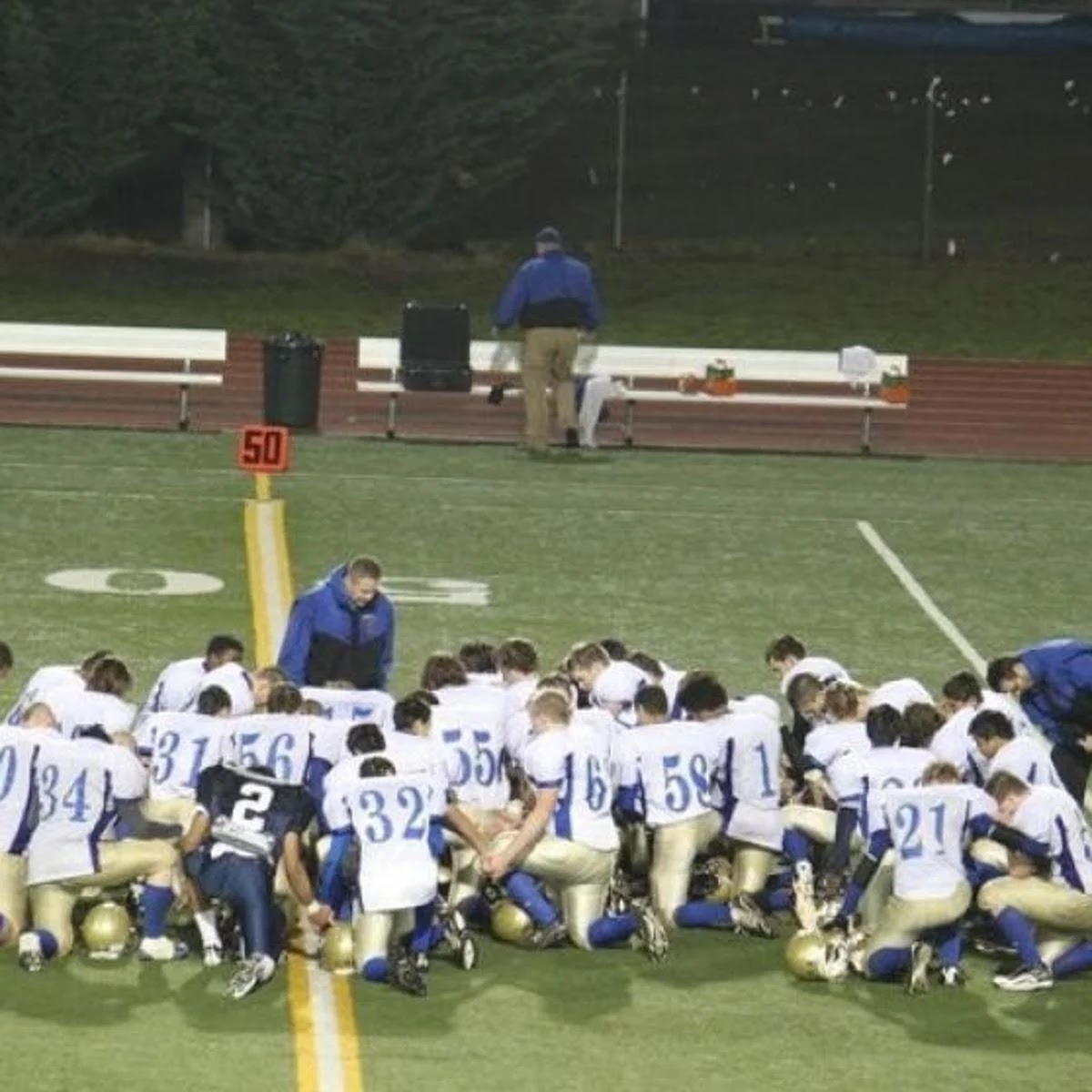
The Church of the 50 Yard Line


As we all know, God is particularly interested in the outcome of American football games.  He watches them assiduously.  He anxiously awaits the prayers of players and coaches, thanking him for....well, for playing good football, and winning games.  In the case of a loss, he expects prayers invoking his assistance in the efforts of players and coaches to play better.

For those who conceive of God as having far better things to do, and being above the fascination of some of those inhabiting our tiny planet in a tiny solar system in one of billions of galaxies making up the universe in high school and (dare I say it?) even college or professional football, that is an irrelevant consideration for the Justices of our Supreme Court.  Much seems to be irrelevant given the increasingly narrow way in which majority decisions are being characterized by them.  The members of the majority purport to be serenely unconcerned with the implications of their decisions.  In fact, they appear angered when those implications are mentioned.

Given the importance of football here in God's Favorite Country, it's no surprise that some of us feel it right and good to thank the God of the universe for performance on the gridiron; for good, accurate passes, solid (but legal) tackles, agile running, etc.  And they should be free to do so, just as the Church of Latter Day Saints should be free to baptize the dead, and Scientologists free to believe in Xenu.

The Supreme Court should be concerned with beliefs and rituals of religions only when the Constitution is implicated.  The question in Kennedy v. Bremerton School District should have been whether a school district violated the Constitution when it fired a coach whose religious practices it had tried to accomodate, but who insisted on praying on the 50 yard line after games, joined by a number of students and players.  But that is not what the majority opinion is about.  For the majority, it was transformed into the question whether the Constitutional rights of a coach engaged in "private prayer" "alone" were violated when he was fired from praying on the 50 yard line after games, joined by a number of students and players.

The majority's insistence that the prayers in question were private religious expression that the coach engaged in alone is, to put it mildly, bizarre.  It's difficult to believe it makes this assertion given the exhibits displayed in the dissenting opinion; it's difficult to believe it believes its own claim, in fact.  It would be hard to conceive of a more public expression of religious belief than one engaged in at the 50 yard line of a football stadium; hard to conceive of prayer engaged in alone while surrounded by others.  Kennedy is shown in one of these gatherings brandishing what seems to be a football helmet standing before kneeling players, as if he was a priest raising the host, or a minister holding a Bible saying "this is the Word of God" to an attentive congregation.  Whatever he's doing in that case, he wasn't "praying alone."

The majority avoids addressing this display by claiming that such evidence was not properly before it.  The majority opinions of the court seem to be becoming more and more scholastic in nature, in that they are filled with technique--drawing distinctions, emphasizing differences between cases, narrowing focus.  Clearly, the majority doesn't conceive of the Supreme Court as a policy-making court, but rather as an error-correcting court.

The majority makes much of the fact that the coach didn't coerce any one to accompany him to the 50 yard line to pray.  One wonders if the Justices have any idea what high school students and particularly athletes in a team sport think and do.  They don't want to be singled out.  They don't want to seem against what might be conceived of as a celebration of victory.  The want to be one of the team; they want to be in with the coach.  It's difficult to believe the Justices aren't aware of this, and it is disingenuous of them to pretend otherwise. 

Sex, religion and guns are the great obsessions of our nation, particularly of those of us who are angry and self-righteous, and such people are more and more inclined to impose their views regarding them through the law.  They seem to have zealous advocates on the Supreme Court.


Wednesday, June 22, 2022

Let Us Pay For Them To Pray


In an opinion mercifully lacking in self-serving references to antiquated opinions of jurists dead for centuries, the Supreme Court of our Great Quasi-Republic has decreed that a law of the State of Maine in force since 1981 is unconstitutional.  The law provided that public funds (taxes) may, in certain circumstances (primarily where public schools are unavailable), be used to pay tuition to private schools of a parent's choice, provided the schools are nonsectarian.  A "sectarian" school is considered to be one associated with a particular religion or belief system, which teaches regular academic subjects but also promotes a particular religion or belief system or teaches subjects taught from the standpoint of that religion or belief system.

In Carson v. Maine, the Supremes have decreed that this cannot be, i.e. that if public funds are to be used in support of private schools, they must be used to support schools which promote a particular religion or belief system.  

The majority of the Court notes that this doesn't mean that public funds must be used to promote a particular religion or belief.   At this time (not yet?) the Court makes no such decision.  The majority points out that Maine may avoid this result by providing an adequate number of public schools.  Presumably, it may also do so by ceasing the program by which public funds may be used to pay tuition to private schools where there are no public schools.  If public schools are not available, it seems, it is constitutionally more appropriate that schools promoting a religion be paid public funds if public funds are used to promote education.  Constitutionally speaking, better no education at all than no religious education, saith the Supremes.

The majority makes an interesting distinction between past precedents against using public funds to benefit religions and its decision in this case.  It states that previous decisions prohibiting the use of public funds to support "church leaders" or education of religious clergy do not apply in this case.  In this fashion, a religious belief--a religion--may be supported by public funds, but particular adherents of a religious belief may not.  What, though, is the basis for this distinction?  Why is it significant?

It isn't clear to me that this is addressed by the Supremes.  It is, instead, merely a difference in circumstances relied on to avoid the need to acknowledge prior decisions as binding.  It's precedent-avoidance, of a kind indulged in by lawyers whenever they want to ignore the kind of reasoning employed in the previous case, and its holding.  

One wonders if the intent behind the doctrine of separation of church and state was to merely prevent the direct funneling of public funds to "church leaders."  Or if it was the intent that public funds be available to religious believers who are not religious clergy, but nonetheless to further the purposes of a religion.  In what sense is one or the other more likely to lead to or constitute the establishment of a religion?  In what sense is a person's ability to practice his or her religion impaired if he's unable to use public funds to pay the tuition of his children needed for them to attend a school promoting his or her religion?

I'm a cynical soul, I'll admit.  I think the number of citizens of U.S.A. who actually practice their religion, rather than merely avow it, is relatively small in comparison with its population.  Diogenes the Dog searched for an honest man. I think the search for a true Christian (for example) would be no more successful.  Practicing a religion in these times consists of simply following established rituals and ceremonies.  Perhaps that's always been the case.

But let's say that engaging in those rituals and ceremonies is practicing religion.  I doubt attending a secondary school will constitute such practice.

I, for one, would oppose the use of public funds to pay the tuition of any private school.  So the fate of this particular law is a matter of indifference to me.  The state may have an interest in an educated citizenry, up to a point, meriting expenditure of taxes received, but I don't think it can be maintained it has an interest in the promotion of any particular religious faith.

And that would seem to me to be the real question to be addressed.  Should, or may, public funds be used to pay the tuition of a Christian, or Muslim, or Hindu, or Jewish high school?  Perhaps Scientology has high schools also--I don't know.  I would say no, regardless of the religious faith being promoted.   It appears the majority of the Supreme Court would say yes.


Monday, March 15, 2021

The Vatican Just Says No


There once was a species called human,
Who thought God cared what they were doin',
But the truth is He said that "For me, they've been dead,
Since the Garden of Eden stopped bloomin'."

That's just a limerick of my creation which I thought up not long ago in a different context, but it seems appropriate in light of the Vatican's announcement that it can't "bless" homosexual unions.  I was going to write that it seems appropriate so near to St. Patrick's day, but a gnawing sense of doubt combined with a quick search of the Internet reveals that the limerick didn't necessarily have its origins in Ireland, though there is an Irish city which bears the name. 

I've noted before that our religions are not unnaturally, but still unreasonably, based on the assumption that if there is a God, that God is fascinated, perhaps even obsessed, with humanity.  Given the vastness of the universe, this seems unlikely.  To maintain that we're God's sole or greatest concern is preposterous, as we're mere specks on a speck among an unimaginably large host of specks which make up what God is said to have created.

Even more unreasonable (I think) is the belief that God is particularly concerned with our sexual conduct.  Any God which lays down rules governing who we have sex with and how we have sex is a very small, petty, and peculiar God indeed.  It follows that those of us who believe there are such rules and seek to enforce them are even smaller, more petty and peculiar.

And so we come to this latest declaration by the Vatican, endorsed, we're told, by the Pontifex Maximus himself.  The One Holy Catholic and Apostolic Church welcomes those who are gay ("homosexually inclined" is the wording used, I think) in a kind of grudging fashion, according to the declaration, but no union of gays may be blessed because only the sacramental may be blessed.  The most relevant sacrament is marriage and marriage, as we know, may only be between a male and a female.  Thus, no blessed gay unions and as sex is inappropriate outside of marriage, all gay sex is inappropriate as well, and may never be appropriate.  

This comes from having a Busybody God, a name I've used in the past in this blog.  But as you may guess from the limerick at the top of this post, I find myself curious regarding why such a God--the kind that is worshipped by the Abrahamic religions--would care what we do, if we accept the doctrine of Original Sin.

Under that doctrine, we're at the least tainted by the sin committed by eating of the Tree of Knowledge by our ancestors, the first humans, which caused them to be expelled from the Garden of Eden.  There are several versions of the doctrine of Original Sin.  The most draconian of them has us damned from birth.  We may nonetheless be saved if God chooses through the medium of Grace, but that's in God's sole discretion.  Then there is the version that proposes that we're cleansed of the sin by baptism.  Another version is that Jesus saved us from Original Sin through his sacrifice.  There may be more versions, I just don't know.  But even the kinder, gentler versions I know of provide that all of us are born with the proclivity to sin as a result of the first (notably heterosexual) humans.

So, we're either damned or damnable from the moment we are born.  If that's the case, though, why does God even bother to peer at us suspiciously, and why did he bother to dream up and impose the many regulations it's claimed he imposed on us after the Garden of Eden was shut down?  He would have written us off after the Original Sin was committed, I would think, as we all would be sinners of necessity thereafter.  Can it be the case that he decided in the first century C.E. that we may in one manner or another avoid the curse of Original Sin, and so appeared among us and induced us to create the sacrament of baptism sometime later?  What changed his mind?  Why are those who lived before then damned without recourse?  Why would he be so interested in what we do given that it's more likely than not that were going to sin anyway, being inherently inclined to sin?

The problems which arise from belief in such a personal God so fascinated with us aren't merely limited to those that result from the fact such a view is incredible, therefore.  They include those that arise when the doctrine which is inferred from that view is made and applied.
 

Friday, November 27, 2020

The Diocese, the Synagogue, the Governor and the Supremes


Much is being made of the Supreme Court's recent decision regarding the State of New York's restriction on attendance at religious services.  I wonder whether that "much" may have something to do with the hyperbolic statements Justice Alito, apparently in a very ideological--or should I say righteous?--mood, made before the Federalist Society.  Those concerned with the possibility of a new conservative majority of the Supremes further broadening the scope of the Establishment Clause may have cause for their concern given Alito's unqualified expression of his fears of government regulation.  But it seems to me this decision is fairly narrow.  It's the fact that there seems to have been no need for the decision to be made that's worthy of note.

The decision doesn't prohibit restrictions on the number of attendees at religious services during the pandemic.  Roughly speaking, it merely provides that the restrictions imposed in this case aren't adequately justified in the law given that restrictions on secular uses are not as stringent.  Such restrictions are subject to strict scrutiny; there must be a compelling reason for their imposition.  According to a majority of the Supremes, there was no such compelling reason.  There is nothing establishing that attendance at religious services is more likely to cause the spread of COVID than attendance at a liquor store or grocery or any of the kinds of secular uses that are less strictly restricted.

It's difficult to be outraged by this.  What is odd, however, is that injunctive relief was sought from the Court during the pendency of an appeal to a Federal Circuit Court, and the restrictions which were imposed are no longer imposed.  Typically, injunctive relief isn't available in the absence of the high probability if not certainty the applicant will suffer irreparable harm if it isn't granted.  Assuming that the inability of a person to attend a religious service will cause irreparable harm, if the restriction claimed unconstitutional is not being imposed, it isn't at all clear that irreparable harm of the kind claimed to exist will actually take place.

This is one of the points made by those Justices dissenting.  They note that if the restrictions are imposed once more, application for injunctive relief may be made at that time.  The majority, however, maintains, for reasons which don't seem to be given, that there is a constant threat they will be imposed and so injunctive relief is needed.  The majority appears to lower the burden imposed on those seeking the extraordinary relief of injunction considerably if what may possibly take place is sufficient grounds for issuance of an injunction.

It would be a matter of concern if that's what intended by the decision, or if that is how it will be construed in the future.  Then protection would arguably be available to anyone who thinks that freedom to worship may be restricted whenever a government may potentially restrict it and has the power to do so.  That would make the prohibition under the Constitution absolute, or provide an opportunity for the imposition of a uniform rule by which restrictions may be judged, instead of the case-by-case approach which has been wisely used in the past.

It occurs to me that activist judges may be conservatives as well as liberals.  An activist is an absolutist, and absolutists aren't thoughtful, careful thinkers--or jurists. 

Monday, November 25, 2019

Rage, God and the Other Hitchens


The "Other Hitchens" as some may have guessed is Peter Hitchens, the brother of the late and more notorious Christopher Hitchens.  Peter is, or was, a journalist by trade, and although I hesitate to say it having brothers of my own, is probably known to most of us as Christopher's brother.  This may be unjust; frankly, I don't know.

I recently read Peter Hitchens' book The Rage Against God subtitled, I think, "How atheism led me to faith" (I'm not sure, as no helpful if irritating colon appears between the "God" and the "How" on the cover of the book; which indeed wouldn't make much sense).

Peter like his brother writes quite well.  Unlike his brother, he believes in God.  He believes in Christianity in fact, which means to me--necessarily though in many cases without acknowledgement and even in denial--that he believes in a certain God, said to be the only one in being, though Father, Son and Holy Spirit).

The painting, or more properly altarpiece, shown above is The Last Judgment by Rogier van der Weyden, a work of the 15th century.  The book is a kind of account of Peter's youth, his lapse into atheism, and his return to the faith of his fathers, combined with as assault upon atheism and its adherents, including his brother, and the arguments they make against religion and particularly their attitude toward it and the religious.  If I understand him correctly, this painting made such a profound impression upon him that it was essential to his rejection of atheism and embracing of Christianity.

I should say first that I think that Christopher Hitchens, whose writings I mostly admire, Richard Dawkins and others of the "new atheists" are excessive and extreme in their criticism of religion and the religious.  So to a certain extent I sympathize with complaints made by Peter Hitchens in this book.  But for various reasons I think it fails in its effort to persuade (as I think he tries to do) that Christianity is necessary to civilization, morality, and most everything we fallen creatures do, think or say.

I think it's clear that Christianity, not religion in general or belief in a deity, is what is being defended and propounded.  This is because Christianity is the only religion he mentions except to the extent he refers to other religions (primarily Islam and Judaism) as examples of the the efforts made by atheist countries or societies such as the USSR and (Christian support of it notwithstanding) Nazi Germany.  This is part of his claim that such societies purposefully persecute religions because of a hatred of God and because religion is based on the belief that what is good and right exists outside of humanity and indeed outside of the universe.  Totalitarian governments do not want anyone to believe such things, according to him, because they persuade people to think there is something greater than the State, something by which the State is to be judged.

Also, Christianity in its Anglican form in the 1950s is what he looks back upon most fondly.  Its current version is not at all to his taste.  The first portion of the book is an indulgence in nostalgia, in fact.   The author longs for the days when England ruled the waves, and the sun never set on it empire.  It's unclear to me whether he believes that the acceptance of Christianity by England assured her success and dominion and its rejection caused its decline, but one does get that impression.

Those halcyon days having passed, and with them all glory, grandeur, poetry, courtesy, gallantry, honesty, the author perforce became an atheist.  There were a number of reasons for this decline, and Christianity played its part in it, by buying into liberal views on sex, on multiculturalism, on relativism, on egalitarianism, etc. 

Then came the day he saw the work of art pictured above.  He saw in the naked figures at the bottom of the work people who he says looked just like people he knew.  Their nakedness apparently helped foster this impression.  This was not because they were naked, but because they weren't wearing any of the peculiar clothes worn by people of that time.  As a result they could not be dismissed as different.  Most effective, though, was the fact that they were in terror of the Last Judgment, some even shown as vomiting in fear.  

It seems fear was a motivating factor in Peter Hitchens return to the faith.  Fear of judgment, presumably, and eternal damnation due to conduct contrary to the laws of God.  Fear certainly can motivate intensely.  However, being told to believe in God or else doesn't seem to persuade unless one is already in extremis as it were.  Also, it hardly seems to be a particularly Christian method of persuasion.  "Believe or burn in hell forever" isn't something one can picture Jesus saying, though some of his followers were apt to make this threat on his behalf.

If fear played a part in making him believe, I honor his honesty in admitting as much.  But he argues also that in the absence of belief in God, horrible things are done.  Witness the USSR and Nazi Germany.  This also seems one of his arguments in favor of having a religion.

It is at least something he thinks atheists like his late brother should acknowledge if they were fair, and gave religion its due.  Even cynics and likely non-believers like Napoleon (not his example, but mine) recognized it was necessary for the "common people" to believe in religion for the sake of order.  Thus his deal with the Catholic Church.

This may be an argument to the effect that religion has its uses, but again is not one which inspires belief in Christianity or any other institutional religion.  What is it that he believes inspired him, or should inspire others, to believe?

Here I confess I begin to lose him.  The Soviet Union and Nazi Germany were horrible.  Were they horrible because they persecuted religion and sought to eliminate it, or for other reasons?  Maybe there was more than one cause.  If there was, can we claim as he seems to that it was their eradication of religion--Christianity in particular--that made them become evil?  Does it makes sense to contend that if they had tolerated religions--Christianity in particular--they wouldn't have been evil?  Or only evil sometimes, as Tsarist Russian was, as he seems to admit?

Whether he does so intentionally or unintentionally, he seems to maintain that Christianity alone can give us what we need to be moral and to have a just and true civilization.  A part of this is his assertion that it is necessary to have a standard of what is good and true beyond what humans can conceive in order for us to know what is good or true.  A part is his claim that only Christianity, with its injunction that we love one another, that can bring us close to God, to do his will.  The Christian demand that we love one another is superior to, for example, the Golden Rule.

He chides his brother for saying it is unrealistic to demand that we love one another as we love ourselves or are children.  He claims we show this love in dying to save others as in war, or to save a child in danger.  Well, certainly such selfless acts have been done, but despite the rhetoric employed these days not everyone is or can be heroic.  We are not heroes everyday.  Typically, we favor our children for example over those of our neighbors or total strangers.  It is unclear to me that we always love each other, and clear that we do not, and not having done so for ages suggests we aren't likely to  do so no matter how many gods command us to.

But in the end, and finally, I am again astonished by the arrogance of the Christian apologist.  For all the good points and respectable arguments he makes, other religions are hardly mentioned as guides to living life morally.  And no consideration is given to the fact that humansurvived, somehow, for ages before Jesus lived and even for a longer period before Christianity became what it is today, and in that time developed laws and theories of ethics and the good state, and good life, without belief in Christianity and even without belief in a personal, transcendent deity, that Christianity borrowed from assiduously.

I don't understand the rage against God or the religious felt by some atheists, but neither do I understand how such people as Peter Hitchens contend that the only choice to be made is to be atheist or to be Christian.


Monday, October 21, 2019

Stoicism and Religion II


In the last post, I concluded that Stoicism isn't a religion, but could be religious, at least in a sense.  But is that truly the case?

I think that strictly speaking it can be if we use "religious" according to its dictionary definition as set forth in Merriam-Webster online.  A Stoic certainly can be devoted to a deity or underlying reality (the vague "Divine Fire" or "Divine Reason").  We can and do say that someone who believes in God is religious.  But the "God" commonly referred to when we say that word isn't an immanent "God" of the kind we find referred to by the ancient Stoics or other pantheists, nor is it the "god of the philosophers" we see referred to often enough even by those ostensibly devoted to institutional religions.

Who and why the reference is made is interesting, however, and indicates that the meaning of "God" is dependent on that who and that why.  Christian apologists, theologians and philosophers throughout history have managed to maintain that the "god of the philosophers" or something very much like that "god" is, in fact, the Christian God.  When they do that I think they necessarily must disregard Jesus as he is depicted in the Gospels, though (despite the Gospel of John's use of the word "logos" which must then, perforce, be made flesh and walk among us--something it's rather hard to imagine logos doing).  Nor is it possible to claim that the Christian God as he is actually worshiped in Christian churches is the god of the philosophers, if the ceremony of worship is considered.

And so I wonder whether it is entirely honest, if it is disingenuous in other words, to claim that Jesus is the god of the philosophers as is attempted from time to time.   Maybe those who do that are like some of the ancient philosophers who claimed that people should engage in the traditional worship of the gods despite the fact that the myths pertaining to them were silly at best.

If worship as ceremony, or ritual, is required for one to be religious, however, it would seem that a Stoic would not be religious.  Western history would seem to establish that worship is communal, something that groups of believers participated in generally at regular times and in a particular manner.  That was the case as far as I'm aware in pre-Christian and Christian times.  The ancient mysteries involved ceremony and invocation in group settings; sometimes large groups as in the case of the Eleusinian mysteries, sometimes in very small groups (the temples or caves in which devotees of Mithras would meet suggest 20 to 50 men would participate in worship).  Pagan worship involved parades and feasting and rituals of various kinds.  Christian worship certainly is communal, though one hears of hermits and folk who lived on pillars and other ascetic extremes, but these are rarities, and meant to be.

I find it hard to picture Stoics gathering for any similar purpose.  For that matter, I find it hard to imagine what they would do.  I personally am adverse to religious gatherings and ceremonies of any kind, though I've noted before my sentimental fondness for the old Catholic ritual.  This is one of the reasons I avoid not only Catholic but other Christian, and even Unitarian gatherings (from what I hear, Unitarians are similar to Christian church gatherings, with singing and reading from I'm not sure who--perhaps the New England Transcendentalists).  The only current non-pagan form of worship I can think of that might be tolerable would be Quaker, where it seems nothing is required beyond silent contemplation unless someone gets the urge to testify--which I like to think would be infrequent.  As for the so-called modern pagans, I suspect that Wiccans, Druids etc. do whatever they do in groups and that some sort of ceremony and liturgy is involved.

Are there any forms of worship engaged in by Stoics, or pantheists, or panentheists?  If so I don't know.  And this makes me wonder whether worship of such a kind can be, and also wonder whether it is possible for them to be considered religious.


Monday, October 7, 2019

Stoicism and Religion

I find myself wondering, now and then, whether Stoicism can be considered a religion, and for that matter whether it should be considered religious.  The answers I encounter when I read those who have addressed the question--those I've become aware of, I should say--are generally to the effect that it can be religious, but is not a religion.

This makes sense if "religion" is defined as a an organized system of beliefs, ceremonies and worship of a superhuman being or beings, i.e. something in the nature of the institutionalized religions with which we're familiar, and "religious" as relating to a devotion to an ultimate reality or deity (I take these definitions, roughly, from Merriam-Webster online).  Despite its growing popularity, Stoicism as far as I know has not become institutionalized or organized to such an extent, and certainly ancient Stoicism, at least, accepted and was devoted to an ultimate reality or deity, that being the Divine Reason.  That deity may even have been worshiped in a sense.  I think of the Hymn of Cleanthes.

In fact, some ancient Stoics seem even to have thought of the deity as personal, as having certain human characteristics and being concerned with humans as individuals.  One sees this tendency sometimes in Epictetus and Seneca.  The early Christian Fathers were fond of Seneca, and could only be so if they saw in his writings some reference to a personal God--though one must be careful in coming to such a conclusion, as the early Christians, like later Christians, would assimilate pagan philosophy in various ways when it suited their purpose to do so.

It seems clear enough that Stoicism need not be a religion, nor need it be religious.  Indeed, it may not even be a philosophy, in the ancient sense of wisdom and choosing the way in which to live.  We know that the wisdom of Stoicism is fundamental to modern psychological therapy such as CBT.

Well and good.  But I confess to feeling a bit disturbed when I see Stoicism used by, and associated with, the worlds of business and the military.  I've no doubt that Stoic techniques can have their uses in those worlds, but the great Stoics of the past were not interested in Stoicism as a path by which success in business could be obtained, or as useful in the development of good soldiers.  I think it's quite clear that the Stoics would consider success in business and in war as being the result of an undue concern with matters and things outside our control, regarding which we should be indifferent at most.

Whether it is or is not necessarily a religion or religious, should it be one or the other?  I think we humans have had and have now more than enough in the way of organized religions.  It isn't clear to me that they've done us much good, overall, and it is clear to me that they've been responsible for a great deal of harm.  Once organized as a religion, I think even Stoicism would lose much of what makes it wise and beneficial.

I do think it should be religious, though, for reasons I hope to explain.  This may be nothing more than an indication of personal preference or desire.

Let me say, first, that I use "religious" here much as it is defined by Merriam-Webster as noted above.  If Stoicism posits the existence of a Divine Reason that is the intelligence or generative influence infusing the universe, and if this spirit is immanent in nature, then I think a "religious" feeling results.  How is it possible to contemplate the vastness of the universe and all it consists of with anything but a sense of awe, and with reverence?  And if acting in accordance with Nature consists of being in accord with the universe, it would seem that by devoting ourselves to Nature is a devotion to the divine that's immanent in the universe.

It may be that in thinking or feeling this way I'm in a minority, because I haven't been able to find any author who sees this as essential to Stoicism, or deals with the religious aspects of Stoicism to any significant extent.  I understand Ricardo Salles addresses this somewhat in his work, but his book on it is so expensive I've haven't had much of an inclination to buy it.

One sees the Stoics referred to as pantheists, or the Stoic view of the universe as panentheistic, but these reference are made in passing, and left unexplored, as if there is nothing more to be said.  For that matter, one sees "modern paganism" called pantheistic, even by its adherents, but those who think of themselves as Wiccan, or Druids or Heathens seem ignorant of Stoicism and ancient philosophy generally.

Surely there's a religious kind of Stoicism in evidence somewhere?  Prepare ye the way of the Divine Reason!