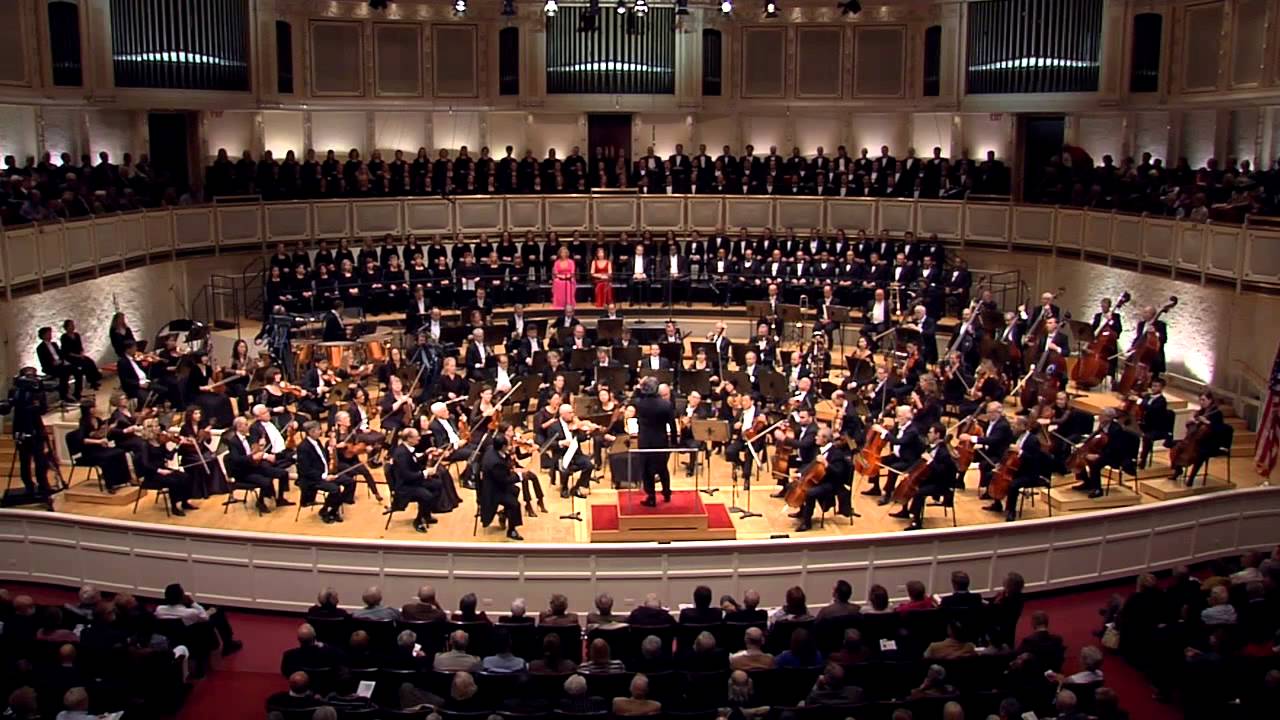
Last weekend, I attended a performance of the Chicago Symphony Orchestra during one of my solo sojourns to the downtown of The City of Broad Shoulders, the Windy City as it's also called. Charlie Kane said of it to his friend Jedediah that "the wind comes howling in off the lake and gosh only knows if they ever heard of lobster Newburg" but it wasn't for that wind that it earned the latter nickname. According to what I've read, an East Coast journalist called it that because of the tendency of its residents to boast of it, rendering them and their city "windy" in the parlance of the times.
It's interesting that although I visit River North and the Loop with some frequency, and enjoy classical music, I haven't been to a performance previously. I'm not even certain why I did so in this case. I had been to Winter's Jazz Club the night before and enjoyed what I heard and was checking for other live performance of music or a show, and thought of the symphony and am glad I did.
An orchestra at work is an impressive and powerful thing to observe. It would seem to me that composing for a full orchestra is onerous and creating a composition which can be played and enjoyed by musicians and audiences is a remarkable artistic achievement. Hearing an orchestra play great music is a notable sensory experience, or is for me.
Listening to the CSO that evening prompted me to wonder, though. Is classical music still a living art form? One can of course still listen to and enjoy the work of great composers of the past as played by capable professional musicians, and that in itself, I would think, will always keep some of us listening to and appreciating the music. But what of new composers and compositions and how they compare to the those of the past?
I was about to write that I'm unfamiliar with modern classical music (it seems difficult to even write those words as what is classical would seem on its face or by definition as not being modern or new). But if we include within it the classical music written by 20th century composers, that wouldn't be entirely correct. I have some familiarity with Stravinsky, Shostakovich, Schoenberg, Ravel, Debussy, Elgar, Benjamin Britten, Respighi, Berg, Poulenc, Richard Strauss, and Rachmaninoff so perhaps it can be said that as to classical music of the first half of the 20th century, at least, I'm not altogether ignorant. But I know virtually nothing of what's gone on in the last 60 years or so.
I can't say I've liked some of the modern classical music I've heard. Atonal and twelve tone music annoy me, for the most part. To my doubtless unschooled ear, some modern classical music is mere noise. It is I'm sure highly complicated noise, and may even be organized noise, but I don't associate noise with classical music or music of any kind. I'm aware of the fact that certain composers have invited musicians to more or less do what they please, or select certain chords of phrases randomly and play them haphazardly, or laugh and shout or honk while others in the orchestra do something more traditionally associated with their instruments.
That sort of thing has led me and perhaps others to speculate that classical music has played itself out. That's to say that what has been done has pretty much covered all the ground which can be covered by orchestras or quintets or quartets or trios of a melodic nature by past masters of the various styles popular prior to the 20th century or the more melodic styles of the last century, for example the tone poems of Richard Strauss and Respighi. And so, classical music composers now in a kind of despair resort to musical chaos.
I don't see how that can be, though. I'd think that the variety of instruments available traditionally in classical music, combined with what technology now allow for, means it's likely still for new classical music to be made. And, I think that it could still be music and not be wholly derivative of what has been done by the great composers of the past.
It's not a question of whether there is classical music which can yet be composed and played, then. It's more a question of whether there will be patrons of that music. Will those who now grow up with modern popular music even be exposed to let alone appreciate classical music? Will they be musicians willing to play classical music?
The experience of being at a live performance of an orchestra would, I think, convince some of them at least to be patrons of it, because it can impress and can even be profound. And, it does so without the need for the light shows filled with dancers, musicians pretending to play guitars and stars who most likely lip-sync their way through songs which are so over-produced that they can't be duplicated in a live venue.
It's interesting that although I visit River North and the Loop with some frequency, and enjoy classical music, I haven't been to a performance previously. I'm not even certain why I did so in this case. I had been to Winter's Jazz Club the night before and enjoyed what I heard and was checking for other live performance of music or a show, and thought of the symphony and am glad I did.
An orchestra at work is an impressive and powerful thing to observe. It would seem to me that composing for a full orchestra is onerous and creating a composition which can be played and enjoyed by musicians and audiences is a remarkable artistic achievement. Hearing an orchestra play great music is a notable sensory experience, or is for me.
Listening to the CSO that evening prompted me to wonder, though. Is classical music still a living art form? One can of course still listen to and enjoy the work of great composers of the past as played by capable professional musicians, and that in itself, I would think, will always keep some of us listening to and appreciating the music. But what of new composers and compositions and how they compare to the those of the past?
I was about to write that I'm unfamiliar with modern classical music (it seems difficult to even write those words as what is classical would seem on its face or by definition as not being modern or new). But if we include within it the classical music written by 20th century composers, that wouldn't be entirely correct. I have some familiarity with Stravinsky, Shostakovich, Schoenberg, Ravel, Debussy, Elgar, Benjamin Britten, Respighi, Berg, Poulenc, Richard Strauss, and Rachmaninoff so perhaps it can be said that as to classical music of the first half of the 20th century, at least, I'm not altogether ignorant. But I know virtually nothing of what's gone on in the last 60 years or so.
I can't say I've liked some of the modern classical music I've heard. Atonal and twelve tone music annoy me, for the most part. To my doubtless unschooled ear, some modern classical music is mere noise. It is I'm sure highly complicated noise, and may even be organized noise, but I don't associate noise with classical music or music of any kind. I'm aware of the fact that certain composers have invited musicians to more or less do what they please, or select certain chords of phrases randomly and play them haphazardly, or laugh and shout or honk while others in the orchestra do something more traditionally associated with their instruments.
That sort of thing has led me and perhaps others to speculate that classical music has played itself out. That's to say that what has been done has pretty much covered all the ground which can be covered by orchestras or quintets or quartets or trios of a melodic nature by past masters of the various styles popular prior to the 20th century or the more melodic styles of the last century, for example the tone poems of Richard Strauss and Respighi. And so, classical music composers now in a kind of despair resort to musical chaos.
I don't see how that can be, though. I'd think that the variety of instruments available traditionally in classical music, combined with what technology now allow for, means it's likely still for new classical music to be made. And, I think that it could still be music and not be wholly derivative of what has been done by the great composers of the past.
It's not a question of whether there is classical music which can yet be composed and played, then. It's more a question of whether there will be patrons of that music. Will those who now grow up with modern popular music even be exposed to let alone appreciate classical music? Will they be musicians willing to play classical music?
The experience of being at a live performance of an orchestra would, I think, convince some of them at least to be patrons of it, because it can impress and can even be profound. And, it does so without the need for the light shows filled with dancers, musicians pretending to play guitars and stars who most likely lip-sync their way through songs which are so over-produced that they can't be duplicated in a live venue.

