Showing posts with label Supreme Court. Show all posts

Friday, February 13, 2026

"What Power Has Law Where Only Money Rules?"


I've mentioned Gaius Petronius Arbiter a/k/a Titus Petronius Niger, author of The Satyricon, Suffect Counsel of Rome, courtier of Nero, on more than one occasion in this blog.  He's mentioned by Tacitus and others, so there's credible evidence he existed.  He appears as a character in the novel Quo Vadis, which formed the basis for a movie of the same name.

He was known as the "arbiter of elegance" in Nero's court and a voluptuary, but also was competent and vigorous in performing his public duties.  He eventually fell afoul of the Emperor, like Seneca, and took his own life in a most remarkable way, slowly bleeding to death by opening his veins but stopping the flow of blood using tourniquets to prolong his life while enjoying conversation and banter with friends and writing a description of Nero's misdeeds which he sealed and had delivered to the Emperor after his death.

I qoute him in the title of this post.  It's a perceptive statement by a fascinating man intimately familiar with the rich and powerful oligarchs of a great empire ruled by a meglomaniac.

The ancient Romans had a high regard for law.  They generated a vast amount of written law through the centuries.  Much of current European law derives from that of Rome.  A knowledge of law was considered essential to a successful career, and many prominent citizens acted as advocates (such as Cicero).

The Roman respect for law wasn't limited to written laws.  Romans also revered the mos maiorum, the unwritten code of the customs and traditions they considered peculiarly Roman, such as duty, respect and discipline, which governed the conduct of their ancestors.

When Petronius wondered whether the law had any power where money ruled (implying that it did not), he was therefore maintaining that money had profoundly corrupted and undermined Roman society; had in fact perverted it.  The power of money had changed what it meant to be Roman.

It's become a cliche that the United States is failing and falling as the Roman Empire did and for similar reasons. Like all clichés, it's too simple, but there are similarities.  The U.S. was founded in large part by lawyers.  The Constitution is a legal document--essentially a set of laws.  The rule of law was essential to its creation and forms the basis for its continuance.

It's rapidly devolving, however, because plutocrats have usurped the administration of the government and have no respect for the law to the extent that it serves to thwart their power and influence and the realization of their desires.

The Supreme Court has assured that the nation's government can be bought by sanctioning its purchase as a Constitutional right, and narrowing the definition of bribery, in effect holding that politicians may be paid in return for their services except in rare circumstances.

So we may well ask Petronius' question now, 2000 years after he posed it, and come to the same conclusion he did.


Thursday, September 11, 2025

Hiding in the Shadow Docket


The increasingly pitiful Supreme Court of our nation has, since the installation of the current regime, been busy accepting an extraordinary number of "emergency applications" it's made and duly issuing the orders it's requested.  It's a most compliant court.

Because such applications are, supposedly, to be made and accepted only in emergency situations where briefing, oral argument and written opinions as in normal cases would take too long and so fail to timely address the emergency, orders granting or denying the applications need not be explained.  No written opinion or rationale need be provided.  The Justices, like gods, merely decree.  We're not entitled to know why or how they came to do so.

These Jovian orders comprise what is known as the shadow docket.  While there have in the past been very few matters decided in this abrupt, mysterious manner, the current Justices seem to delight in exercising judicial authority in this fashion. Yay or nay is all they need say.

No doubt it's much easier to decide cases when no reasons for a decision need be given.  And, certainly, it can be convenient in other ways as well.  For example, if a case raising similar issues in similar circumstances should come before the Court, but a majority of the Justices don't want to issue the same order issued during the "emergency", they can simply maintain that the rationale which applied but was not disclosed previously didn't apply in the new matter.  Who could contest such a claim?

Better yet for them, how may the Justices be successfully criticized for a decision they made when the reasons for the decision cannot be known? It may have been made for the worst of reasons, or no reason at all, for all we know.  It simply doesn't matter.

Do the Justices lurking in the shadow docket feel something of a thrill, being able to make unreviewable orders as they please, with no need to account for them?  If so, let's hope they don't find it addictive.

Of course these decisions made in the shadows of the shadow docket do little or worse for litigants, lawyers and judges, trying to understand them. They benefit only the regime and the Justices who cater to it. Lower courts, lawyers and litigants are left in the dark because the Justices cannot be bothered to explain the orders they make.  Merely knowing that an application has been granted or denied provides little guidance.

This deliberate practice of issuing orders for no apparent reason is at the least irresponsible and selfish.  It's also cowardly, I think.  If your going to decide matters of great importance which are unreviewable, you should have the courage to explain and defend those decisions.  It's no wonder the reputation of the Supreme Court is in decline.


Sunday, July 7, 2024

The Disesteemed Court

They saved their worst for last.  Though it seems hard to believe given the quality of some of their earlier decisions this term, the majority of the Justices left to the end three of the more stunning opinions issued by an increasingly demeaned institution--those regarding presidential immunity, federal administrative law and what are called "bump stocks."

The majority opinions in these cases seem to be contrived.  That is to say, they appear to have been prepared not through a process of reasoning, but instead in support of a desired result.  The rationales employed strike me as examples of special pleading.  The Justices making up the majority agree on an end to be achieved, and direct their clerks (who do the bulk of the research and writing) to find caselaw and, where necessary, other authority supporting that end.  This is something lawyers do all the time, of course, in the service of clients.  But while one is justified in expecting that the Justices, or at least their clerks, are familiar with the law and what lawyers do (which may be wishful thinking in some cases), there's also an expectation that they will transcend special pleading and make an impartial decision, not one that is consistent with their belief of what is appropriate.  

But more and more we see a court filled with unabashed ideologues and toadies of the wealthy and special interests which appeal to their vanity and, it's sad to say, their expectation of rewards. They feel entitled to reward for having been placed in a position which promises to them perpetual employment in an exalted position which many of the well-to-do see as rendering them very useful to their quest to become even more well-to-do and powerful.

Immunity from criminal prosecution isn't something to be easily and broadly granted to public servants.  Even in the time of the Roman Republic, officials and magistrates were immune only during their term of office.  Once that term expired or was otherwise terminated, they could be prosecuted for their actions taken while, e.g. consul or governor.  During the Republic, private citizens could bring prosecutions.  A Roman magistrate was thus much more exposed to prosecution than any official could be now.  

The fact that no former president has been subject to prosecution until now indicates that this isn't something that is likely to occur, so it's difficult to understand why the need for immunity is pressing or why it should be of such a concern.  Just what is it that a president could do which requires the protection of absolute immunity from prosecution?  In what way would the possibility of prosecution hinder a president?  A case in which a former president is prosecuted for electoral fraud, or for mishandling classified documents doesn't raise concerns that prosecutions for the performance of official or significant acts will be forthcoming.  A prosecution for encouraging a riot or insurrection is similarly one which we may expect not to arise often.

It's true that presidents are not protected in the case of unofficial duties by reason of the recent decision, but there is nothing in our history or in the law which indicates absolute immunity for "official" action was ever contemplated by the Founders or anyone else.  That is characteristic protection of a monarch or autocrat, something those who established this nation sought to avoid.  And if, as must be acknowledged, the president has an obligation to enforce the laws of the United States, and preserve, protect and defend its Constitution, how would it be possible for a president to be immune from conduct contrary to those laws or the Constitution?  Such conduct could easily be described as "official" however according to the majority opinion, if it involved making use of the authority of the office of the president.

Requiring lower courts to determine what is or is not official assures that the law in this respect will be uncertain and confused until such time as the Supreme Court itself takes on the burden it refuses to take on now, but instead foists on others.  It is a recipe for chaos.  Having created such a standard, it seems cowardly to leave it to others to determine its meaning and consequences.

The majority's opinion in the Chevron case, considered in combination with the Trump case, suggests that it has little regard for the lower courts which must now cope with the problems which will result.  District Courts will now have to grapple with cases which normally would be handled by the agencies themselves or administrative tribunals.  District Courts are overwhelmed by litigation already; what will happen to them now is anyone's guess.  It would be interesting to determine whether the current Justices have any experience in the actual litigation of cases in court, or any appreciation of the time and expense required to obtain a decision.

The bump stock case represents a kind of exaltation of minutia, a focus on definition over all else which is an expression of the Court's increasing detachment from the reality of life in the United States.  The Justices have become monks of sorts.  They sit secure and isolated in the Court, which has become a kind of monastery in which they and their clerks and staff peruse scriptures and commentaries, issuing bans and proclamations which rule our lives, without concern for the consequences. 


Tuesday, May 21, 2024

Under the Upside Down Flag (Alito Incognito)


It's said that displaying the picture of a Supreme Court Justice upside down is a sign of profound distress due to an emergency threatening the nation.  It may also be used as a symbol of protest.  This picture of Justice Alito was posted by here by someone.  I don't say it was me, but I take advantage of it to comment on the flying of the Stars and Stripes, Old Glory, The Grand Old Flag of our Glorious Republic, The Flag Of Our Fathers, upside down at his house  in January, 2021, contemporaneous with the insurrection effort of January 6 of that year and the silly "Stop the Steal" movement related to the 2020 election.

Justice Alito when confronted with proof that this took place promptly hurled his wife under the bus, and claimed that she had done it without his knowledge or consent.  He was, it seems, unaware of events taking place at his home and of the conduct of his wife, who as far as I know has neither confirmed nor denied his gallant claim.  Alito claims she treated our flag in such a fashion because of signs on display in the yards of certain of his neighbors, which we're to believe were so offensive as to merit this call for distress, or which otherwise required that she brandish her support for the claim the 2020 election was stolen in this fashion.

It's not a persuasive claim or explanation, I think.  The Justice has displayed an ignorance of women in general in the past, but it doesn't follow from this that he was, or is, ignorant of the thoughts and actions of his wife specifically.  Also, just why anyone would think flying the flag upside down is an appropriate response to nasty neighbors is unclear.  I can't help but wonder if this was Alito acting incognito; i.e. with his identity rather thinly concealed by the person of his wife.

If hanging the flag upside down was conduct in support of the "Stop the Steal" farce or was intended to express belief that the election had been stolen, it's remarkable that the spouse of a Supreme Court Justice would act in this fashion given that even at the time, as I recall, the claims made in that respect had been laughed out of courts throughout the nation.  One would think a belief in judicial impartiality and reserve would cause a reasonable person to question the basis for the assertions being made in court which various judges dismissed, and it may be expected that even the wife of a Supreme Court Justice would hold such a belief, if not the Justice himself.  But perhaps this isn't to be expected of either the Justice's wife or the Justice himself in this case.

We see at the Supreme Court as we see elsewhere in our politics and society a sense of disdain for lives different from ours and thoughts which are contrary to our own.  We also see self-righteousness of an extreme kind.  In politics and in an increasingly political judicial system, the expression of this self-righteousness is pharisaical.  

We know the Supreme Court Justices have recently refused to adopt a code of ethics similar to that which applies to other federal judges.  It seems they're serenely confidant that no such code need exist (it's to be hoped they don't think that ethics themselves are unneeded at the Supreme Court, but only in lesser courts).  We know also that another Justice and his wife have blithely accepted costly gifts from very rich friends and admirers, for the most part wealthy conservatives, and see nothing objectionable about this mooching on their part.  This kind of self-regard can be dangerous, as Supreme Court Justices, who have no term of office and whose decisions cannot be appealed, can come to think of themselves as truly supreme.

We can expect that neither Justice Thomas (whose wife supported claims of a fraudulent election) or Justice Alito will recuse themselves from cases involving the January 6th insurrection under the circumstances, of course.  

It's unsurprising that the reputation of the Supreme Court is diminishing.  Lawyers know judges better than most, and probably are no more impressed by the knowledge or characters of the current Justices than they are of most other judges of appellate courts.  They know there's nothing particularly laudable or admirable about them and their significance is simply in the power they wield.  But it strikes me that others are coming to know this as well.  Unfortunately, certain of the Justices seem bent on making certain that respect for the Court continues to dwindle.


Friday, June 30, 2023

We Don't Need No Stinkin' Affirmative Action


Sorry, but I couldn't prevent myself from paraphrasing the immortal lines from The Treasure of Sierra Madre spoken by the Mexican Bandit leader as portrayed in the movie, above, in referring to another decision of the Supreme Court.  This one is about Affirmative Action, or rather the demise of that program or policy, as a result of the opinion in the case involving Students for Fair Admissions (as opposed it seems to Students for Unfair Admissions).


The Equal Protection Clause is at issue in the case.  That Clause was adopted just after the end of the Civil War, and it seems beyond dispute that it was adopted to prevent governments from engaging in racial discrimination of the sort which continued despite the defeat of the rebellion.  It seems curious, therefore, that it is claimed in this opinion that a policy intended to remediate the results of racial discrimination violates the Equal Protection Clause, which is intended to prevent it.

Such, though, is the result when we reverse course in this fashion, and declare that a policy which had been determined to serve a vital governmental interest doesn't really do so anymore, which is what I think is the position taken by the majority of the Court.  It is acknowledged, though in a somewhat grudging and dubious manner, that prior cases sanctioned the consideration of race in admission to institutions of what used to be called "higher learning" as serving such an interest.  But, one gathers from the opinion, it no longer does so, if it ever did.  Why?  Because there just isn't all that much racial discrimination going on now in higher education.  It is so limited at this time that the extraordinary decisions of the past no longer apply.

The fact that Affirmative Action existed always made some uncomfortable in light of the unambiguous language of the Equal Protection Clause.  Affirmative Action by its nature gave preference to certain students based on their race, and so favored them in consideration for admission to an institution, based on their race.  Clearly, if white applicants were given preference, it would constitute a violation of the law.  Why should that not be case if black or other applicants are given preference?

It was thought that it should not be the case because black and other applicants or minority status had been wronged, discriminated against, where others were favored.  That should be fairly clear, one would think.  If strict application of the Equal Protection Clause has the effect in certain circumstances of preventing its purpose from being accomplished, it isn't unreasonable to believe exceptions are appropriate in extraordinary circumstances.  

So, the majority doesn't maintain that Affirmative Action always violated the Equal Protection Clause.  Instead, it's reduced to claiming that Affirmative Action just isn't necessary anymore.  Curiously, it refers to language in prior opinions which spoke of the sunset of Affirmative Action.  It was estimated that 25 years should suffice to dissipate the harmful effects of discrimination due to race, and behold!  Twenty years later  discrimination is no longer a significant concern, and least in the admissions process.  We should congratulate ourselves.

Some disagree with the comforting conclusion of the majority.  And it does seem to be a decision which should have more support in a factual record than this opinion does, limited as it is to consideration of the policies of two institutions in particular.  

Most peculiar, I think, are statements made in the majority opinion which state that nobody doubts that applicants of a particular race may note in an essay submitted for consideration the impact that racial discrimination has had in their lives.  So, it seems race may be mentioned, at least in an essay, according to the Supremes.  Nonetheless, though, it cannot be considered.  What can be considered is how the applicant as an individual derived from that discrimination some sort of ability which would contribute to the university.  If an applicant is black, therefore, the majority thus asserts that while that fact may be significant in developing certain abilities and characteristics due to discrimination--may have indeed been necessary to that development--it cannot be considered in the admission process.  Instead, the individual, which apparently isn't black or isn't deemed black, is what is to be considered.  

It will be interesting to see how this bit of conjuring will play out.


Tuesday, June 28, 2022

The Church of the 50 Yard Line


As we all know, God is particularly interested in the outcome of American football games.  He watches them assiduously.  He anxiously awaits the prayers of players and coaches, thanking him for....well, for playing good football, and winning games.  In the case of a loss, he expects prayers invoking his assistance in the efforts of players and coaches to play better.

For those who conceive of God as having far better things to do, and being above the fascination of some of those inhabiting our tiny planet in a tiny solar system in one of billions of galaxies making up the universe in high school and (dare I say it?) even college or professional football, that is an irrelevant consideration for the Justices of our Supreme Court.  Much seems to be irrelevant given the increasingly narrow way in which majority decisions are being characterized by them.  The members of the majority purport to be serenely unconcerned with the implications of their decisions.  In fact, they appear angered when those implications are mentioned.

Given the importance of football here in God's Favorite Country, it's no surprise that some of us feel it right and good to thank the God of the universe for performance on the gridiron; for good, accurate passes, solid (but legal) tackles, agile running, etc.  And they should be free to do so, just as the Church of Latter Day Saints should be free to baptize the dead, and Scientologists free to believe in Xenu.

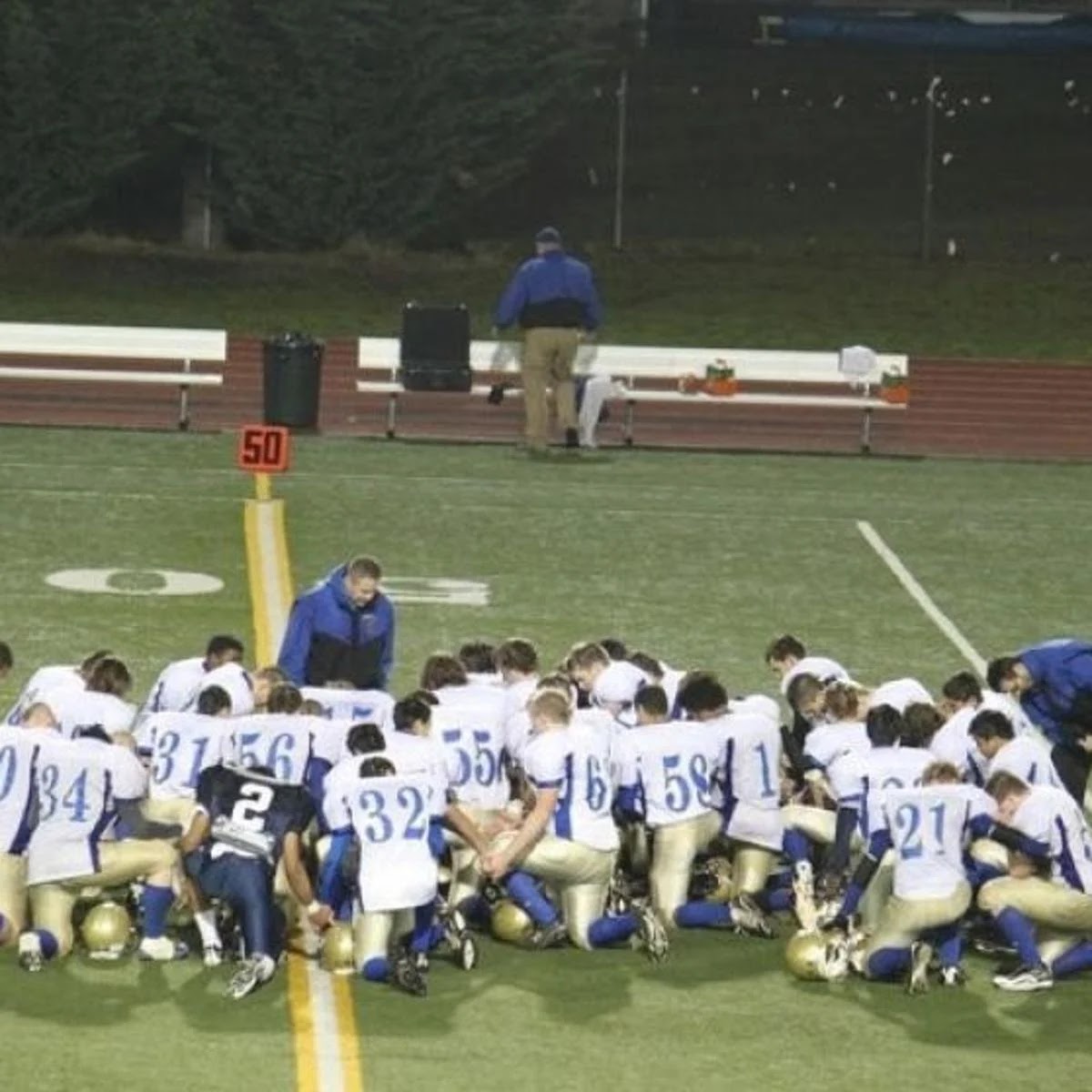
The Supreme Court should be concerned with beliefs and rituals of religions only when the Constitution is implicated.  The question in Kennedy v. Bremerton School District should have been whether a school district violated the Constitution when it fired a coach whose religious practices it had tried to accomodate, but who insisted on praying on the 50 yard line after games, joined by a number of students and players.  But that is not what the majority opinion is about.  For the majority, it was transformed into the question whether the Constitutional rights of a coach engaged in "private prayer" "alone" were violated when he was fired from praying on the 50 yard line after games, joined by a number of students and players.

The majority's insistence that the prayers in question were private religious expression that the coach engaged in alone is, to put it mildly, bizarre.  It's difficult to believe it makes this assertion given the exhibits displayed in the dissenting opinion; it's difficult to believe it believes its own claim, in fact.  It would be hard to conceive of a more public expression of religious belief than one engaged in at the 50 yard line of a football stadium; hard to conceive of prayer engaged in alone while surrounded by others.  Kennedy is shown in one of these gatherings brandishing what seems to be a football helmet standing before kneeling players, as if he was a priest raising the host, or a minister holding a Bible saying "this is the Word of God" to an attentive congregation.  Whatever he's doing in that case, he wasn't "praying alone."

The majority avoids addressing this display by claiming that such evidence was not properly before it.  The majority opinions of the court seem to be becoming more and more scholastic in nature, in that they are filled with technique--drawing distinctions, emphasizing differences between cases, narrowing focus.  Clearly, the majority doesn't conceive of the Supreme Court as a policy-making court, but rather as an error-correcting court.

The majority makes much of the fact that the coach didn't coerce any one to accompany him to the 50 yard line to pray.  One wonders if the Justices have any idea what high school students and particularly athletes in a team sport think and do.  They don't want to be singled out.  They don't want to seem against what might be conceived of as a celebration of victory.  The want to be one of the team; they want to be in with the coach.  It's difficult to believe the Justices aren't aware of this, and it is disingenuous of them to pretend otherwise. 

Sex, religion and guns are the great obsessions of our nation, particularly of those of us who are angry and self-righteous, and such people are more and more inclined to impose their views regarding them through the law.  They seem to have zealous advocates on the Supreme Court.


Wednesday, June 22, 2022

Let Us Pay For Them To Pray


In an opinion mercifully lacking in self-serving references to antiquated opinions of jurists dead for centuries, the Supreme Court of our Great Quasi-Republic has decreed that a law of the State of Maine in force since 1981 is unconstitutional.  The law provided that public funds (taxes) may, in certain circumstances (primarily where public schools are unavailable), be used to pay tuition to private schools of a parent's choice, provided the schools are nonsectarian.  A "sectarian" school is considered to be one associated with a particular religion or belief system, which teaches regular academic subjects but also promotes a particular religion or belief system or teaches subjects taught from the standpoint of that religion or belief system.

In Carson v. Maine, the Supremes have decreed that this cannot be, i.e. that if public funds are to be used in support of private schools, they must be used to support schools which promote a particular religion or belief system.  

The majority of the Court notes that this doesn't mean that public funds must be used to promote a particular religion or belief.   At this time (not yet?) the Court makes no such decision.  The majority points out that Maine may avoid this result by providing an adequate number of public schools.  Presumably, it may also do so by ceasing the program by which public funds may be used to pay tuition to private schools where there are no public schools.  If public schools are not available, it seems, it is constitutionally more appropriate that schools promoting a religion be paid public funds if public funds are used to promote education.  Constitutionally speaking, better no education at all than no religious education, saith the Supremes.

The majority makes an interesting distinction between past precedents against using public funds to benefit religions and its decision in this case.  It states that previous decisions prohibiting the use of public funds to support "church leaders" or education of religious clergy do not apply in this case.  In this fashion, a religious belief--a religion--may be supported by public funds, but particular adherents of a religious belief may not.  What, though, is the basis for this distinction?  Why is it significant?

It isn't clear to me that this is addressed by the Supremes.  It is, instead, merely a difference in circumstances relied on to avoid the need to acknowledge prior decisions as binding.  It's precedent-avoidance, of a kind indulged in by lawyers whenever they want to ignore the kind of reasoning employed in the previous case, and its holding.  

One wonders if the intent behind the doctrine of separation of church and state was to merely prevent the direct funneling of public funds to "church leaders."  Or if it was the intent that public funds be available to religious believers who are not religious clergy, but nonetheless to further the purposes of a religion.  In what sense is one or the other more likely to lead to or constitute the establishment of a religion?  In what sense is a person's ability to practice his or her religion impaired if he's unable to use public funds to pay the tuition of his children needed for them to attend a school promoting his or her religion?

I'm a cynical soul, I'll admit.  I think the number of citizens of U.S.A. who actually practice their religion, rather than merely avow it, is relatively small in comparison with its population.  Diogenes the Dog searched for an honest man. I think the search for a true Christian (for example) would be no more successful.  Practicing a religion in these times consists of simply following established rituals and ceremonies.  Perhaps that's always been the case.

But let's say that engaging in those rituals and ceremonies is practicing religion.  I doubt attending a secondary school will constitute such practice.

I, for one, would oppose the use of public funds to pay the tuition of any private school.  So the fate of this particular law is a matter of indifference to me.  The state may have an interest in an educated citizenry, up to a point, meriting expenditure of taxes received, but I don't think it can be maintained it has an interest in the promotion of any particular religious faith.

And that would seem to me to be the real question to be addressed.  Should, or may, public funds be used to pay the tuition of a Christian, or Muslim, or Hindu, or Jewish high school?  Perhaps Scientology has high schools also--I don't know.  I would say no, regardless of the religious faith being promoted.   It appears the majority of the Supreme Court would say yes.


Thursday, October 11, 2018

Bad Advice and Consent


Article II, Section 2, Clause 2 of the Constitution of our Glorious Republic provides that the President shall nominate, and "by and with the Advice and Consent of the Senate" shall appoint, Judges of the Supreme Court "and all other Officers of the United States."  This is often referred to as "the Advice and Consent Clause." We many, we unfortunate many, have witnessed the lugubrious exercise of this function by the Senate regarding the ascension (if that is a word that can be used) of a Judge of the D.C. Circuit Court of Appeal to the U.S. Supreme Court.  

Besides being a clause, Advice and Consent is also the name of a movie made in the early 1960s, presumably based on a book, starring Henry Fonda, Charles Laughton and other worthies regarding the nomination of a man to serve as Secretary of State.  In that movie, the nominee was accused of being a Communist or former Communist; a satisfyingly serious condemnation given the times.  The Senate revealed in the movie is a fictional Senate, of course, but either through the magic of film and art or otherwise that Senate--though portrayed as corrupt in a fashion--seems possessed of a dignity lacking in the real thing of our time.  On this and on other occasions our politicians and our political institutions have demonstrated that truth can be far stranger, or at least seedier, than fiction.

Perhaps "stranger" isn't an appropriate word in this case.  Sadly, there was nothing strange about the proceedings.  They seemed very familiar, in fact.  Posturing, hypocrisy, self-righteousness, scheming, lying is to be expected whenever our politicians are on public display and particularly when they are in groups.  They scheme and lie in private as well, of course, but may be less inclined to posturing, hypocrisy and self-righteousness when not in the public eye.  Be that as it may, the proceedings were by all accounts spectacular; a spectacle, in fact.  I avoided them as much as possible, but a real effort is required to avoid anything that our dread enemy, the media, finds interesting.

What little I saw was disturbing in a peculiar way.  Events were taking place; people were talking, asking and answering questions, but it was difficult to think of it as something which was not a movie or play.  I wonder if that is how we experience events in which we're not directly involved.  We watch a movie, generally a boring, bad one.   Perhaps, but the feeling in this instance may have had its basis in the knowledge that the outcome of the proceedings was virtually certain.  I think everyone knew that the needed number of members of the Senate would consent to the appointment from the very start, regardless of what was said, simply because the majority of members of the Senate are Republican.  The only real question was how the Republicans would contrive to nominate while appearing to take seriously the allegations which were made, and whether they could do so while increasing their political status and likelihood of reelection--ultimately, the only concerns of politicians.

The Democrats like any other person of middling intelligence knew that the nomination would very likely occur, and so knowing that did what they could to attack the integrity of the nomination.  Perhaps, also, they saw it as an opportunity to bring attention to the plight of victims of sexual assault, but I suspect that their primary end in view was to make their Republican colleagues look bad, which was at least achievable.

I won't delve into questions of credibility.  I think it clear enough that the Judge drank excessively in his younger days, and marvel somewhat that he took pains to deny this, or at least not to admit it.  That appears to have been the only well-established fact.  So, he was less than credible in that respect, and much of his expressed outrage in the proceedings seemed a performance, similar to that of Senator Graham.  This doesn't mean he committed sexual assault, however.  Senate Committee proceedings are not useful in determining criminal conduct.

What I find interesting, and disheartening, is that the process has become so partisan, so infused with political conflict, histrionics and melodrama that it is doubtful whether it serves any useful purpose in assuring that competent people are appointed in any capacity as Officers of the United States.  What competent, honorable person would want to subject himself/herself to such a review, given that the review would be conducted by people whose motivation is not assuring that the best person for the job is appointed, but furthering a political agenda at whatever cost?  Chances are the only person who would go through it would be so eager for power that they're willing to expose themselves, to run the gauntlet.

The Senate can still consent, and will no doubt continue to do so, but is no longer capable of giving advice.  But considering that currently, the one who is suppose to be advised is inadvisable, that may not be much of a concern in the short run.

Monday, August 3, 2015

Send in the Clowns

Yes, I know, they're already here.

Although it's difficult to assess whether the politics of our Glorious Republic is comedy or tragedy, the efforts of the relentless categorizer Aristotle notwithstanding, there's something laughable about this presidential election.  I wonder if the plethora of clowns running for that sublime office is a kind of affirmation by fate that our elections have caused whatever gods may be to despair of us entirely.  Since we are beyond saving, why not turn our national politics and governance into a kind of farce, something entertaining if nothing else.

The cast is impressive in size, although the characters are stock.  The venal, disingenuous, unlikeable Clinton; the big-mouthed,  pompous ass Trump; the holy-roller Huckabee; the scatter-brained, disturbingly named Rand Paul; the oleaginous opportunist Cruz; the youthful, handsome and vacant Rubio; the excitable, apparently vindictive, Christie; the dully passive-aggressive Walker; the odd, emotional Graham; the unexciting leftover Jeb Bush; and the others, thus far unnoticeable, with the exception of Bernie Sanders, who seems to suffer from nothing more than being old in age and an old-time liberal.

And soon, perhaps, Vice President Biden may join the race.  That would be like Leslie Nielsen's Frank Drebin running for the office.

How can an intelligent, responsible individual make a choice among these undesirables?  It is not, if it has ever been, a process of choosing the best or most qualified person.  It has become an exercise in determining who is most likely to do the least amount of damage to the United States and its people, and even to the world given our propensity to rush into problems and places where angels fear to tread. 

There are of course intelligent, responsible individuals left even now here in God's favorite country, and it's likely some if not all of them vote.  But it's not at all clear that they will have any significant impact in deciding who becomes president.  We (and other, less favored, people) enjoy comparing our nation to ancient Rome, which in a way is appropriate as we borrowed so much of its form and architecture.  We have not quite made it to the point where the presidency can be bought in the way Didius Julianus bought his place as Roman Emperor, but we clearly have reached the point where money is of paramount importance, a direct if not the sole cause of success in our elective politics.  For this we must thank our Supreme Court, which decided that hurling any amount of money at our politicians in the hope if not the expectation of favors is perfectly fine in the law.  Only bribery of the most blatant kind is prohibited here in the home of the free and the brave.

We may still hope, however.  Didius Julianus reigned for only a matter of weeks, and was disposed of by the Praetorians he paid.  The auctioning of the Roman principate was shown in a Hollywood spectacular, called The Fall of the Roman Empire by someone who was its seems unaware of the fact that the empire continued in the West for another three centuries or so after that memorable event, and in the East for another thirteen hundred years, more or less.  I recall Christopher Plummer playing Commodus in that film as something of a cruel but cheerful lunatic.

But who can be said to be even the least likely to do harm to us among this rogues gallery?  We can expect such as Clinton and Jeb Bush to play the tired old game of Washington politics in a predictable if not effective manner, but the ascendancy of that caricature of a boorish rich man, the Trimalchio of our time, is it seems a sign that many have soured on business as usual, or have at least concluded that if we must suffer through it we may as well have someone who, being rich and only concerned with being rich, doesn't care about what he says or thinks.

Is it possible that Trump's popularity may indicate that we all now recognize our politicians are pandering hypocrites, ready to do or say anything to be elected and remain elected, which is to say ready to do the bidding of their paymasters?  Or indicate that we are for other reasons sick of what has become a sham?   If so, it may perhaps be a desirable development in its own peculiar way.

Monday, June 29, 2015

Definition Uber Alles: The Obergefell Dissent

I am puzzled by the dissenting opinion in this case.  The majority opinion is, I think, too rhapsodic but ultimately legally sound.  The dissent on the other hand is neither, and I think borders on being weird.  I can do without rhapsody in the Supreme Court, but am disturbed by oddity in that institution.  Both rhapsody and oddity are of concern, as the appearance of either of them in a legal opinion is a sign that the opinion's author has departed from legal analysis and strayed into the Never-Never Land of the zealot.  But oddity is of particular concern when it comes to the consideration of legal rights.

The dissenters are in a difficult position because it cannot be doubted that the ability to marry has been recognized as a legal right protected by the Constitution since at least 1962.  So in order to dissent, they must necessarily maintain that legal right is not available to certain people who are as much protected by the Constitution as any other American citizen.  Normally, such rights are available to all subject to forfeiture, generally by virtue of conviction of a criminal act.  However, it can't be maintained that gay people seeking to marry have all been convicted of a criminal act (no, sodomy doesn't count as criminal anymore under the Constitution).

The dissenters are thus reduced to contending, in effect, that the legal right to marry is a right that can be exercised only by particular people, but that others are excluded from exercising this legal right not because they have forfeited that right but because of a definition.  According to the dissenters, marriage is a legal right that can only be exercised by one man and one women because that is what the definition of "marriage" requires.

The dissent acknowledges that the definition of "marriage" may be changed, though.  The dissenters think, however, that the people through the legislature must change the definition, and not the court.  Thus we find in the dissent references to democracy and the will of the people which are unusual in a Supreme Court decision, as the Supreme Court has for many years disregarded the wishes of the people in upholding and interpreting the law when it deems it necessary to do so to uphold the Constitution, and this is indeed its function in our system.  The dissenters have all of them done just that themselves.  They simply abhor doing so in this case.

By acknowledging that the definition of "marriage" may be changed at all, however, and that if changed the legal right of marriage may be extended, the dissent creates problems for itself.  It makes the existence of a legal right dependent on something that may change, first, and this is something which the dissenters may find hard to stomach in other cases.  There is in addition a danger in letting the people, or the legislature, define what constitutes a legal right, as one hopes the dissenters recognize, even if that recognition would hint that they aren't being entirely impartial in this case.  The Founders were well aware of the potential for a tyranny of the majority, and took steps to avoid it; one of those steps was the creation of the Supreme Court.

There is also a danger in sanctioning the idea that it is possible to "define away" a legal right.  If one accepts that the Supreme Court must in all cases accept what a legislature mandates as a definition, it would be easy enough for a legislature to adopt definitions which would restrict existing legal rights or create new ones by adopting a particular definition. 

Perhaps it can be argued that in the case of "marriage" the dissenters refer to a definition of long standing, not dependent on legislative whim.  But the same could be said of "property" which until recently had been defined for many years as including certain human beings. 

Now there is talk of civil disobedience, and fears of restricting religious freedom.  There is even talk of the Supreme Court defying God's law by those who think of God as obsessed with human sexual relations (God as voyeur, as it were).  But the majority opinion makes it clear that should not be a concern.  This decision should properly be considered as applicable to marriage as a legal concept, which is in effect a contract or partnership.  Religions may consider it whatever they like, and require whatever rituals they think appropriate governing what they think is a marriage.  That should not be a concern of the law.  Similarly, it should not be a concern of religions what the State provides as governing this particular kind of contract or union.

I think it likely that we will not see the same kind of hysteria we saw in the days when the courts mandated segregation.  Acceptance of gay marriage has spread with remarkable celerity, and, frankly, those who oppose it and oppose modern society generally will die off soon enough, to be replaced with the less intolerant, or will withdraw from that society to live and die in relative isolation, for good or ill.

Perhaps the times really are a-changin', this time. 

Monday, May 5, 2014

Not a Prayer

It shouldn't be a surprise, really, that the Supremes sanctioned the practice of the Town of Greece (a rather amusing name under the circumstances) in summoning the local clergy to drone prayers at the commencement of town board meetings.   It may surprise some, however, that it has been the law for some time in our Glorious Republic that such prayers may be made at meetings of governmental bodies, and that the practice is not all that unusual.

True, the rule has been that such prayers should not be overtly preferential towards particular religions.  I don't see this latest decision as changing that rule, but for the fact that the governing bodies of most municipalities in our merry old land govern municipalities the residents of which are (nominally at least) largely Christian as are most of the clergy.  It seems that the Supremes find it not unnatural for prayers that local governments act wisely at their meetings be for the most part Christian in those circumstances, and consider it burdensome for them to be required to import the clergy of other faiths to perform the seemingly thankless task of begging for God's blessing.

I confess that it doesn't matter to me in the least whether prayers are or are not said when our local (or other) leaders gather to govern us, nor do I care what kind of prayers are said, provided that they are not blatantly stupid, clumsy, grandiose or judgmental.  I take it as unquestionable that such prayers have no effect, and think they have no purpose.  They may be said to be needless as a result, but that is not to say they are illegal.  I attend such meetings in a professional capacity on a regular basis and ignore them, when they are said, as a matter of course.  I think it more than likely that most everyone present ignores them as well--just as they do at Church.  As for the Pledge of Allegiance, I've been reciting it for a very long time and don't care that the word "God" appears in it; at this point I'd be confused if it did not.

So perhaps I'm not the most appropriate person to address this decision, as it means so little to me.   I'd find it interesting, at least, if the Hymn of Cleanthes was said before a meeting.  Substitute "God" for "Zeus" and it could be intoned without causing a raised eyebrow anywhere in these United States.  All prayers are the same for the most part, at least those that would be said by anyone at the meeting of a governmental body.  This is significant, I think; or perhaps "insignificant" is a better word.

As prayer is needless, though, so was this litigation.  Given the absurd expense of legal action, I find it absurd this action was brought to begin with, let alone brought before the Supreme Court.  One should pick one's legal battles wisely, and I think it unwise to spend the huge sums which no doubt were spent (one way or another) and the lost time which was devoted to the hoped for eradication of a kind of chant recited at the commencement of a board meeting. 

What, indeed, could have been accomplished even if the suit was successful?  There was no reasonable chance that prayer would have been forbidden, especially by this court.  At best, the Town of Greece would have been put to the expense of summoning non-Christian prayer-sayers to say a prayer now and then.  This cannot be considered a mighty achievement by any reasonable person.  If one doesn't want prayer, it presumably is no victory to assure that there will be different prayers by different people.

Simply put, we have better things to do with our time and money and so does the law.  There comes a point where matters of principle generate nothing but trouble, particularly when it comes to litigation. 

Sunday, April 6, 2014

No Country for Poor Men

It's not a country for poor women either, of course, but I'm obviously mimicking the first line of the great poem by Yeats, and the title of the not quite as great but quite good movie, and so it must be.  The country I refer to is our Great Republic, and this post is devoted to the Supreme Court's latest curious decision regarding the First Amendment, McCutcheon v. Federal Elections Commission.  In that decision, the majority finds, once again, that the First Amendment requires that those with a great deal of money to spend in an effort to support the election of politicians and the success of political parties they prefer, and who want to spend it for that purpose, must be allowed to do so.

Not long ago, SCOTUS taught us that money is speech.  That's not entirely clear to me, but what is clear and what has unquestionably been the case for much longer--a very long time indeed--is that money is power.   Speech may be powerful, but money always is.  Money is power because money allows us to do things and to buy things.

Among the things which may be bought with money is influence in politics, which is to say influence in the election of politicians and influence thereby on the making of political decisions.  Speech may influence, but it cannot do so with the persistent and and overwhelming efficacy of money in a political system which is so entirely dependent upon the expenditure of money, which in turn requires the acquisition of money. 

Money "talks" in this sense only.  It isn't speech any more than it is a belief, thought or an idea, but it serves to contribute to the expression of particular beliefs, thoughts and ideas in such a manner as to assure their predominance.  That is particularly the case where money is essential to the "selling" of beliefs, thoughts and ideas, as it is in these United States.

The majority of the court acknowledges, as it must, that even the right of free speech is subject to reasonable restriction.  However, it apparently feels that money as speech cannot be restricted except in the very limited cases when it is used, directly, in obtaining a quid pro quo.  Also, in a rather stunning statement under the circumstances, it asserts that its decision is required in order to foster the primary purpose of the First Amendment which is to protect the minority from the tyranny of the majority.  Money as speech therefore may be restricted if it is a bribe.  As a bribe, however, money is clearly not speech, as it is in that case something of value given to influence an official in the performance of a public duty.  One is not "bribed" by speech.

So, apparently, money as speech may be restricted when it is not speech.  This would seem to serve to raise questions regarding whether money is in fact speech.  Can money when used to influence politicians be speech when a quid pro quo is not demanded, but not speech when it is demanded?  If it is a thing of value in the latter case, why not the former?

But it also serves to establish what money really is in the context of politics.  It is a means by which influence is obtained and exercised, regardless of whether we call it "speech."  It's not possible to contend that the Justices of the Supreme Court are unaware of this fact.   What SCOTUS seems to be saying is that when money is used to influence public officials, its use is improper, but only in limited and very specific circumstances.  In other circumstances, it is protected by the First Amendment.

Perhaps the majority feels that the very rich, who are indeed a minority, must be free to contribute to politicians, political parties and political causes in a way others cannot in order to protect themselves from the very sizable majority who are not very rich.  If so, the honest assertion of this view would be appreciated and even honorable, in a sense.

If that is their view, though, it would seem that the odd legal conclusion that money is speech is rendered unnecessary.  But when it comes to influence, the rich have no problem getting their voices heard, but not through speech.  Speech is not required for influence, but money most certainly is required.  The influence of the rich will not be thwarted by that of the 99% by any means, and will never be thwarted by them, not because money is protected speech, but because money is spent.

In a system so dependent on money, speech strictly speaking is of little relevance or consequence.  That would seem to be the primary problem with characterizing this as a First Amendment issue.  It is one of power and influence, and where power and influence are concerned, the rich are substantially better equipped than the majority will ever be. 

It's true that the rich have always been better able to influence, if not control, our politics than others.  So that they continue to do so is not remarkable.  What is remarkable to me, though, is the way in which the law is being used to support their influence.  In the past influence was exercised more directly in one sense but also stealthily.  We were less inclined to extol their influence, even inclined to downplay or hide it.  That's no longer the case.   Now we claim that their influence, indeed their greater influence, is required by the Constitution. 

Saturday, June 30, 2012

Supremely Confusing

The Supremes have issued their long-awaited decision regarding the Affordable Care Act, and we hear lamentations from the Republicans and praise from the Democrats, pontifications from pundits, and little else.  It has been a long and depressing process for anyone of sense, I believe, and one can't help but feel glad it's over, regardless of the outcome.  In these dark times, the hyperbolic responses of those on the Right are predictable but still disturbing.  How this era (O tempora!) cries out for calm deliberation.

It is quite correct for the majority to note that courts have no business assessing policy, and should not indulge in questioning the wisdom of legislation.  The majority also appropriately rejected the rather tortured effort to justify the individual manadate under the Commerce Clause.  This was in my opinion what is being called these days "a nonstarter."  A clumsy word employed increasingly in our dundering, heavy-handed society.  Far too infrequently, even the law meshes with common sense, and the claim that citizens of our Glorious Republic may be induced under threat of penalty to engage in commerce by Congress through its power to regulate commerce defies common sense just as much as legal precedent.  So, kudos to the majority for noting this and ruling accordingly.

I'm less comfortable, though, with its determination that what has consistently been called a penalty (and is still being called a penalty by the White House in spite of the Court's decision) is nonetheless a tax, and when considered as such is a constitutional exercise of the Congress' taxing power.  But I suppose the majority takes the position that this is an instance where the law simply does not mesh with common sense.

Those who supported and voted for the law presumably were loath to describe the mandate as a tax due to the fact that the mere thought of a tax sends many of us into a frenzy.  So it's likely that it has never been (and still is not) described as a tax for political reasons, which given the current climate is all the reason our politicians require, or respect.  Nevertheless, there are diffences in the law between a penalty and a tax, and those differences can be significant.  For example, those differences may, as in this case, establish whether or not a law is constitutional.

The law is certainly best defended as a tax.  Our government has successfully taxed all manner of things, and the courts hesitate to declare them unlawful.  I find it hard to understand why the law was not adopted as an exercise of the taxing power in the first place.  We're regularly taxed "for our own good" despite the fact we don't want to be--sometimes, the tax really is for our own good.  But I suppose this is to make the error of thinking like a lawyer, not like a politician (or I suppose I should say like a politician who is also a lawyer, or was one, at least; there are so many of these unnatural creatures).

Another odd thing regarding the outcome of the decision if not the decision itself is the speculation being indulged in to the effect that the Chief Justice sided with the majority because he wanted to "save" the Court from being politicized.  This is a kind of fantasy, I believe, which is probably only briefly entrancing some of our pundits, who think that Justices Scalia and Thomas are far too political.  But the Court has always been political, as have many of the Justices of the past (Douglas comes most immediately to mind as a politically liberal Justice).  I tend to think the Justices, and their close relatives, should keep their mouths and their wallets shut myself particularly as to matters which have or likely will come before them.  But this kind of wisdom and dignity is not to be expected today, and perhaps has never existed.

The decision is a curious, confusing thing.

Sunday, June 17, 2012

The Best Government Money Can Buy

We had it, according to Mark Twain, quite some time ago, and will have it again.  He could be amusing at times, could old Sam, and perceptive as well when he was not pandering to his readers by commenting buffoonishly on noisy, dirty, smelly foreigners in such works as Innocents Abroad (I was reminded of this sad characteristic while reading Mencken's fine essay on Puritanism in American literature).

That Twain felt we had in his time such a government reminds us that things are not all that different, our Supreme Court's decision in Citizens United notwithstanding.  I can't but feel that there lurks in liberal criticism of that decision a petulance born of the belief that there are simply not enough liberally-minded corporations readily available to foot Democratic bills as there are conservative ones to pay for Republican campaigns.  Regardless, though, it is always a concern when money figures so prominently in the election of officials of any kind.  It's not clear to me, however, that the view of the majority of the Supremes that corporations are people for purposes of free speech as well as for other purposes adds that much to the corruption of our politics.

Of greater concern I think is the rejection of limitations on financial contributions to the efforts of our leaders and those who wish to lead us to induce us to vote for them or those things they hold dear.  Corporations have been treated as persons in the law for so many years for so many reasons that maintaining they are not for other, particular purposes is somewhat awkward.  Limiting financial contributions is relatively clear and simple, would likely reduce the opportunity for corruption and would seem to have no clear adverse impact of any significant kind.  It may make it more difficult for our politicians and their minions to bombard us with increasingly trite, simplistic and hyperbolic propaganda, but this would not be a bad thing.


This brings us to the rather perplexing view which is translated into the phrase that "money is speech."  It clearly is not in itself.  It can, though, facilitate the ability of some not only to speak, but to speak very loudly and frequently in many different locations to many people.  Is this facilitation itself free speech, to be accorded constitutional protection?


Consider the law applicable to restrictions on the constitutional right to free speech.  Consider, in other words, those circumstances in which it has been held that government has wrongfully limited that right.  I think it would be accurate to state that money is not often a factor, except to the extent that it somehow figures in action which results in the prohibition or limitation of speech itself.  That unconstitutional limitation rightfully relates to the content of speech or the act of speaking, however, not to the quantity of speech.

If one is prohibited from saying something by government, or speaking at all, that is or should be significant in the law.  If one is prohibited not from saying something, but from having access to unlimited amounts of money from particular donors which will allow you to say it again and again, at all times and in all places through media of all kinds, and hiring professionals to say that something in the most persuasive manner, that is or should be something quite different as far as the law is concerned.

Of course, we can only truly avoid being led by the nose by our politicians and their lackeys by thinking analytically.  But that would mean spending money on educating people to do so.  That wouldn't make money thought, but it would be a thoughtful use of money (I should never have read Chesterton; I can't avoid these cloying little gibes at times, and blame it all on him).  Unfortunately, thinking is often something those who have the money would rather we not do.

Friday, August 13, 2010

The Scope of Judicial Authority

The late philosopher Sidney Hook has some interesting things to say regarding the authority of the Supreme Court in his book Paradoxes of Freedom, published in 1987.  Essentially, he claims that the authority exercised by the Supremes in determining adopted legislation to be unconstitutional is (1) not granted by the Constitution, and (2) fundamentally undemocratic (perhaps anti-democratic is more appropriate).

Hook seems very fond of Thomas Jefferson.  I'm not.  I think he was very much a hypocrite, in various ways, and particularly regarding political power.  His actions when he had power were quite contrary to and went far beyond the limits he claimed so frequently should be placed on those who held power when he did not.  There's no doubting his significance in American history, though, or his brilliance.  In any case, his problems with the judiciary when he presided over the United States were many and serious, and I don't know that he was quite the objective analyst of judicial power Hook seems to think him to be.

Hook does have a point, though.  The Constitution doesn't appear to say anything regarding the power to hold legislation unconstitutional which was assumed by the Court long ago and is and has been exercised so avidly by it and lesser courts ever since.  And, there is something not very democratic about the Supremes, and the judiciary generally, having the last word regarding the validity and enforceability of legislation adopted by the duly elected representatives of the people.  The Supremes, of course, are appointed for life, and there is no significant check on them once they ascend, as it were, to the bench of the nation's highest court.  They may die or grow incapable, or may be subject to impeachment for high crimes and misdemeanors, but that is all.

Hook argues, rather persuasively I think, that the (legendary in some respects) Founders never intended this result. 

I think there are some controls in place.  I have rather more confidence in the force of precedent than Hook does, and think the judiciary is, generally in any case, naturally conservative in the sense that judges don't feel comfortable in actively tinkering with the law by the time they reach the higher courts.  The Supremes seem to have had the ability to control themselves in most cases (I know there are some who would disagree with me on this point).  But it's interesting to consider what would happen if a group of 5 or so determined "lawmakers" somehow found their way onto the Court, and began actively to strike down legislation in pursuit of a particular agenda which could not be justified in the manner legal decisions normally (but not in all cases) are supported at least on their face, i.e., by established law of some kind.

Just what could be done in that case?  Such activity doesn't seem to be in the nature of a high crime or misdemeanor.  I think all kinds of extra-legal pressures would be employed, assuming the agenda turns out to be unpopular.  But it would seem that the only legally effective recourse would be a constitutional amendment expressly restricting judicial authority.  There are of course other possibilities depending on how just extreme matters become, such as lower courts refusing to follow Supreme Court decisions, popular uprisings, dissolution of the Union, but I like to think that these are unlikely, even in our remarkable time.