Showing posts with label Norman Mailer. Show all posts

Sunday, June 3, 2018

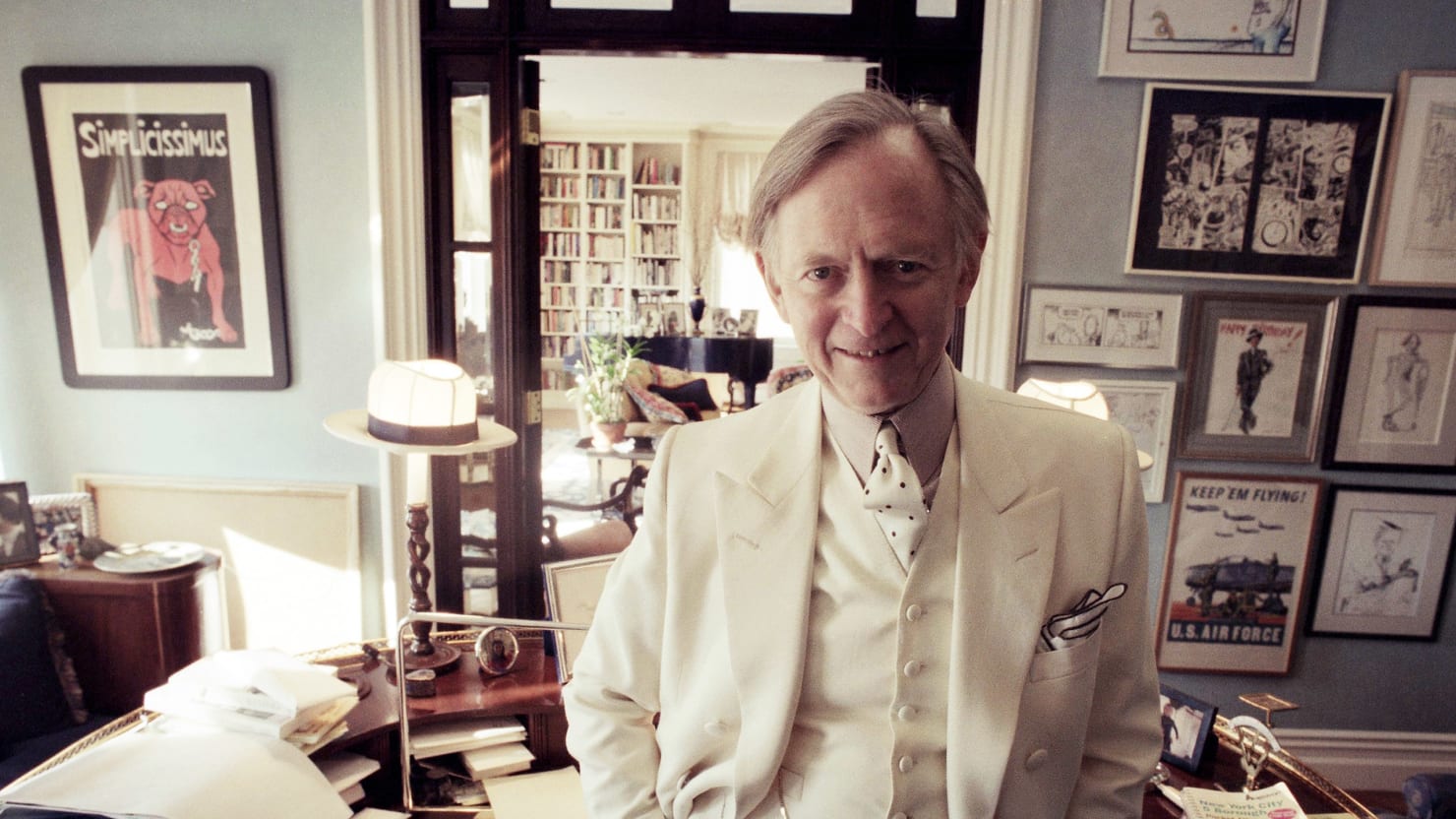
Tom Wolfe: An Appreciation


I was always a fan of what was called the "New Journalism" as practiced by Tom Wolfe and a few others.  I particularly liked his Radical Chic which so devastatingly mocked the propensity of rich, intellectually-inclined white who hosted events for such as the Black Panthers, and mocked Leonard Bernstein in particular,.  "New Journalists" as I understood them included Norman Mailer, whose Armies of the Night and Miami and the Siege of Chicago were personal favorites.  Then of course there was Hunter S. Thompson, though he I think was referred to as  Gonzo Journalist, perhaps because his new journalism was associated with the intake of drugs.

It's odd, then, that Mailer was among those who criticized Wolfe for not really being an artist or novelist, despite the fact or perhaps because he wrote so well.  John Updike was a critic as well.  I've never had enough interest in Updike to read any of his work.  Mailer interested me, though I thought his writing would become grotesque now and then, particularly when the subject being addressed was sex.

Wolfe's journalism was very good indeed.  The Painted Word and From Bauhaus to Our House are impressive.  But I find it hard to understand why his novels failed to pass muster with some; why they're considered somewhat lacking by other novelists.  I suspect, though, that this is the case merely because they tell interesting stories and tell them well, and also sell well.

Wolfe's novels are picaresque, in the sense I think that the Satyricon of Petronius Arbiter and The Golden Ass of Apuleius are as well.  They're adventures involving protagonists who are recognizable who encounter ordinary and extraordinary circumstances and react to them in ordinary and extraordinary ways.  Most of all, they're enjoyable.

It may be that art has come to mean that which cannot be enjoyed, that which is not entertaining.  Art is supposed to inspire in us some feeling which isn't associated with pleasure, being too profound.  It can be disturbing, grim.  It must cause us to think--never a pleasant experience for most of us.  It may move us to tears or anger.  It is supposed to evoke some strong emotion.

That may be so, but if so is dispiriting, I think, for the artist and those who patronize the artist or his/her work.  What we experience in life can be dreary enough.  Why seek to create dreariness, or seek out such creations, when we're exposed to it in "real life" and allow it to disturb us from moment to moment?

In dark times, entertainments are few and become coarse.  Those who can tell good stories and tell them well, with wit, imagination and intelligence, should be honored as much as any; perhaps even more.

Monday, October 2, 2017

The War I Missed


I turned 18 in 1972.  That was the year the last draft lottery took place.  The lottery applied only to those who had been born in 1953, though, and I was born in 1954.  I duly registered for the draft, but consequently wasn't drafted.  My draft card lies somewhere among the debris I've accumulated over the years, but there is no other token of the Vietnam War among that debris, nor did I become debris of that war as many others did.  The Burns/Novick production The Vietnam War serves to remind me of the war I was fortunate enough to miss.


I didn't know when I registered that there was no chance I would be drafted, unless another lottery was held.  In fact, I knew little enough of the war itself.  Though a Boomer, I wasn't an old enough Boomer for the war to have a great deal of impact on me personally.  I knew no veterans at the time.  As far as I can recall, there wasn't much discussion of the war among my friends in high school, or even in college.  We weren't threatened by it, not really.  By the time I graduated from college, of course, the war had ended.


What I remember of the war and those times is what I saw on TV or read in the newspapers.  Like most whose exposure to the war was thus limited, I knew very little, relatively speaking.  I never participated in a protest march.  I never protested.  I was 14 at the time the 1968 Democratic convention took place in Chicago, and saw footage of the rioting, heard the speeches at the convention, or some of them, watched the now famous, or infamous, Buckley/Vidal debates with what comprehension I had as a 14 year old, which I think wasn't much.


I'm a fairly avid reader, though, and read of the war as I grew older.  I knew, for example, that in purely tactical terms the Tet offensive was a miserable failure for the North long before the work of Mr. Burns and Ms. Novick appeared on our TV sets, and knew also that our nation wasn't particularly impressed by that fact.  I knew the argument that we should have won, but could not win as the war wasn't supported by the nation.  I knew that this lack of support was sometimes blamed on liberals or the liberal media.   I tend to think that an empire failed to do justice to its soldiers, and failed even to recognize that it was an empire engaged in a war of empire, between empires.

I knew the argument we should not have been there in the first place, knew of the incursions into Laos. the troop withdrawals late in the war, the largely ineffective "peace talks", Kent State, the march on the Pentagon (I read Norman Mailer's The Armies of the Night; also Miami and the Siege of Chicago), the murders of Robert Kennedy and Martin Luther King, the campus protests.  Much is called to mind in watching Burns/Novick's version of the war.

What I didn't know, most of all, was what happened to those who fought or otherwise served in the war.  This documentary does us a great service by informing us of what happened to them, and what they thought and think about it. 

I think that if I had been drafted, I would have been one of them in some capacity or another.  I had no objections to the war which would have sufficed to prompt me to seek refuge in Canada, and didn't think of myself as a conscientious objector.  What I find most remarkable, and disturbing, is how little touched I was by a war that took the lives of many of those but a year or two older than I was; it's an unsettling fact.  Perhaps our sense of history is ultimately selfish, or perhaps mine is, in any case.
 
Very few of those appearing in the documentary come out looking well, outside of those who fought.  For them I find it impossible to feel anything but pity and respect.  Those objecting to the war appear small.  It's possible, of course, that objections to the war could have resulted from the belief that the war was immoral, but the protesters preening in front of the cameras hardly seem heroic or lit with the fire of righteousness.  Pity for them is appropriate when they're killed, as were those at Kent State, or beaten, or jailed if for merely expressing an opinion.  How many of them were, though?  The politicians seem even smaller, in fact despicable. 
 
In the end, America did what was politically expedient.  Arguably, that's what it did when it became engaged in Vietnam in the first place.  Arguably, that's what it does now and what it will always do; what is all it can do.


Wednesday, August 1, 2012

R.I.P. Gore Vidal

No sooner do I mention him in my little comment on Mencken and Gore Vidal dies.  He succumbed to age and that which it seems is often the end of the aged, pneumonia. 

He was a celebrity, of course, and in that sense was not remarkable except for his acidity.  He didn't seem to care whether he pleased or not when he acted in that capacity, appearing on television talk shows, primarily, and for that indifference he must be honored--generally, celebrities are tiresome in their zeal to evoke pleasure in their audience.  He is of course remembered for his "debates" with William F. Buckley, Jr. during the 1968 Democratic convention in my beloved Chicago.  I vaguely remember watching those, and feeling pity for Howard K. Smith, the amiable but overwhelmed moderator.  Neither Vidal nor Buckley benefited from that encounter; both were probably at their worst.  Vidal of course later mocked Buckley through the device of William de la Touche Clancy, a character who now and then would appear in Vidal's wonderful series of novels of American history commencing with Burr.  Clancy was the editor of a right-wing publication and a notorious pederast.  Vidal had very well known encounters with Norman Mailer as well.

Regardless of his celebrity status, however, he was in fact quite remarkable as a writer and stylist, in my opinion at least.  His writing was generally elegant and insightful and distinguished by a magnificently dry wit.  He wrote enchanting novels--historical novels in particular (my favorite being Julian).  He is, with Patrick O'Brian and Mary Renault, one of the best writers of historical novels I've ever read.

But he was especially able, I think, as an essayist and critic.  He may well be the last of the great essayists.  In this age of Twitter, and, yes, blogs, none of us seems capable of extended thought; our technology doesn't encourage it, and in fact discourages it.  He had lapses, it's true.  At least as he grew older, he seemed to either indulge in or propound conspiracy theories regarding Pearl Harbor, the assassination of John F. Kennedy, and what we have chosen to call 9/11.  I've always wondered, though, whether he was pulling our collective leg when he wrote such things.

He seemed to know lawyers (good ones, I mean) quite well.  I'm not sure why he knew them well, but I judge this to be the case by his characterization of them in his novels, and specifically his portrayal of the proceedings in the case of the United States v. Aaron Burr.  He also seemed to know politicians quite well, and this is unsurprising as he was part of a political family, and actually ran for office himself.

He was also a critic of American interventions, military and otherwise, in the affairs of other nations, which I think sensible in most cases.  He seemed to long for the time when the United States was not an imperial world power, which would I think take us back to before the Spanish-American war (although the Mexican-American war was a most egregious land-grab and a shameful enterprise as noted by one U.S. Grant).

Unless there is some change in the way our culture seems to be heading, I doubt we will see his like as a writer again.  Christopher Hitchens is the only one I can think of who (recently) could write as well, and they fell out, perhaps inevitably.  But I'm a pessimist, and my feeling that we have become a society too concerned to speak, think, write and emote as quickly and briefly as possible may be unwarranted.  I hope that's the case.