Showing posts with label Heidegger. Show all posts

Tuesday, December 19, 2023

One Little Hitler


I haven't been able to determine who drew the editorial cartoon gracing this post, but it was apparently made in 1942.  I think we're safe in believing that it isn't, in fact, a self-portrait.

It presents an interesting take on Hitler's popularity with the German people at that time.  The slavish figure genuflecting to Der Fuhrer gives thanks that Hitler has saved him from democracy, which is called a scourge.

The belief that democracy is if not a scourge then a decadent failure as a form of government which should be discarded was a popular one among the intelligentsia of the time, including that disgusting Nazi toady, Heidegger.  It continues to be the belief of various right-wing intellectuals in Europe currently, for much the same reasons.  Those reasons seem to have their bases in nationalism, the preservation of cultural if not biological purity, resentment and the desire to be safe and secure followers of a national or cultural hero-figure.  Democracy is seen as chaotic and too favorable to opposing and unusual views and people.

One can't help but wonder if that's how many feel about it here and now.  Not that our Great Republic has ever been a democracy, properly speaking.  But such as it is, it may be that we have come to a point where a significant number of us are not comfortable with it, for reasons similar to those supporters of fascism in the past.  

Others have already wondered whether our Glorious Union is becoming similar to the version of America in Sinclair Lewis' It Can't Happen Here, published in 1936.  Comparisons have been made between current political figures (one in particular) and Buzz Windrip, the American dictator in the novel.  Buzz was probably modeled on Huey Long, but his personality traits are similar to those of other men better known now than the Kingfish, a Louisiana populist.  Buzz incarcerated political opponents, denigrated women and minorities, was anti-immigrant; he was vulgar, vain, outlandish, and a prolific liar, and very popular.  The American fascism described in the novel was a great friend to big business.  It had more in common with Mussolini's version of corporate fascism than with Hitler's Nazis.  Hitler wasn't all that well known in America at that time.

In these times when political figures declaim, to acclaim, that immigrants are poisoning our blood and are vermin, as are political opponents, the assertion that what took place a hundred years or so ago in Europe can't take place here is less than credible.  It's apparent that elections and the rule of law mean nothing to many here in God's Favorite Country.  What's next?

It's interesting that in Lewis' novel, the opponents of Windrip and his regime took refuge in Canada.  We hear Canada being praised often in these dark times, for a number of reasons.  Was Lewis prescient in that respect as well?


Thursday, August 3, 2023

Razzle-Dazzle


Sometimes, when feeling despair at the fact that such a large percentage of my countrymen are seemingly incapable of making reasonable judgments based on available evidence, and subject to delusion, I try to comfort myself with the idea that they are not truly saps, but rather are so entertained by the spectacle our politics have become that they simply don't want the show to stop.  What is taking place now would make a good dark comedy, after all.  Perhaps not even a subtle one, subtlety being something lacking in American politics and perhaps even culture, but more of a Marx Brothers' movie along the lines of a farce like Duck Soup or A Night at the Circus, though Groucho was far more clever and intelligent than the main character of this ongoing farce can ever be. Can it be that they are so amused by the freak show that they fear it may end, and so clamour for more and more despite the consequences for our nation?

This is wishful thinking, unfortunately.  It's odd enough that anyone would find this thought a satisfying alternative to what's actually taking place (better a perverse but knowing cynicism than what Mencken would probably have called "boobery"), but no.  We may not be sophisticated enough to be decadent.  Only ignorance and gullibility can explain what's now the case.  Gullibility in particular, I think.  Which brings us to the notion of razzle-dazzle.

This is a word which it seems has its origin in late 19th century American slang.  So, at least, is thought by the editors of the Online Etymology Dictionary which describes it as "a word, app. of U.S. coinage, used to express the ideas of bewilderment or confusion, rapid stir and bustle, riotous jollity or intoxication, etc.  Also, deception, fraud; extravagant publicity."  The rallies we see seem to be a sort of tent show of the kind that evangelical preachers and faith healers used to put on (or do they still?), inspiring the believers to unthinking credulity.  Or, maybe, a magician's act of a sort, in which the misdirection is obvious enough but nonetheless persuasive.  The snake oil salesman has a place in our history.  Perhaps its become an honored one.  Is there a nostalgia for the days of the bumpkin being taken advantage of by the city slicker, which also is a part of our history?

How do we explain the appeal of something or someone so obviously a con?  There must be an explanation.  Razzle-Dazzle seems as good as any.  If it's a peculiarly American word it may also be a peculiarly American tendency, to be dazzled and confused by showy deception.  Do we long, spiritually, for the arrival of the circus or the Wells-Fargo wagon, to bring color to our drab lives?

I find it hard to think of any historical precedent for this situation.  Hitler wreathed himself in Romantic, mystical appeals to a German Volk, a Master Race, and was aided in such claims by philosophical and intellectual loonies like Heidegger, but there is no philosophical appeal being made in this case.  Resentment is being fostered, but not yet to the extent it was in Germany after WWI. Intolerance and the desire for sameness has always been characteristic of Western civilization, but the blithe disregard of honor and virtue we seethe with as a nation is extraordinary.  

I don't think charisma has a place in the mix.  Those involved in this remarkable song and dance have none.  They resemble Willie Loman more than any successful leader in history, good or bad.  They seem gnomish, if not in actual size then in stature and character.  

We can look to the example of Rome in this and other cases, and there may even be some justification in doing so.  Spectacles were wildly popular with the people.  Celebrations of triumphs, the games of the arena, the races of the hippodrome, attracted the attention of the populace and even the most depraved of the Emperors, such as Caligula and Nero, had the admiration of many merely because they kept the people entertained.  Perhaps our future leaders will be entertainers.  They will take residence in Washington as they now do in Las Vegas.  

Maybe this is the new form of American Exceptionalism.  We can hardly be seen as exemplary anymore, but we're certainly distinctive and unique.  Mencken called us boobs, and his assessment was thoughtful.  We're seeking, and may yet attain, a government for the boobs, by the boobs and of the boobs.


Thursday, April 20, 2023

Heidegger the Horrible


I make no secret of the fact that I loathe Martin Heidegger.  I've mentioned it in this blog from time to time.  I've also mentioned it in a philosophy forum I frequent. 

My loathing of him is largely based on the fact that he was, and remained until his death, an unrepentant, and even an enthusiastic, Nazi.  It's true that I also don't care for him as what I've read of his work strikes me as romantic and even mystical, when it is comprehensible.

For example, I thought his The Question of Technology to be at once dour and fanciful.  He seemed to be condemning the use of technology to generate energy through regulation of water, and its use to extract and store coal, declaring the former to be, in effect, monstrous and the latter to be a kind of rape of the earth.  The fact that humans have been regulating (altering its course at will) water through irrigation, and using it as a source of energy in milling, for thousands of years, and cutting and storing lumber as well for millenia, isn't mentioned in the essay.  Instead, a hydroelectric plant and mining through use of technology is compared, unfavorably, with peasants lovingly planting seeds in nature's bosom and such.  It's difficult to believe that this kind of reasoning is given serious consideration.  But that isn't grounds for revulsion, typically.

I've been scolded for this by several persons.  Usually, the scolder has (sometimes grudgingly) acknowledged his Nazi past, but considers it a kind of fluke or flirtation.  If so it was a long lasting one, as he didn't relinquish his membership in the Nazi party, and was a member until the end of WWII.  I've also been told that his philosophical work must be distinguished from the man himself, and that his philosophical work is superb, sublime; think of the most excessive expression of adulation you can conceive, and repeat it with his name as a sort of mantra, and you will begin to understand the praise he receives.  

But I think the attempt to distinguish the Nazi from his work is becoming more and more difficult as we learn more and more about him.

I've been listening to an audiobook version of Richard Wolin's Heidegger in Ruins:  Between Philosophy and Ideology.  If the claims made in it are accurate (and a persuasive case is made that they are, and that they're well documented), I think it is unreasonable for anyone, now, to claim that Heidegger the faithful Nazi is unrelated to Heidegger the philosopher.

This is because the publication of the so-called Black Notebooks has served to reveal the extent of his anti-Semitism and his acceptance of the mythos of Nazism (the superiority of the German Volk and its special mission to save the West, if not the entire world, from World Jewry and technology and attendant nihilism), and their relation to his focus on Being, even as it appears in his book which is given a kind of sacred, biblical status by his followers--Being and Time.  His nearly ecstatic reflections on German superiority and its mission seem not dissimilar to statements made by Himmler.  It seems that Heidegger thought the Jews if not every other people but the Germans lacked Being.  But for the Germans, all others have no connection with Blut und Boden, apparently a necessary condition of Being.

If this does not justify the war and the Holocaust, it seems to have sufficed as far as Heidegger was concerned to relieve the Germans of any blame for them.  Thus, he wrote of the "self-annihilation" of the Jews and the "inner truth and greatness" of National Socialism well after 1945.  His claims when rector at Freiberg (that's him posing as rector at the head of this post) that Hitler was the future of Germany and its law and similar hosannas to Der Fuhrer and his programs were not isolated, foolish statements, but expressions of strongly held beliefs.

I still have much to listen to, and will try to do so, though frankly the portrait of Heidegger appearing in the work so far is that of someone who was at best a disingenuous, self-important, poseur with looney, mystic beliefs in a master race and at worst a dishonest, self-serving apologist for mass-murder and a brutal autocracy.  It makes for disturbing listening.


Monday, March 7, 2022

Mere Thuggery is Loosed Upon the World


In the drawing above, Senator Charles Sumner is shown in the course of being assaulted with a cane by Preston Brooks, a member of the House of Representatives.  It's an interesting moment in the history of Congress, and that of the United States.  Not all that long after Sumner was beaten unconscious, the Civil War began.  It's not completely clear whether Brooks was motivated to cane Sumner because of the latter's stance against slavery, or because the Senator vilified a fellow Senator who was Brooks' kinsman.  I think it's likely that Brooks felt his kin was being dishonored, as Sumner and others made their anti-slavery stance clear long before the incident.  Brooks evidently didn't challenge Sumner to a duel because he didn't consider Sumner to be a gentlemen.  So, he resorted to beating him as he would a dog or, likely, a slave.

"Thuggery" is variously defined as rough, violent or anti-social behavior by criminals or bullies.  I'd call the caning of one member of Congress by another an act of thuggery.  Happily, actual violence between members of Congress is relatively rare.  But thuggery of one kind or another is becoming commonplace, or so thinks your less than humble servant, Ciceronianus.

Why is this?  Consider those who have commonly been described as thugs.  There were of course the bandits in India from whom the word is derived.  Unfortunately, the word has become associated with some rap or hip-hop sorts who apparently find being considered a thug to be attractive.  But it's also been associated commonly with, e.g., mafiosos, low-level but brutal criminals, bullies, muggers, and even some political regimes, like the ever-repulsive Nazis (unless of course you're a devotee of Heidegger, the Nazi so esteemed by intellectuals, the good Nazi).

Thuggery by a political regime is most recently on display with the Russian invasion of the Ukraine.  The reasons given for the invasion have been baseless, and even obviously so.  Some are absurd.  There is some truth in the assertion that Russia and the Soviet Union has for a very long time always wanted and claimed the Ukraine, but though that may be a fact it's hardly grounds for an invasion, unless it is simply a means by which territory may be obtained that is claimed by a recognized, sovereign nation by another stronger nation through the use of force, which is to say by thuggery.

But thuggery is evident in other respects as well, though perhaps in a smaller and less violent way.  Here in our Great Republic, it seems to be increasingly characteristic of our politics and many of our people.  The person formerly known as the president was and is in several ways a kind of thug-wannabe--an admirer of real thugs on the world stage, and a (thus far) failed thug in his efforts to overturn a legal election.  This is not to mention the manner in which he ran his (often failed) businesses, blithely avoiding debts through the bankruptcy courts and, apparently, spreading unsubstantiated claims regarding their financial soundness.

It can also be maintained that he and his minions encourage thuggery.  As a friend recently said, through them an "ugly door" has been opened and several kinds of bullies, boors, bigots and others have flowed through it to run amuck in our society in a kind of celebration or festival of thuggery, sometimes of a low, mean kind and sometimes by those pretending to a grand manner in politics, media and culture.  Rudeness and the flaunting of ignorance and prejudice are seen as admirable; some people seem to think they're entitled to be louts.  It's become something of an honor.

We may be becoming a nation of Jonathan Swift's Yahoos, without Houyhnhmns to guide us. 

Wednesday, January 5, 2022

A Day that will Live in Ignominy


On January 8, 2021, I wrote a post about the events of January 6th of that year at the Capitol of our Great Republic, remarking that it represented the end of American Exceptionalism.  That it surely did, and does, especially as it seems that that the hope of many of our especially craven politicians and pundits is that those events will be disregarded or forgotten, or even thought of fondly, like the antics of well-meaning but fractious children.

I don't refer to the self-infatuated blowhard who it seems has cancelled his plans to pontificate publically on the first anniversary of those events.  This cancellation would seem wise even from a purely self-interested perspective (and what other perspective does he have?).  What he would say is what he has said.  Watching him say it again would be like watching a demented person repeat a story he's already repeated many times, in much the same way with much the same words.  It wouldn't be a pretty sight even for his biggest fans.  Because refraining from making a spectacle of himself once more would be wise, he may yet do so, but in a less open format.

I refer to people who've actually been elected to office.  That in itself doesn't speak well for them, as this may hardly be called a mark of distinction in these sad times.  But for an elected official to be intentionally disingenuous about disgraceful conduct directed against a lawful election is especially ignominious, as it implies that such an official is unconcerned with and indeed against lawful elections generally, concerned only that the result of an election is desirable.  That is a view which would render representative democracy ineffective.  If accepted, elections would merely be a show to those elected, the winner being the one who could most efficiently "fix" the outcome.  That elected officials, and pundits and those who effect public opinion, could countenance this and even think it's desirable is shameful.

I suppose I should acknowledge that this is to assume that those seeking to disregard or justify what took place on January 6, 2021 don't believe that the 2020 election was stolen.  In a way, this assumption credits them with more intelligence than they may have.  But it's hard to believe that any reasonable person accepts what's being called "The Big Lie," a reasonable person being one who requires more than unproved allegations, shot down in court after court, to accept election fraud.  It's true, though, that reasonableness isn't something we see much of in our Glorious Union right now.  It's also true, unfortunately, that there are those in politics who will stop at nothing to assure that they will retain their position and power.

Perhaps it wasn't all that much different in the past.  Perhaps instead we live in a time when those who are unreasonable, ignorant, prejudiced and intolerant are more able to make themselves known and noticed than ever before.  I've speculated along those lines in this blog more than once.

Still, though, we may have come to the point in the U.S.'s decay when it no longer matters how the majority of people may vote.  Instead, it may be more important what some people, regardless of whether they're a majority, believe is right.  People who think they know what's right have found democratic government to be wanting--a kind of inconvenience--since at least the time of that pioneer of totalitarianism, Plato.  Ironically, Plato feared that a democratic form of government would allow demagogues to sway people away from what is right and good (that being what Plato thought was right and good) thus impeding the march to perfection he sought to impose on us.  Plato sought to change us.  Now, though, demagogues serve to prevent change, change being an evil in the eyes of those who hold power and have privilege.  

I fear, by the way, that I can't take credit for the felicitous phrase "self-infatuated blowhard."  I've seen it applied to another favorite of many among us, Martin Heidegger.  I just had to use it myself in another connection, and apply it to another ignominious figure.


Monday, November 29, 2021

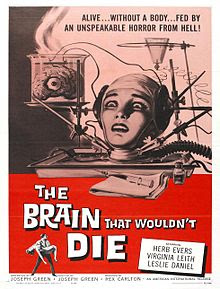
Brains in Vats and the Untrammeled Mind


Not a brain, but a brain in a vat.  That's what won't die, at least in that part of the world (if there is one!) inhabited by philosophers.  "An unspeakable horror from hell!"  Indeed.

It's difficult to imagine a less serviceable avenue of thought than that indulged in by many philosophers for many centuries, relentlessly wondering if there is what is suggestively referred to as an "external world" and, if so, if it can be known by us. Worse, though, is their shameless tendency to write on the subject, if indeed it can be called one.  The consideration of the "question" is singularly purposeless, not merely because it's incapable of resolution, not indeed merely because it's questionable there is a "question" to be addressed, but because its consideration along with any possible resolution makes no difference to us, or to our lives.

It can't be disputed that we always act as if there is an "external world" and for the most part that our belief in it and its characteristics is substantially justified.  Anyone who seriously questions it could be accused of deliberately and thoughtlessly disregarding his purported belief.  Such a person would have to be mentally ill--"There is no world, but I live in it" isn't a statement most would make, and if one would make it seriously one would be treated, justly, as not quite sane.  That is what's done by philosophers who chew on this old chestnut and do so verbally and in print, to the amazement and bewilderment of those who listen to them or read their words (assuming, of course, that they exist).

What's particularly curious about this fixation with our claimed ignorance is that it's sometimes asserted that our incapacity is established by "scientific evidence."  There is of course the problem that it's questionable whether there can be any evidence, scientific or otherwise, if we can't know the "external world."  But it would seem obvious that the scientific evidence indicates that we evolved over time through our interaction with the rest of the world and interact with it consistent with our expectations time and time again.  If the results of experiments are "scientific evidence" it's apparent that scientific evidence in support of the existence of an "external world" is overwhelming.

Why, then, is this fantastic subject one of continuing interest and effort?  Let's ask, following Cicero:  Qui bono fuisset?  Where we humans are concerned, it's always important to consider who benefits from a particular act, question or issue.  Benefit--ours in particular--is always uppermost in our minds.

Who would benefit from a belief that we can't know the world, that we're separate from it, that it isn't real, or less than real; isn't true or less than true?

Those who thrive on it, clearly.  Philosophers, of course, do so.  For some it's their bread and butter.  Most if not all of the religious, as well.  "My kingdom is not of this world"--so said Jesus or so said someone who said Jesus said it.  The clergy in particular.  What would they do if people didn't think there was a world beyond this one; a world better than this one, which is the "real world"?

Anyone who benefits from disregard of or disparagement of the world as it is conceivably gains from the perception that there's something fundamentally wrong with things, so we may have to include politicians and pundits as well among those who claim the world isn't as it appears to us.  

No wonder that Plato, who first wrote extensively of a reality not of this world, was a totalitarian at heart.  If the world isn't real, then clearly we should seek what is real.  If we can't, we should be made to do so, for our own good.

And so we see what metaphysics and epistemology can lead to, if untrammeled by the world!  Without weights or guide lines, they ascend uncontrolled into the air like the balloon of the Wizard of Oz, they render us inhabitants of that city in the sky, Cloud Cuckoo Land of Aristophanes.  No wonder, perhaps, that Heidegger was a Nazi.  
 

Tuesday, January 8, 2019

There are Monsters, and then there are Monsters


Now and then, and in any case too often, I find myself drawn to discussions, of a sort, concerning Heidegger in a philosophy forum I frequent.  I don't think I can say I'm irresistibly drawn to such discussions, as I've managed to avoid some of them.  In this particular case someone asked for assistance in understanding a paragraph from Being and Time.  I found the paragraph so obscurely written, so crammed with what seemed to be jargon, that I succumbed to the unworthy desire to mock it.  This led one helpful poster to provide what I think must be called a translation...a surprising one to me as it seemed only vaguely related to the topic apparently being addressed in the paragraph in question.  Having helped me, though, the poster then scolded me, saying that I should learn the meaning of the vocabulary used by Heidegger if I wished to criticize him.

I personally think that a person should not have to learn the meaning of special words in order to read and understand a philosopher's work, or that of anyone else for that matter.   I think philosophical and most other points can be made without recourse to arcane language.  There should be no code one is required to discover (the "Heidegger Code"?) before the meaning is revealed.  Be that as it may, though, this post is inspired by a statement made by another poster after the word "Nazi" was brought up (I wasn't the first to do so).  That statement was to the effect that in assessing (with admiration, it apparently goes without saying)  Heidegger's philosophy we shouldn't get "bogged down" in the fact the man was an absolute monster.

This statement interests me, and not just because it acknowledges Heidegger was a monster.  Most of his apologists admit, as they must, that he was a member of the Nazi party.  Most know of the speeches he made in support of National Socialism and Hitler.  Most know, or should know, that he was a party member until the end of the war, that he never criticized the Nazis, or Hitler; that he never mentioned the Holocaust; that he never expressed regret for being a member of the party.  It's no longer possible to maintain he was not an anti-Semite after the publication of the Black Notebooks and his letters to his brother.  It's increasingly difficult for an apologist to maintain, reasonably, that Heidegger was not an enthusiastic Nazi, though some try to do so still.

So, instead, one hears from apologists that it doesn't matter.

I find the statement interesting because it speaks to the title of this post.  When we say someone is a monster, what do we mean?  Does someone who is a monster cease being a monster in some circumstances?  If Heidegger (or someone else considered a monster) was a monster, was he a monster when "doing" philosophy (or something else considered worthwhile)?  Does/should it matter if a monster does something worthwhile--does/should it make the person less of a monster?  Or, is a monster still a monster when doing something admirable, but that fact does not reduce the merit of what was done?  If that's the case, do we admire the monster or what the monster did?

The picture at the beginning of this post is an illustration used in the 1831 edition of Mary Shelly's Frankenstein.  It doesn't depict the monster as most of us know him.  Men, women, children can be monsters, but they need not be evidently a monster, a monster by appearance.

Do we, can we, say of someone "he/she is a monster, but a great philosopher/artist"?  When it comes to art, I don't think we usually distinguish between the creator and the created in any definite or significant sense when we understand that the act of creation was intended, and admire what was created, nor do I think it reasonable to do so.  We admire an artist who creates a great work of art because he/she creates it.  Nobody but the artist could so; the work of art is essentially a product of the artist as a person.  It isn't the work of just a part of the artist, i.e. the good part.

Nor do I think we make such a distinction in the case of a philosopher whose philosophy we admire.  If we admire Heidegger's philosophy, we admire Heidegger as well, for the same reason as we admire the artist.  Only Heidegger could write his philosophy, and Heidegger is a person.  But, we can't intelligibly say that we admire Heidegger the philosopher, not Heidegger the Nazi, as they're the same person.  Heidegger intended to be a Nazi and intended to write philosophy.

Say that's the case.  Can we nonetheless say the work of art/philosophical work can be considered apart from the artist/philosopher?  Can we say the fact Heidegger was a Nazi isn't important to his philosophy, or that we cannot or need not get "bogged down" in the fact he was a Nazi in reading or assessing his philosophy?  Well, I don't think we can deny or explain away the fact that if we admire Heidegger's work, we admire what the Nazi did and thought; we admire the Nazi's philosophy.  That Nazi sure was a hell of a philosopher.

Some have argued that Heidegger's philosophy encouraged or justified, or led to, Nazism.  What I've read of him indicates to me that he believed in the superiority and special destiny of the German language and people and did so for quasi-mystical, quasi-philosophical reasons, and this oddness is found in Nazism and other "isms" based in German romanticism.  But as to his ontology, his metaphysics, I will probably never know.  I'm not keen to learn, or discover, or decipher the Heidegger Code. 

Sunday, July 1, 2018

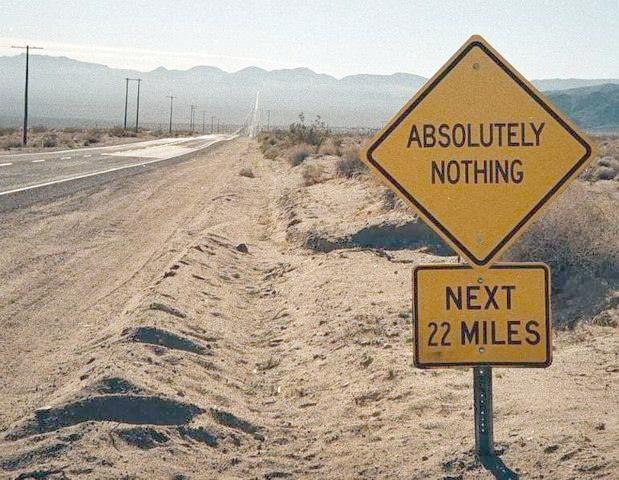
Meet the Nothing

There's something called "the Nothing."  There's something called "Nothingness."  They are (are not, perhaps) a concern to certain philosophers of a certain kind.  Apropos of nothing, Cicero once said (I paraphrase) that there is nothing so absurd that some philosopher has not already said it.

"Nothingness" I suppose represents the state of being nothing, or perhaps is characteristic of nothing, or is the quality of nothing or is characteristic of "the nothing."  Nothing is, apparently, the opposite of Being, or its negation.  I may be mistaken though.  I know nothing of the Nothing.

Heidegger the Great and Powerful wrote of the Nothing in his inaugural address on becoming rector at Freiberg, where he infamously made some speeches praising and indeed glorifying Hitler as, among other things "the future of Germany and its law."  I spent some time asking questions about this speech in a philosophy forum I frequent, and eventually was duly accused of bad faith for doing so and, I would think, also because I didn't understand what he was saying.  Which was nothing?  I still don't know.

I think Heidegger is something of a sacred cow in some philosophical circles and his followers eagerly leap to his defense whenever he is questioned or mocked.  They may be all the more avid in his defense because there's no doubting the fact that he was a member of the Nazi party, and never publicly expressed any remorse over that membership, nor to my knowledge did he ever publicly express criticism of the Nazi regime before, while or after it was in power.  As a result, those who defend him are defensive in doing so.

But I've been told many times, sometimes sternly, that his misdeeds in life have nothing to do with the merits of his philosophical works, and I would say that it's likely his fondness for Hitler and the Nazis at the least did not arise due to his writings regarding "the Nothing."  Had, in other words, nothing to do with the Nothing.

I think Rudolf Carnap said all there is to say about "the Nothing" as it is referred to in the inaugural address.  What he says essentially is that "nothing" shouldn't be spoken of as if it is something or used as if it is a name for something, and if it is so used it leads to meaningless propositions.  But Heidegger seems to understand this and indeed says he does in the address.  Nevertheless, he says this is a defect in logic, not in use of the word "nothing" or indeed in "the Nothing."  "The Nothing" is encountered only when one is "suspended in dread" (or anxiety).  It's only this encounter which allows us to understand Being.  "Being" apparently refers to that which is.  That or those which is or are have "Being."

"Being" and "nothing" are concepts, names, or something which fascinate many philosophers, I'm sorry to say.  "Being" seems to me to suffer from some of the same problems as "nothing" or "the Nothing."  It may be used as a noun or name, and is treated as if it is something, a quality possessed by that which is, as opposed, apparently, to "that "which is not.  But at least unlike "nothing" or "the nothing" it actually refers to something which exists; indeed, everything that exists.  "Nothing" doesn't refer to any thing.

The fascination with "nothing" seems to be related to a question which in turn is a fascination of some philosophers.  That question is:  "Why is there something instead of nothing?"

Now some, like me, would say that there are problems with that question.  That problem as I see it is that it also is premised on an assumption that there is something that would exist if something didn't exist, called "nothing."  One can ask if one wants to "Why there is something?" but one can't then refer to anything that is "instead of" something.   Nothing would exist, true, but "nothing" doesn't replace something.

I think the question when posed as, "Why is there something instead of nothing?" or "Why is there something?" isn't one that can be answered by philosophers.  If it can be answered at all, it would be an explanation of the fact that things exist, and that explanation would seem to be one that would formulated by science, not philosophy.  That is, unless one is satisfied by an answer which is merely speculative.

It is a question which invites not merely speculation but the use of words in the fashion used by Heidegger and others when it comes to "nothing" and so invites confusion and what Carnap calls "pseudo-statements."

Carnap suggests such statements by philosophers may serve to do what poetry and art does, or music.  For me, that means that such statements may be evocative, and evoke a kind of knowledge or appreciation of the true or correct.  That may be generally true, but as I think Carnap observes the poets, artists and musicians or composers do a better job in this respect that do philosophers.  Some of the most profound feelings I've experienced arose from reading poetry or listening to music.  But "the Nothing" inspires nothing in me, I'm afraid.  Don't tell anyone, though.  This is between you, dear reader, and me.

Thursday, August 25, 2016

Of "Trigger Warnings" and "Safe Spaces"

The University of Chicago has made the news because it has sent to incoming freshman a letter (how quaint!) notifying them that it doesn't favor so-called "trigger warnings" and "safe spaces."  I've heard these phrases before, and have seen them in certain forums I frequent, I think in connection with the now more or less ubiquitous references condemning "political correctness" in colleges and universities in particular.

Apparently, a "trigger warning" is a notice of some kind to students that material or speech they might find offensive, or which would make them uncomfortable or even traumatize them, is about to be considered, discussed, written of...taught?  A "safe space" it seems is some place in which they may shelter from that regarding which a trigger warning would be given.  I'm delighted to read in one of the news stories that Brown University provided a safe space during some dispute or debate regarding sexual assault in which Play-do and bubbles were provided to those seeking safety, among other things.  The story doesn't indicate whether these items were made available as an ironic or sarcastic gesture.  How I wish I had Play-do to comfort me, right now.

Campuses have been subject to protests by various and sundry for quite some time.  Since the '60s, at least.  Students have been offended by any number of things for quite some time as well.  As far as I know, however, it's not until recently that institutions of what is sometimes laughingly called "higher learning" have found it necessary or appropriate to issue trigger warnings and/or create safe spaces.

Are we lawyers responsible for this?  Have we counseled colleges to do these things in order to avoid liability to the traumatized, the offended, the uncomfortable?  I hope not, but the United States is a litigious society.  I can conceive of circumstances where an incendiary speaker could induce an environment where physical harm to people or property might result and in those circumstances a lawyer could be inclined to advise against indulging the speaker by allowing him to speak.  I find it harder to conceive that a lawyer would recommend trigger warnings or safe spaces as a matter of policy, though.

Have we become too fearful of offending people, or of exposing them to what they might think offensive?  I'm not one who finds "political correctness" to be a matter of great concern.  Generally, I think those who are not politically correct or refuse to be politically correct are in most cases simply inclined to be rude and stupid.  It's not laudable to not be politically correct if being politically correct is simply to avoid being deliberately insulting or insensitive.  But I don't think institutions like colleges and universities need concern themselves with sifting material to determine what might disturb someone and to notify others that material may be considered, let alone provide them with a haven if it is.

State institutions or state funded institutions may be required to invite proponents of various points of view, some of them offensive, if they invite others or could be considered a forum for the expression of speech protected by the First Amendment.  However, it's not clear to me that a college must otherwise invite or allow anyone to propound anything to their students or faculty, regardless of whether or not it's offensive, unless it be part of a curriculum--in which case it would presumably be for the students' benefit; or for their education, which I suppose may or may not be considered by them to be beneficial.

It's the possibility that trigger warnings and safe spaces be given or provided as a matter of policy regarding material communicated in courses that causes me the most concern.  History, and what takes place in the present, is filled with offensive words, thoughts and conduct.  How would it be possible for a college to function effectively if trigger warnings would have to be given before Nazi Germany could be studied, or South African apartheid, for example?  Would objecting students be allowed to go to a safe space while this takes place?  What about technology some find offensive, courses of study which might encourage the use of nuclear power which some object to, or who knows what else?  Would warning have to be given, and students allowed to shelter in some space where they might gaze upon comforting photographs of Heidegger or some other technophobe?

It's also necessary to consider the fact that students, or most of them, will some dreadful day leave college and find themselves exposed to a world in which trigger warnings are few or nonexistent, and safe spaces, if there can be such things, must be of their own device.  In what way could college prepare them for that world if college becomes a place of trigger warnings and safe spaces?

I know, of course, that I've written before in some post or other that I consider the college years to be a kind of sojourn to a wonderful place unconnected with what we'll encounter for the rest of our lives; for most of us, at least.  Those who stay there may be able to ignore much of the world others cannot.  I also think that once we leave it, college becomes less and less important to us.  So it may be that no permanent harm will result if students are bombarded with trigger warnings and become used to running for the Play-do when disturbed.

But it seems to me that this will render higher education less of a benefit than it could be.  It also seems to me that students would be well advised to school themselves to not be unreasonably disturbed by why others say and think and do (except, of course, in cases such as sexual assault and active harm or oppression).  In fact, now that I think of it, Stoicism should be taught in college.  It's study should be mandated.  Compulsory training, Stoic exercises.  Perhaps there's such a thing as "Radical Stoicism"?

Monday, October 26, 2015

Reason and its Enemies

Richard Wolin, a professor of history and comparative literature at City University of New York, has written an interesting book entitled The Seduction of Unreason:  The Intellectual Romance with Fascism from Nietzsche to Postmodernism.  Although its title is cumbersome (it seems authors these days must include explanatory subtitles, as it were, following colons, in every book title) the writing is not.  It's a lengthy book, but unfortunately there's much to tell.

The title of the book is, shall we say, suggestive of its argument.  If it had been written by an American or English philosopher, continental philosophers and their followers here would likely ignore it.  But perhaps the author's status as a professor of comparative literature will lure them into reading at least summaries of the book, comparative literature buffs being far more capable philosophers than actual philosophers almost by definition as far as postmodernists are concerned.

It's not clear to me that the romance of intellectuals with autocracy began with Nietzsche.  I think certain philosophers have always had a fondness for "enlightened" despotism.  Even J.S. Mill in his more Romantic moments thought this would be beneficial, and under the influence of such as Coleridge dreamt up a kind of elite, a "clerisy", which would govern humanity wisely.  This pernicious view has been with us since Plato, at least.

But fascism is a peculiar, modern form of autocracy, a hodgepodge of political, racial, quasi-religious, quasi-philosophical and nationalistic mumbo-jumbo, and as such grew out of what I think can fairly be called the "unreason" which resulted from the reaction to the Enlightenment which has been called (not very creatively) the Counter-Enlightenment.  I personally prefer calling it the Un-Enlightenment.  Some thought that because reason, in and of itself, didn't produce a paradise here on Earth, it's opposite should be unleashed upon the world.

It turns out reason's opposite could be all kinds of things when considered by European intellectuals.  The emotions, the instincts, Jungian collective unconscious, the erotic, the spirit inherent in a particular race or purported race or nation.  Whatever was unreasonable in human beings was glorified at least as much as reason, or what was thought reason, was glorified by other European intellectuals during the Enlightenment.  This intellectual environment was ideal for the growth of fascism, a political/social/cultural philosophy dependent on the unreasonable, dismissive of moderation and tolerance, devoted to the irrational in humanity.

This led to what was extremely goofy in some cases, as Wolin points out.  There is Georges Bataille, for example, a follower of Nietzsche who was fascinated with human sacrifice.  He and others formed a little society which was devoted to the idea, if not the practice, of human sacrifice.  It seems its members were willing to be sacrificed but not inclined to perform the sacrifice, sadly.  Bataille was an influence on Foucault, who favored the Iranian revolution and the religious fascism of the Islamic clerics who took control after the Shah was overthrown, and others.  I'm not sure what was going on in the case of Bataille and sacrifice, but suspect he thought this was the sort of thing unreasonable people would and should do, which is undeniable, and that there was something mystic and pagan involved in it.

Goofiness aside, though, the emphasis on unreason motivated the endorsement of Hitler's Nazism and Mussolini's fascism by a number of thinkers dissatisfied with liberal democratic politics and values.  This is pretty well documented, and Wolin of course goes into some detail regarding famous Nazis and fellow travelers such as Heidegger and Paul de Man.

Mussolini's Italy and  Hitler's Germany were once considered models of efficiency and, it's hard to believe, physical and mental health.  It was thought that these nations had a vigor and intensity lacking in liberal democracies, for what may be considered spiritual reasons.  They were one, a people united, not chaotic in the manner of the democracies and especially the Weimer Republic.  Most importantly it seems to their intellectual devotees, they had abandoned liberal values as well; freedom, individuality, the conflict of ideas and worst of all, materialism.  Money and business have always been the subjects of contempt for the learned as well as the aristocratic.  Of course, the learned were also inclined to  associate them with Jews, themselves yet another subject of contempt.

It's quite possible to overestimate reason, and to impute too much importance to it.  It's also quite possible to underestimate the significance of the irrational in our lives.  Man cannot live by reason alone, and it may be said that the Enlightenment thinkers erred in their zealous emphasis and reliance on it to the exclusion of all else.  I think sometimes that those of the Enlightenment were drunk on their sudden freedom from the dominance of the Church.

But I find it impossible to blame the Enlightenment for the ills of our society, as it seems members of the Un-Enlightenment are inclined to do.  It isn't reason or science which motivated the Holocaust, for example.  Essential to that horror were concepts of the Volk and German Romanticism and mysticism.  They were also essential to German expansionism and sense of mastery and special  purpose; to rule the world and thereby save it.  Heidegger warned against technology but eagerly joined in the glorification of Hitler and in according him the status of a demigod.

We're at out best when we think, and as Dewey said we think when we're presented with problems.   Thinking involves problem solving and is essential to it.  We don't think when we rely on mysticism, our so-called inherent nature, our "being", our vigor, our unity, religion, our race in making decisions.  It's when we abandon reason as a means to solve problems that we produce monsters and follow them.  We become followers only, in fact, as we don't think but rather feel; followers only follow, some better than others.  Reason provides the best chance of understanding and solving the problems we face in life.

Unreason doesn't require justification.  There's no process by which those seduced by it test its results, no questions are asked as unreason isn't subject to question or for that matter definition.  Questioning, defining, testing have no place when reason isn't employed, but is instead shunned.  The result is certainty, but at a terrible price, as the certain are thoughtless, intolerant and cruel.

Thursday, March 12, 2015

The Problem with Hemingway

I'm an admirer of Hemingway's work, for the most part.  I'm not all that fond of his novels, except for The Sun Also Rises.  It seems to me that his longer works become disconnected, and lack impact as a whole (though parts of them are impressive).  His short stories are, for me, always enjoyable and sometimes remarkable.  I wonder, as I have here in other posts, whether this is the case for all American writers I've read.  But it may be that I lack the patience to appreciate novels generally.  This wasn't always the case, though, so it may be a function of age (strangely; but I'm nothing if not strange).

I think A Farewell to Arms retains what I will call the precision and purity of his short stories, but For Whom the Bell Tolls does not.  The latter novel straggles into the didactic and maudlin.  I'm uncertain whether The Old Man and the Sea is a novel or an extended short story. 

I refer to precision and purity not merely because I find them attractive in his work, but because Hemingway himself seems to have valued them highly.  He wrote in Big Two-Hearted River, or a version of it, that the character Nick wanted to write like Cezanne painted.  Nick, in that story at least, is generally considered Hemingway's alter ego.  He's also known to have been critical of James Joyce for using "tricks" in his work, though he also wrote that Joyce's characters were too much like Joyce himself.  Perhaps "simplicity" is a better word for the works of Hemingway I like.  Though I don't doubt he wrote with great care and purpose, I don't get the impression of contrivance and unnecessary and indulgent elaboration I receive when reading other authors when I read him; and I value this highly.

Since the days of his greatest popularity and acclaim, however, Hemingway and his work have been subject to a great deal of criticism.  Hemingway the person is said to have been unduly macho, cruel to friends and enemies, jealous; it's maintained he was an alcoholic, insecure in his masculinity (whatever that is supposed to mean), preposterous, a bore, self-serving.  His work is said to lack subtlety and art, to be easily imitated, to focus too much on "masculine" concerns like hunting, fishing, fighting and war; to be predictable.

The novel published after his death, The Garden of Eden, makes one wonder about the accuracy of the traditional, rather stereotypical, view of his personality and his writing.  It's difficult to think of Hemingway writing about what we would now call "gender roles" and "gender confusion" although his attraction to women of masculine appearance has been noted previously.  His scope as a person and as a writer may have been much greater than previously believed.

His personality and conduct must be considered in light of what seems indisputable--that he suffered from mental illness, as did other members of his family.  His father committed suicide as did other close relatives.  He clearly deteriorated during the 1950s, becoming paranoid and depressed, and was subject to various physical ailments as well.  It's speculated he was bipolar.

What seemed to be the primary problem with Hemingway as writer after his death, particularly in the late 20th century, was I think that he went out of style.  His writing was much imitated for a time, he fell out of fashion.  I recall feminists finding him particularly hateful, and anti-war feelings during the Vietnam era resulted in a lack of interest in his work.  So the themes of his work were thought chauvinist and macho.  But his style was also in disrepute, and as it seemed to some his later writing came to be repetitive in style as well as them.

My problem with Hemingway, to the extent there is one, has nothing to do with the fashion of the moment, nor am I a critic of his style, which I find admirable;  I very much enjoy reading his work, generally.  I have no problem with the subject matter of his work either, though I've never been a hunter or fisherman, and have no interest whatsoever in killing otherwise harming animals, especially for "sport"; nor have I been a soldier.  His fascination with "grace under pressure" is one which I may even share.  His manner of writing, and the way it seems to me to express ideas and feeling with which I'm familiar and for which I feel empathy, transcends subject matter in some fashion.

My problem with him arises from his (to me) inexplicable love for bullfighting.  I've read Death in the Afternoon but was unimpressed.  It seems to me to be a grotesque pageant in celebration of the extended ritual torture of an animal, ending in its death.  It's not clear to me how any reasonable person could enjoy such a spectacle, let alone admire it and its participants.

Bullfighting may have originated in the Roman games I did a post on recently, but if that's so something changed to have resulted in the adulation for the toreador we see in the cruel circus and in Hemingway.  Animal fighters, beastiarii, were held in low regard by the Roman populace, in contrast to gladiators.  The sacrifice of animals to placate the gods was also characteristic of pagan religions, and no doubt caused unnecessary pain and death, but as far as I am aware sacrifice did not involve prolonged torment. 

It's sometimes claimed the courage and skill required to be a successful toreador renders bullfighting interesting and them admirable.  No doubt the toreador is exposed to danger, but the bull has been tormented and bled by picadors by the time he encounters it.  How is it possible to find, as Hemingway did, grace, beauty, courage and honor in such mere slaughter?  There is something unseemly, unworthy and base in the spectacle and therefore in those who laud it.

This is what makes it hard for me to admire Hemingway as a person.  There is a cruelty present in him which doesn't arise from hate or circumstances which seem to justify cruelty in return for cruelty.  It is more a kind of sadism. 

Does this impact his work?  I don't think it's possible or advisable to separate a person from his work as others do, which is why I hold Heidegger in low esteem.  I have not felt that way about Hemingway, though.  Do I draw a distinction between philosopher and artist, cutting the artist more slack because I feel a philosopher should be held to a higher moral standard?  I suspect that's the case, and wonder why. 

But that is the subject of another post.

Sunday, November 23, 2014

Make the World Go Away

What a song Hank Cochran wrote.  It has been sung by many, perhaps too many, from stars to bands in bars.  Some of these bands no doubt had to put up with annoying listeners like me, who once began to sing "Make the Band go Away" after their version of this sad classic finally reached its conclusion.

But I have no wish to write more of the song, except to note its claim that it was the world which caused the heartache expressed in such a maudlin fashion.  The world did it, not the one with the broken heart.  He should not have....what, exactly?  Succumbed to the charms of the wicked world?

Regardless, I wish the world to go away for different reasons.  I find the world annoying, or rather the people of the world, or most of them.  Those we see and hear about in any case, and their number is growing. 

This makes me sad.  I should not be annoyed.  I strive to walk the Stoic path (has nobody yet written of the tao of Stoicism?), and so should be indifferent of that which is not within the control of my will.  But I find myself irritated by so much of what transpires in the world I see, and sometimes wish that the irritating components of it would kindly go away.  Or unkindly go away, it matters not to me.  At least I'm indifferent to the manner in which it would go away.

We see, and hear, too much of the world and those people who inhabit it these days, as I've noted before in this place.  I've maintained that the deluge of information and opinion we suffer encourages thoughtlessness and thoughtless response to thoughtlessness.  I suppose I'm indulging in that now, thereby proving my point, to me at least.  How does the world annoy me?  Let me count the ways.

The politics of our Glorious Union irritates me tremendously; all aspects of it.  Most recently, I scowl helplessly at the (most recent) calls for impeachment of the President for taking executive action on immigration.  I can't help but wonder at this, given the long history of such action taken by Presidents in the past and given the enormous discretion it seems has been given to the President and the agency by the law and regulations.  There is also, of course, the consideration that the House has refused to legislate, out of what I assume is what it seems primarily motivates our politicians--the desire to be elected and fear of not being reelected.  The seemingly deranged reaction of those opposing the action leads me to wonder, once again, why it is this President provokes such rancor.  More and more it seems to me to be fundamentally irrational, and contemptible.

But unreason is present everywhere, not merely in politics.  It seems we flaunt our unreasonableness around the globe.  Surprisingly, there seems to be a kind of reaction against reason.  We see it and have seen it for some time in the guise of postmodernism, perhaps the most futile of intellectual pretensions.  Futility indeed seems to be what it seeks, everywhere.  At least, it revels in what it conceives to be the futility of everything but postmodernism.  Unfortunately, it provides no hope of anything but futility; it simply claims to provide us with a means to establish that all is futile.

I pause to wonder, though.  Is this my age talking?  Am I becoming, or have I become, an old fogey, like Alan Bloom?  Perhaps.  But what might distinguish me from other old fogies is that I think of reason as a method; I don't think that what was then and is not now is necessarily better than the present.  I don't long for good old days or good old ways.  I don't think the use of reason will result in a return to things as they were.  For the most part I think, and hope, it will not do so. 

But it seems that thinking is something we're not interesting in doing.  Perhaps we never have been.  Perhaps we've always acted on impulse and irrationally, and simply have more opportunity to do so now, in new and different ways, and this is broadcast instantly to the world at large.  It may be that technology has merely enhanced our irrationality, provided a means by which circumstances which previously served to blunt our impulses and stupidity (provided time to think or at least to be less excited).

Certainly, we've found ways to make ourselves appear ridiculous to more and more people.  Also, our sins may be forgiven but if we're not careful they'll live on forever, somewhere on the Internet or some smart phone. 

The likelihood is we're no more stupid (and no smarter) than we have ever been, but our stupidity is less private than it has been in the past.  One would think that would make us long to be less stupid, or at least more careful.  Perhaps it will, in time. 

We can hope that our technology may save us.  Because it emphasizes our faults and failings, it's possible that we'll eventually feel so shamed or disgusted with ourselves that we'll learn to exercise restraint.  Perhaps it will make this world go away by forcing us to think about what we do.

Well, it's good to dream.  But I see another future, one born of our tendency to assign blame to anyone, or anything, but ourselves.  The fear of technology has been with us since at least the last century, what with Heidegger and others whining about what it does to the world and to us.  If we find ourselves so disgusted with what we see and hear, the inclination may be to prevent ourselves from being able to see and hear what disgusts us.  It would be so much easier to regulate media and the Internet than correcting or regulating ourselves  As we have so many times in the past, we may seek to prohibit people from using technology in certain ways, regulating the content of what can be seen or heard or sent or broadcast. 

That would not work of course, but would result in a different world, which we then would wish to go away.

Thursday, August 14, 2014

A Citizen of the World

The claim that one is a citizen of the world has been attributed to both Socrates and Diogenes.  If Socrates made the claim, he did so before Diogenes who as a Cynic was a follower of Socrates as were the Stoics.  It was the man Socrates, though, they followed and not the creation of Plato--the character appearing in Plato's dialogues.  It's said that Socrates was concerned primarily with philosophy as a guide to how to live, and eschewed epistemology and metaphysics which, alas, meant a great deal to Plato.

The idea of being a citizen of the world instead of a citizen of a city-state evidently horrified many at that time.  It seemed to denigrate the city of one's birth, the significance of one's county.  This was deemed unpatriotic then and is still thought to be now, particularly it seems in our Great Union.  For the Stoics, however, being a citizen of the world, the cosmos (thus cosmopolitan), was something of great worth and followed from the desirability of being virtuous.  It emphasized the common nature of man and fostered the ideal of a brotherhood of man encompassing the world; ideally a world which functioned according to natural law.

Those who believe in American exceptionalism sometimes think it appropriate to proclaim this fact in a rather prideful manner.  We are proud to be Americans and feel ourselves in some sense better than those who are not.  But pride, for me, when we apply it to ourselves, is something which we're entitled to feel when we, personally, have achieved something.  We who are born Americans did not achieve that status properly speaking and what our country does isn't necessarily our personal achievement.  It would seem more appropriate to be grateful we're Americans in that case, and this in turn would seem to make it less likely that we would indulge in the chest-pounding we like to engage in when patriotism is invoked.  But instead we boast of our country rather as we do our favorite team in sports, which diminishes our country and I think ourselves.

But we are not alone in our pride and our belief in our superiority and exclusivity.  In fact, the world seems more tribal now than it has in the past; indeed, it seems violently tribal.  Religious extremism, racism, ancient grudges perceived or actual, political disagreements, nationalism, all seem create divisions among us.  Curiously, the fact that the world is for other purposes "smaller" than ever before due to technological advances hasn't mitigated these divisions.  It seems to enhance them in certain senses, in fact.  We live in a time where we can learn most anything we want about what is transpiring throughout the world in real time, and the opinions of others are readily available if we care to discover them.  Perhaps we are intimidated by this rather than enlightened. 

The wisdom of the Stoics and others is in any case disregarded.  It may be this is due to the fact that we resort to the most comforting, simple beliefs when confused or uncertain, even if those beliefs sanction barbarity.  Anything to avoid thinking.  It may be we're fundamentally irrational creatures regardless of our knowledge and sophistication.  It may be we wait for a god to save us like the unfortunate Heidegger (the Fuhrer having failed him), and in the interim are willing to do anything that will assuage us.

I'm more inclined to believe that selfish concerns, the pressure of cultural and religious beliefs long ingrained in us and an unceasing desire to master or possess things which are not in our control are at fault, but must confess that I despair of this ever changing unless we take the time to train ourselves and others to think rationally and understand the insignificance of the things which dominate our conduct and desires.  This training, though, may be something which can't be imposed on others in any useful manner.  It would seem to be worth a try, though, as nothing else has worked in the past.

One sees why education has been considered so important to certain philosophers.  How to think is something which should be taught as early as possible, but parents fear this and may not tolerate it as part of their children's education.  This is because they're inclined to want their children to think and act as they do, and fear that their children won't be taught to think as their parents do, which would likely be true.

This has been recognized, and since Plato those who think they know what is best for all have dreamed of education as a process by which those being educated are dragged to the truth as it were, screaming and kicking if necessary.  It's why totalitarian, fascists and other authoritarian governments insist so often that children be taken from their parents to be trained in the Right Way.

We're in trouble I fear, and the question is how and whether we'll work to get out of it.  I doubt if circling the wagons is the way to go, but am having problems coming up with workable solutions.

Monday, May 27, 2013

Fear of Technology

I've just read a book with the portentous title The End of Ethics in a Technological Society by Lawrence Schmidt, "with Scott Marrotto" (I wonder what "with" means here; usually we see this with books by athletes and celebrities who have problems writing, don't we?).  It's a worthy book I believe, but I think it representative of a school of thought I find disturbing, in that it portrays technology as something apart from humanity and in some sense controlling it, resulting in...."the end of ethics."

This is not to say that the authors think we have no part in creating technology, of course.  However, they seem to think that technology, once created, effects us in ways which diminish us as ethical creatures, leading us to engage in conduct driven by the technology itself and the desire to create more technology.  They claim that the liberal ethical tradition of rights and duties is not adequate to combat the nihilism which has resulted from technology.  They seem to advocate a return to transcendental, steady, uniform values, possibly of a supernatural nature although they also appear to acknowledge that the idea of natural law, which was abandoned in the Enlightenment, need not have a supernatural basis.

I say they "seem" to advocate this because they claim they are not making any proposal of any kind, but are merely pointing out that other ways of combating this nihilism don't work.  This is one of the annoying aspects of the book, the employment of the "I'm not saying what I believe is right is, in fact, right, but everything else is wrong" approach to critical study. 

To me, the book is far more persuasive than the criticism of technology one sees in Heidegger, which seems sentimental and romantic.  Schmidt (with Scott Marrotto!) doesn't invoke joyous peasants placing seeds in the bosom of nature, or chalices, or monstrous hydro-electric plants, which I think is fortunate for us all.  But like Heidegger they take a passive approach to the "problem" of technology.   Heidegger thought only a god can save us (unsurprising I think for someone who thought that Hitler was the "future of Germany and its law"), and they evidently believe a return to a God-sanctioned morality is required to "stop" technology and its effects. 

The Enlightenment no doubt fostered an unrealistic belief in the perfection of humanity, although I think the excitement generated when thought slipped the surly bonds of ancient and medieval conceptions of "science" was understandable.  And I think it's quite correct that technology can and does present a danger.  But I think it's a mistake to think that technology does so as something unnatural to humanity, that turns us away from the spiritual or the higher concerns which should guide us.  Technology is entirely natural in humans and is something we do quite naturally.  As a result, we do it sometimes without thought.  But it is a result of our desire to make life more comfortable and less of a challenge to us, and is used for the satisfaction of other desires as well.  Those desires have always been with us.

Technology has not ended ethics of any kind, as ethics itself is a kind of technology; it is a way of resolving problems, a guide for better living.   What it can do, though, is to eliminate what has stood in the way of the satisfaction of certain desires in the past, and provided reasons for not indulging those desires.  A large portion of the book is devoted to a discussion of the ways in which technology has facilitated warfare.  The authors point out that drones, for example, leave us detached from the harm they cause.  That may well be, but the reasons for war are the same as they have even been, e.g., a desire to dominate other peoples, a need for resources of one kind or another, fear, hatred, etc. 

When we are less likely to suffer harm, when we risk less, we're more inclined to do things, good or bad.  In that sense, technology can impact our moral conduct.  But this doesn't make technology bad in itself (if it can even be thought of as distinct from us). 

If this has a rather Deweyian sound to it, it should (also it should sound like Dewey's interpreter as to technology, Larry Hickman).  Dewey of course would be (and was) subject to criticism as a proponent of Enlightenment thinking, a "progressive" who believed nature should be dominated by humanity.  But I think this is incorrect because Dewey, unlike his critics, didn't distinguish humanity and nature, technology and ethics or spirituality, philosophical problems and the problems of day to day life as they did.  Nor did he think of technology as an end in itself, as he thought means and ends formed a continuum.

The problem of technology must be addressed actively, by requiring the intelligent use of technology--not use in a short-sited fashion, or in the satisfaction of short-term desires.  Intelligence establishes our resources are limited, and that certain technologies destroy our environment.  Intelligence should tell us that we are parts of nature, not superior to it or that our true life is waiting for us beyond it.

There will be no god to save us, nor need there be.  Waiting for that god or any god is a good way of either achieving nothing or sanctioning absolutism and fanaticism when someone appearing to be that god or a precursor to that god comes on the scene, as one would think Heidegger should have known by the time he allowed himself to be interviewed by Der Spiegel.  Either we will save ourselves or we won't.

But we won't save ourselves by becoming Luddites, or ascetics, or monks, or peasants, or little Buddhas, or nature-loving neo-pagans and Wiccans, though--simply because we won't become them.  We will always be technological.

Friday, June 11, 2010

On Romanticism and Technology; Heidegger's "Question Concerning Technology"

Sometimes, I would maintain, a chalice is just a chalice.  Similarly, a hydroelectric plant is just a hydroelectric plant. 

Each are made, by humans.  Each are examples of technology (Heidegger is I think quite correct to construe "technology" broadly; just about all we do constitutes technology of a sort).  Each have a function.

Obviously, they like most everything else can be employed in the fashioning of metaphors.  They may be used as examples.  Their differences may be noted.  They may be subjects of poetry.  One might say a chalice, as a sacrificial vessel, and made as one, is in various respects different from a hydroelectric plant, made for quite another purpose.  And one might even say that a chalice has a "higher" purpose than a hydroelectric plant (well, someone might).  None of this should be surprising.  I wonder whether this is, essentially, all that Heidegger is really doing in this essay.

The use of Aristotle's four kinds of causes is interesting.  Their use is not explained, however.  It appears that Heidegger merely assumes that these are to define our consideration of the question "what is technology?"  I'm not so sure.  I think it's clear, though, that his use of them serves to guide (or slant as would be said now) the analysis.  So, too, with his insistence on defining "technology" and explaining it by reference to the origins of the word in ancient Greek.  Why assume that the ancient Greek from which the word may be derived tells us anything regarding how it is used now, or what technology is (what its "essence" is as he insists on putting it)?  Why assume that what the ancient Greeks may have thought on this issue is at all pertinent, let alone determinative?  Heidegger seems even to acknowledge this, or at least to acknowledge that his technique can form the basis of an objection.  But he forges on.

The "monstrous" hydroelectric plant, and apparently modern technology generally, "challenges" nature, it takes from it, according to Heidegger.  The plant "commands" the Rhine.  Modern technology "expedites" unlocks and exposes the energies of nature.  But, he complains, this "expediting" is directed towards another purpose.  Coal, he says, has been "hauled out" and stockpiled.  Being stockpiled, it is "on call."  Heidegger apparently finds this disturbing.  Worse than being stockpiled, apparently, is the fact that it is converted to heat (challenging forth the sun's warmth, he says) and then "ordered" to deliver steam to turn wheels that keep a factory running (they must be some wheels).

He contrasts this with the work of the peasant, sowing the fields.  This doesn't challenge the soil.  The peasant in the sowing of the grain "places the seed in the keeping of the forces of growth and watches over its increase."

I tend to grow a bit suspicious when peasants are referred to this manner, sowing the fields and placing seeds in nature's generous soil, that sort of thing.  I suspect the peasant is becoming the subject of a romantic fantasy.  Regardless, though, I wonder if Heidegger realized that the happy peasant didn't live on whatever happened to have grown each day.  Surely he understood that agricultural produce was regularly stockpiled (like that coal) well before the modern age?  It had to be.  Winter, most annoyingly, continued to arrive each year, and nothing could be grown then--the "forces of growth" took vacations.

Presumably, Heidegger also realized that sources of heat in addition to coal, such as wood and peat, were stockpiled for future use throughout history, waiting to be "ordered" to produce heat to warm people and their food.  One also assumes he was aware of the fact that humans had employed irrigation for thousands of years, "commanding" the waters of rivers to go on unnatural detours.

Heidegger's negative characterizations of modern technology can be applied just as easily to ancient or medieval technology.  So, I think he had a tendency to romanticize the past, and that this negatively effected his view of technology.  Similarly, he has a tendency to attribute concepts we associate with humans to the objects he idealizes.  The chalice is "indebted" to the silver from which it is made, and the silver is "co-responsible" for the chalice.  This is most poetic, but that is all it is.

There isn't necessarily something bad about this essay, but there doesn't seem to be anything good about it, either. It's certainly not what I would call an analysis of technology.  I don't think it is analytic in any sense.  Heidegger clearly feels there's something wrong, or monstrous, with such things as hydroelectric plants that he doesn't feel is wrong with the back-breaking labor of  peasants sowing fields by hand (perhaps a plow could be used; it's not clear).  But it seems to me that he doesn't explain why he feels this way in any intelligent manner.  He characterizes, but provides no justification for his characterizations.

Wednesday, June 9, 2010

Why I Hate Heidegger

I have a tendency to react somewhat strongly whenever Heidegger is mentioned.  Anyone participating as I do in a philosophy forum is likely to encounter his name with some frequency.  Almost as frequently as his name is mentioned, I strongly react (I've managed to control myself now and then).  This has been noticed.  Recently, I was challenged to explain my reactions.  This is an effort, or the start of an effort, to do so.

As may be guessed my reactions, such as they have been on that forum, have been adverse.  They have been strongly adverse.  I have a tendency to dwell on his Nazi past.  In all honesty, I've condemned him as loathsome, an anti-Semite, a worshipper of Hitler, a despicable Nazi toady, a cruel and incessant enforcer of racial exclusion laws while rector at Freiburg, a twisted romantic, an ungrateful friend.  And I maintain he was all of these things!  I think he would have been happy to take the place of Goebbels if he could have, or at least would have delighted in being the chief philosopher of the Nazi Way.  But, sadly for him, his considerable efforts to endear himself to Hitler failed, and he was reduced to pouting, for the most part, during the balance of his Fuhrer's reign.  Unrequited love eventually silenced his praises for the man he called the present and future of Germany, and its law.  But he never seemed to get around to condemning Hitler or the Nazis, except in commenting that they just didn't go about things the right way. 

Well, you see what happens.

I've been told that the fact he was a Nazi has nothing to do with his philosophy or his influence, which are claimed to be profound.  There's no doubting his influence, of course.  I have my doubts about his philosophy.  But, I don't hate him for his philosophy, except to the extent it led him to act as he did.  I hate him for the man he was, and deplore the fact that a philosopher was--and could be--such a man.  Think of it; a philosopher not merely buying into Nazi doctrines, but enthusiastically spouting them--indeed, justifying them.  And, worse yet, implementing them.

It may be that I have too romantic or idealized a view of philosophy and philosophers.  In any case, I personally can't think of Heidegger the man as someone separate and distinct from Heidegger the philosopher.  And, I rather doubt he would make such a distinction.

My attitude towards Heidegger the man probably impacts my view of him as a philosopher.  We tend to be dismissive of the intelligence of those we hate.  But, I'll try to relate some of my problems with philosopher Heidegger without indulging in comments about Heidegger the contemptible man (oops! Sorry).

I must confess immediately that I can't stand reading him.  Nor do I enjoy reading such as Sartre, or Kierkegaard, or Schopenhauer (most of the time), or Foucault, or Hegel, or Nietzsche (most of the time).  I grow impatient.  I dislike the terminology (especially the many usages of the word "being").  I'm American, you see, and we know what Heidegger thought of Americans--I'm probably incapable of appreciating the finer and more significant aspects of life, and am technology mad and money-grubbing (actually, I'm rather lame when it comes to technology).

Also, I find his fear of science and technology to be disquieting.  There's something of the romantic and even mystic in Heidegger, I think, but it is a bad sort of romanticism that he seemed to glorify, and not just when it comes to the mystical destiny of Germany.  We can't return to gamboling about the forests, if we ever did so (I suspect we didn't much).  There can be no question that we can (and have) posed a danger to our environment, and there are dangers we must avoid.  But, we will continue to manipulate the environment, and we will continue to employ science and technology to achieve our desires, and we won't do so because of a mistaken conception of metaphysics.  That's what we do, and it will not change.  We must learn to do so intelligently.  I  don't think Heidegger believed this is possible.  In any case, I don't think he showed us how to do so in any useful sense.  And I'm big on useful--but so of course was Dewey, and Heidegger hated him as representative of "Americanism."