Sunday, April 14, 2019

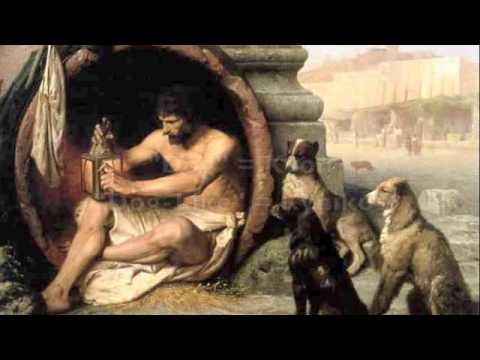
Diogenes the Dog


As the seemingly endless season of farce we call the presidential election begins, I think of Diogenes the Cynic.  I suppose I also think of Aristophanes, as he wrote farces aplenty and so would recognize one when he sees it, though he might, for a moment, be puzzled at the numbing length of this one in particular.  But Diogenes comes to mind primarily simply because he knew what a farce human life was then and mocked it incessantly, mocking even that high priest of the farce, Plato.

They say Diogenes walked about Athens with a lantern, looking for an honest man.  I've also read that he said he was looking for a human.  If that's so, I think he knew what Plato and others thought we were--truly homo sapiens, or that we could and should be wise--and set about looking for what such people thought we were in their foolishness, and of course found no such thing.

A farce our lives were, certainly, but just as certainly still are if we are what we seem to be; the same creatures we were in the time of Diogenes and no doubt were even before then.  It's hard to defend us and if we were put on trial I doubt we could find a lawyer willing to appear at our side...unless his/her doubtlessly high fee was prepaid, always a wise precaution when presented with a losing case.  We haven't changed.

We remain as greedy, superstitious, stupid, gullible, fearful and hateful as we ever were, as we always have been I suspect.  We may not sacrifice to the gods as we did, we may not worship the bones of saints as much, we may not en masse rely on chants and various plants to live healthy lives to the extent we have, we may not ignore the consequences of our actions quite as much as we did once upon a time, but we do it still to a significant degree, and there's no reason to think we'll stop until we've either eliminated ourselves or reduced ourselves to the point where we may start the same process all over again on an Earth less threatened by us than it is now.

There are many stories about Diogenes.  It's said he lived in a barrel, masturbated openly, ridiculed Plato and other worthies, flaunted conventions of all kinds, remarked that in the home of a rich man there's no place to spit but in his face.  Looking about him today he would still see no humans using even the most powerful flashlight available, let alone an honest man.  He would see the same he saw each day of his life and know now if he did not know then that we're unchangeable, and merely better equipped now than we were then to sate ourselves or wreck havoc depending on our moods and means.

The Earth is still no place for the man who called himself a citizen of the world.  In fact, especially here in this country, we are less and less inclined to think of ourselves as similar to any other people or as united in interest with them; certainly not equal to them, but altogether better than others, unique, the favored of God.  Just as the ancient Greeks believed they were, but sadly we're unable to produce men like Diogenes as they did.


Monday, April 8, 2019

What Comes After Disgust?


This has become a pressing question, for me.  Not with respect to life in general, I hurry to say.  I suffer no existential crisis.  How could I, being an aspiring Stoic?  Not for me the despair and nihilism felt by some.  In the broad sense, what is, is, whether I accept it or not, and it happens I accept it.  But enough about me.

What prompts the question is the state of our nation.  More particularly, the state of our nation's politics and politicians.  More and more, day by day, sometimes hour by hour or minute by minute, it and they inspire nothing but disgust in me; loathing, even, that most extreme form of disgust.  To be clear, I refer not only to the scatter-brained oaf inhabiting the White House and those who facilitate his caperings (and there are many Republicans, alas) but all those who participate in the corruption that overwhelms our governors and government.

I'll speak plainly.  Politicians are by their nature liars.  Perhaps it's more correct to say that politicians must be liars.  In order to be a politician, one must dispense with honesty and honor as it's necessary to please those who have the wherewithal to maintain one's status as a politician, regardless of what they believe, think or do.  The fortunate politician may accept the same beliefs, thoughts and acts, but in order to be successful at politics must placate more and more people, again regardless of what they believe, think or do.  The politician has committed to the sale of his/her soul, assuming they have such a thing.

The U.S. is too often compared with ancient Rome, generally to late Republican Rome.  That's an unfair comparison--to ancient Rome.  Rome even as the Republic decayed produced men of honor and even genius--Cicero and Cato, for example.  Who do we have to compare with them?  We're fortunate if our politicians are able to speak coherently, let alone speak the truth.  The Roman Republic was an oligarchy, of course, but in what sense are we better?  Juvenal (I think) wrote that all things were possible in Rome if one has money, and that is the same here and now.  But money is all that we honor and respect.  It's no longer a tool, it's an end in itself.  Our politicians aren't oligarchs, they're clients, in the Roman sense, and are bought and sold like slaves.

Assume, then, that politicians will lie when it suits them.  What reason is there to believe anything they say?  What reason is there to believe they will do anything if they say they will?  One can make estimates as best one can based on the undoubted fact that they will do, as often as possible, what it is in their interest to do as politicians.  So, they may be predictable as self-interested liars are, but though predictable remain, entirely, dishonorable and disgusting.  A government of shills, of whores, in fact, though whores at least provide a service many think is desirable.

Accept that our politics and politicians inspire disgust.  What, if anything, is next for them and for us?
Do we simply resign ourselves to disgust?  Do we tell ourselves that we will abide with what is disgusting provided we are left alone with our disgust?  Is cynicism (small "c") our default position?  That's one option, certainly.  But disgust can become anger and anger can become violent.  What is disgusting can become too disgusting if left unchecked.  Ultimately, we will become one of the disgusting or one of the disgusted.

Monday, April 1, 2019

Homage to Hunter S. Thompson


I've only noticed recently, while reading Hey Rube,  the extent to which his work resembles that of another old favorite, H.L. Mencken.  I wonder somewhat why that's true.  I suppose it's because some of what he (Thompson) wrote was too full of references to drugs, and although Mencken certainly drank and would poke fun at the Prohibition law, I've read a great deal of him and have yet to find any extended comment on that peculiar thirteen year period in which the Volstead Act so greatly enhanced the lives of bootleggers and organized crime figures.

Otherwise, it seems to me that they wrote, and thought, much the same.  The writing of both men was flamboyant in some senses, and yet could be succinct and sharp.  Their personalities were different, Mencken being more or less conservative in his lifestyle, though drolly so, and Thompson being anything but that.  But they were both iconoclasts, suspicious of authority, impatient with stupidity, and contemptuous of politics and politicians.

Just what drove Thompson to take his own life I cannot say.  From what I read, he may have found himself surprised and overwhelmed by the fact he was aging and no longer capable of doing and enjoying what he used to do and enjoy, at least in some significant sense.

Thompson didn't write a great deal in his later years, but I'm enjoying reading his ruthless assessment of the Bush-Gore election and its principals, and of American politics in the early years of this century.  I can't help but think that he would have roused himself to comment as mercilessly on the politics and circumstances of this our time, and suspect he would have been even less restrained now than he was throughout his career, though restraint was never a part of his character.  He called America "The Kingdom of Fear" while he was alive, before our current encounter with and it seems acceptance of that combination of greed, fear, hatred, arrogance and ignorance which serves as the politics and culture of this sad time.  What would he call America now?

He would call it something, and it would be something bad.  Nasty, I would think, even as our nation has become nasty in a particularly vile way.  It is impossible to respect someone or some group of people who are spiteful, especially where the spite is encouraged and manipulated by the well-heeled; when, in other words, the spite is at the direction of the rich.  Their only purpose is generally to line their own pockets and/or those of their friends.

If there's one thing we could count on, it is that Thompson  wouldn't merely criticize, he would horsewhip those who rule us and seek nothing more than to retain their rule over those they dupe, in writing.  And it seems to me that there are none now willing or able to do such a thing.  Perhaps that's what must be done if one is to be noticed.

Most important of all, though, is that the criticism be not merely scathing but intelligent.  We live in a world where almost everyone has or can easily enough obtain an audience of like-minded associates, and many believe that they don't need intelligence, or wit, or knowledge to ponitificate.  Most any can make use of the World Wide Web or social media to say something, and they will do so, however ineptly, and will be listened to at least by some.  Mere spouting of ideas, such as they are, would make little impression among all the noise.  Faux outrage and anger are so common as to make no impression on those who listen to talk radio.

It would take something special to be noticed, and what is more special today than the ability to write or speak clearly and well?  Thompson could have done this.  I'm not sure anyone else can.

Monday, March 18, 2019

The Death of Objective Reality Has Been Greatly Exaggerated

Those of us who take the time to at least scan the news sources available will have learned that objective reality has been thrown into doubt.  Those who scan more thoroughly will have learned, also, that it has supposedly been thrown into doubt by an experiment made upon photons, based on a thought experiment created by a physicist named Wigner, and called "Wigner's Friend."  Well, someone who is not Wigner and someone who is not Wigner's friend (and presumably others) decided to depart from the world of thought and thereby managed to cast doubt upon objective reality.  Or did they??

I'm quite ignorant of quantum physics and I suspect many others, including some of those who wrote the articles which proclaim that there is no objective reality on which we may rely, or fondly believe exists, due to this experiment.  Nonetheless, I suspect that right now, at least, there isn't much to worry about.

Clearly, much depends on what we mean by "objective reality."  If it consists of the (observation?) of the behavior of photons under the circumstances of the experiment, that is one thing.  If, instead, what is called "objective reality" is the world in which we strive, and fail, and succeed, and build, and design, and work, and play, and eat, and drink, and take vacations, and watch the caperings of our fellows and those others that we encounter day by day and hour by hour, that is another.

What little I know of quantum physics is that it is almost mystifyingly different from the "macro" world in various respects.  So for me, at least, it comes as no surprise that in this particular experiment, the someone who isn't Wigner and the someone who isn't Wigner's friend "observed" different things about the photons in question; even "irreconcilable" differences (on which many a divorce is based).  Things certainly are wacky among those photons, and we've apparently recognized that for quite some time.  Why assume that what takes place among photons will alter in any significant sense the reality in which we live?  It certainly hasn't done so until now.

However, life goes on, as it has for many, many years.  And, unless you're wedded to the conception of "objective reality" as being immutable, eternal and absolute, you've come to recognize that we poor creatures live in a world of probability, and make judgments and decisions based on generally, if not absolutely, reliable "facts" about who or what we interact with, successfully.  We can predict what will take place in most cases, "to a reasonable degree of (insert word like "engineering" or "medical" as we lawyers must have it) probability."  And you've also come to know that we manage to get things done although our knowledge is not absolute.  It's to be hoped that you've even come to recognize that you are a part of objective reality, not something distinct from it, and that because of that it isn't something separate and distinct from you, but that you're included in it.  Reality is objective enough.

It may be that we humans, having evolved in a "macro" world, lack what's needed to fully understand the quantum world.  Perhaps we simply don't yet know enough about the quantum world to explain the outcome of this experiment.  Perhaps there are multiple, alternate universes.

"The universe is change."  So said Marcus Aurelius, long ago.  Maybe this experiment will change the world in some way yet unknown.  But I doubt it will fundamentally change the reality in which we live unless we somehow undermine that reality, or someone or something else does.  Until then, reality will remain objective enough., for and with us.

Monday, March 4, 2019

The Sublimely Silly


The discouraging state of our politics has led me to ignore this blog for a bit, but I feel inspired, in a way, by a book I've been reading.  It's by Richard Wolin and is entitled The Seduction of Unreason (yes, the title is elongated by use of a colon as are so many other titles of so many other books, but this annoys me so I refuse to include the explanation which is apparently required, by some).  The book reviews the astounding group of intellectuals living in continental Europe in the 20th century who admired fascism.

I've expressed dissatisfaction with various Continental philosophers and intellectuals in the past, so I confess that a book like this is bound to appeal to me as it is bound to enrage others.  The Enlightenment had its faults, no doubt, but it is staggering to review the lengths to which those who came to loath it were willing to go to deride it not only in their writings but in their lives.

Somehow, the wise came to believe not that reason and science could be, and was, misunderstood and misused.  That would seem to be clear enough to those having common sense.  Instead, they came to believe that reason and science were wrong, or perverse.  The revolt against the Enlightenment, or the Counter-Enlightenment as it's called in this work, was a revolt, it seems to me, against thinking.  Against intelligence.  Against problem-solving.  Against studying a situation, weighing options, and making an informed decision.

And so the intellectuals of Europe came to promulgate the view that it was not only appropriate but necessary that human beings stop thinking.  Only by doing so could we truly live.  We should let our emotions run rampant, war against one another, return to what the wise apparently felt we were in pagan times.  I'm not sure why it was thought that we were spectacularly irrational in pre-Christian times, though one can understand that Christianity could be perceived as stunting us.  Perhaps intellectuals of the time thought all pagans were followers of Dionysus as portrayed by Nietzsche in his wildest dreams; all Dionysus and no Apollo.  Or were all warriors.  Perhaps they thought all were ecstatic initiates of the mystery religions, or what they thought were the mystery religions at the time.

Perhaps they forgot, or chose to ignore, the very rational philosophers of antiquity.

For whatever reason, they did and said some very silly things.  Some even practiced animal sacrifice, and dreamed even of sacrificing humans.  They became mystics.  They thought in fact that mysticism is what we truly want, especially when acting en masse.  Thus the appeal of such as Hitler in their eyes.  They believed, I think, that people wanted to be told what to do by some seemingly super-human leader who personified the mythic characteristics or particular races and nations.

It was an amazing rejection of thought, an acceptance and glorification of thoughtlessness.  Critical thinking was discouraged, even condemned.

Some of this is still with us today, of course.  And though I may exaggerate, what are we to make of the learned who so completely abandoned rational discourse and analysis as to render them inhuman and immoral?  It seems to me a kind of betrayal, a surrender of our heritage resulting from an ignorance of our ancient past in the West, and the embrace of a barbarism already overcome.

Worse, it renders judgment impossible and undesirable.  Absolved of the responsibility to judge correctly, we're not accountable for what we decide to do.  I can't help but wonder how anyone with a sense of self-respect could accept a view of human existence which is so childish; which makes children of us all.