Wednesday, January 5, 2022

A Day that will Live in Ignominy


On January 8, 2021, I wrote a post about the events of January 6th of that year at the Capitol of our Great Republic, remarking that it represented the end of American Exceptionalism.  That it surely did, and does, especially as it seems that that the hope of many of our especially craven politicians and pundits is that those events will be disregarded or forgotten, or even thought of fondly, like the antics of well-meaning but fractious children.

I don't refer to the self-infatuated blowhard who it seems has cancelled his plans to pontificate publically on the first anniversary of those events.  This cancellation would seem wise even from a purely self-interested perspective (and what other perspective does he have?).  What he would say is what he has said.  Watching him say it again would be like watching a demented person repeat a story he's already repeated many times, in much the same way with much the same words.  It wouldn't be a pretty sight even for his biggest fans.  Because refraining from making a spectacle of himself once more would be wise, he may yet do so, but in a less open format.

I refer to people who've actually been elected to office.  That in itself doesn't speak well for them, as this may hardly be called a mark of distinction in these sad times.  But for an elected official to be intentionally disingenuous about disgraceful conduct directed against a lawful election is especially ignominious, as it implies that such an official is unconcerned with and indeed against lawful elections generally, concerned only that the result of an election is desirable.  That is a view which would render representative democracy ineffective.  If accepted, elections would merely be a show to those elected, the winner being the one who could most efficiently "fix" the outcome.  That elected officials, and pundits and those who effect public opinion, could countenance this and even think it's desirable is shameful.

I suppose I should acknowledge that this is to assume that those seeking to disregard or justify what took place on January 6, 2021 don't believe that the 2020 election was stolen.  In a way, this assumption credits them with more intelligence than they may have.  But it's hard to believe that any reasonable person accepts what's being called "The Big Lie," a reasonable person being one who requires more than unproved allegations, shot down in court after court, to accept election fraud.  It's true, though, that reasonableness isn't something we see much of in our Glorious Union right now.  It's also true, unfortunately, that there are those in politics who will stop at nothing to assure that they will retain their position and power.

Perhaps it wasn't all that much different in the past.  Perhaps instead we live in a time when those who are unreasonable, ignorant, prejudiced and intolerant are more able to make themselves known and noticed than ever before.  I've speculated along those lines in this blog more than once.

Still, though, we may have come to the point in the U.S.'s decay when it no longer matters how the majority of people may vote.  Instead, it may be more important what some people, regardless of whether they're a majority, believe is right.  People who think they know what's right have found democratic government to be wanting--a kind of inconvenience--since at least the time of that pioneer of totalitarianism, Plato.  Ironically, Plato feared that a democratic form of government would allow demagogues to sway people away from what is right and good (that being what Plato thought was right and good) thus impeding the march to perfection he sought to impose on us.  Plato sought to change us.  Now, though, demagogues serve to prevent change, change being an evil in the eyes of those who hold power and have privilege.  

I fear, by the way, that I can't take credit for the felicitous phrase "self-infatuated blowhard."  I've seen it applied to another favorite of many among us, Martin Heidegger.  I just had to use it myself in another connection, and apply it to another ignominious figure.


Thursday, December 23, 2021

Homage to Krampus


Christmas is somewhat dreary again this year, courtesy of the pandemic and those astounding individuals who, unconsciously imitating those who feared vaccines for preposterous reasons long ago, have made certain it continues to be a problem.  There were fears in the past that those vaccinated would become like the animals from which some ingredients of the vaccine were derived, and it seems that fears now are similar in quality.

It seems appropriate that in less than merry Christmases, the remarkable figure of Krampus should be given some respect and attention.  Perhaps that should be the case even during happier holidays.  Not Krampus as depicted in the movies which have been made more or less recently, which are inevitably crass and horrific, but Krampus the legend, a companion of sorts to Saint Nicholas.  

I'm fascinated by Krampus.  I don't know how he came to be associated with the figure of Nicholas, who has become Santa Claus.  It seems Krampus was known in Central Europe and the Balkans.  Being a demonic figure in looks if not in character, it's been thought by some that he's a remnant of pagan beliefs, pagans being naturally drawn to demons in Christian tradition if not demons themselves.  For some reason, he follows or perhaps accompanies Saint Nicholas in his December travels.  Nicholas dispenses gifts to good little girls and boys.  Krampus, carrying chains with him, punishes naughty little girls and boys, usually by smiting them with birch branches or rods.  Sometimes he merely leaves them as a kind of gift for parents of naughty children, who are encouraged to wield them in punishment themselves.  He's also depicted as chasing after women, a randy fellow, possibly because he's part goat.   It seems he was a popular part of the Christmas season in 19th century Europe.  This post features a Krampus card, similar to a Christmas card.

Just how Saint Nicholas came to be part of the European Christmas tradition is unclear (to me at least) as well.  He was a bishop in what is now Turkey.  It seems he miraculously saved children from peril in one or two instances.  He was also said to distribute gifts to children and others, at or around the time of his feast day, December 5th.  His myth traveled to Europe for one reason or another, where he eventually served as the inspiration for what we know as Santa Claus.

It seems somehow appropriate that Krampus would visit houses with or just after Nicholas this time of year.  Santa is said to make lists of who is naughty or nice.  I imagine that the Saint would have one list, Kampus another.  In the likely event that a house would contain both good and bad children, Nicholas would give gifts to some and Krampus would whack the others with his birches. 

Thus, children would learn directly and emphatically the rewards for being good and the punishment for being bad.  These would be made perfectly clear.  Nicholas handing out gifts while Krampus chases children round the Christmas tree, chains clanking as his rods whistle through the air, is an image which could not be forgotten.  It's unfortunate that Krampus isn't charged with punishing the stupid as well as the bad, in which case many parents would be beaten by him as well.

There's justice in this legend.  Even Oliver Cromwell, who banned the celebration of Christmas as frivolous when he became Lord Protector, would have approved.  Well, of the part with Krampus in it in any event.  Perhaps we should keep Krampus in Christmas along with Christ.
 

Monday, November 29, 2021

Brains in Vats and the Untrammeled Mind


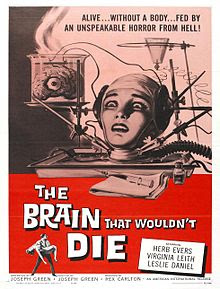
Not a brain, but a brain in a vat.  That's what won't die, at least in that part of the world (if there is one!) inhabited by philosophers.  "An unspeakable horror from hell!"  Indeed.

It's difficult to imagine a less serviceable avenue of thought than that indulged in by many philosophers for many centuries, relentlessly wondering if there is what is suggestively referred to as an "external world" and, if so, if it can be known by us. Worse, though, is their shameless tendency to write on the subject, if indeed it can be called one.  The consideration of the "question" is singularly purposeless, not merely because it's incapable of resolution, not indeed merely because it's questionable there is a "question" to be addressed, but because its consideration along with any possible resolution makes no difference to us, or to our lives.

It can't be disputed that we always act as if there is an "external world" and for the most part that our belief in it and its characteristics is substantially justified.  Anyone who seriously questions it could be accused of deliberately and thoughtlessly disregarding his purported belief.  Such a person would have to be mentally ill--"There is no world, but I live in it" isn't a statement most would make, and if one would make it seriously one would be treated, justly, as not quite sane.  That is what's done by philosophers who chew on this old chestnut and do so verbally and in print, to the amazement and bewilderment of those who listen to them or read their words (assuming, of course, that they exist).

What's particularly curious about this fixation with our claimed ignorance is that it's sometimes asserted that our incapacity is established by "scientific evidence."  There is of course the problem that it's questionable whether there can be any evidence, scientific or otherwise, if we can't know the "external world."  But it would seem obvious that the scientific evidence indicates that we evolved over time through our interaction with the rest of the world and interact with it consistent with our expectations time and time again.  If the results of experiments are "scientific evidence" it's apparent that scientific evidence in support of the existence of an "external world" is overwhelming.

Why, then, is this fantastic subject one of continuing interest and effort?  Let's ask, following Cicero:  Qui bono fuisset?  Where we humans are concerned, it's always important to consider who benefits from a particular act, question or issue.  Benefit--ours in particular--is always uppermost in our minds.

Who would benefit from a belief that we can't know the world, that we're separate from it, that it isn't real, or less than real; isn't true or less than true?

Those who thrive on it, clearly.  Philosophers, of course, do so.  For some it's their bread and butter.  Most if not all of the religious, as well.  "My kingdom is not of this world"--so said Jesus or so said someone who said Jesus said it.  The clergy in particular.  What would they do if people didn't think there was a world beyond this one; a world better than this one, which is the "real world"?

Anyone who benefits from disregard of or disparagement of the world as it is conceivably gains from the perception that there's something fundamentally wrong with things, so we may have to include politicians and pundits as well among those who claim the world isn't as it appears to us.  

No wonder that Plato, who first wrote extensively of a reality not of this world, was a totalitarian at heart.  If the world isn't real, then clearly we should seek what is real.  If we can't, we should be made to do so, for our own good.

And so we see what metaphysics and epistemology can lead to, if untrammeled by the world!  Without weights or guide lines, they ascend uncontrolled into the air like the balloon of the Wizard of Oz, they render us inhabitants of that city in the sky, Cloud Cuckoo Land of Aristophanes.  No wonder, perhaps, that Heidegger was a Nazi.  
 

Tuesday, October 26, 2021

The Coarsening of Stoicism


Stoicism is ubiquitous.  All want to be, or profess to be, a Stoic, or so it seems.  Stoicism is touted as the guide to a good life; but not merely a good one, a successful one.  After all, the ancient Stoics maintained that we may live a good life without being successful.  But who now would want to be good without being successful?  There are books, lectures and no doubt podcasts on how Stoicism may benefit entrepreneurs; may make us leaders; make us rich and powerful, make us efficient.  Marcus Aurelius is the Dale Carnegie of these times.  Reading him, we learn how to win friends and influence people.  

Stoicism is said to be desirable even when shorn of what was thought by ancient Stoics to be essential to it.  For example, the Stoic belief in a Divine Reason that is the generative and guiding force of the universe is said to be unneeded by the modern Stoic, according to Lawrence Becker and Massimo Pigliucci.  Mr. Becker goes so far as to refer to himself and others as Stoics despite the fact he (and presumably the others he refers to when stating what "we" Stoics think) don't accept the divinity of the ancient Stoics.

As Stoicism is claimed to exist without a divinity, without Providence, why should it be necessary that it retain the other characteristics of ancient Stoicism?  Why should the modern Stoic disdain the acquisition of wealth and power, which requires that we pursue things beyond our control, and concern ourselves with them closely?  Why shouldn't the modern Stoic seek fame and fortune by making use of the skills which are developed through Stoic practice?  Why try to act virtuously--why, indeed, think that virtue is the only good, and the only thing needed for happiness?

Those of us who admire Stoicism as taught and practiced by the ancients may feel gratified that it has become so popular.  Stoicism is a form of practical wisdom, and can help us in many respects just as CBT may be of assistance in addressing disquiet or psychological difficulties.  But is there a point where its popularity debases it?

Stoicism has seen resurgences in the past, but I doubt there has ever been a time before this when it was considered beneficial and admirable for reasons which seem to me to be at best tangential, at worst contrary, to what it was developed to be; a philosophy of life.  A way of achieving tranquility and equanimity.  Not a method by which to be successful in business or in other pursuits which are unrelated to virtue.  

Perhaps it's the case that coarseness is an essential component of our culture and society.  What is arguably good because it achieves virtue is accepted only to the extent that it serves another purpose, one worldly.  That's necessary to popularity, here and now.  That's been the case with Christianity for quite some time, in fact.  The moral teachings of Jesus are honored in word, but it's claimed that Jesus will assist us in this life by making us prosperous.  He'll take care of his own.  

So will Zeno, or Chrysippus, or Cleanthes, Epictetus, Marcus Aurelius, Seneca and others, perhaps.  But I'm inclined to think that most of Stoicism will fade away as it increases in popularity, and it will become yet another self-help craze, but one which those who popularize it (and make money doing so) can claim is entitled to added dignity as being based on ancient philosophy.  


Thursday, October 21, 2021

Removing Jefferson


In Gore Vidal's novel Burr, Thomas Jefferson is sometimes referred to as "Massa Tom" by some of his contemporaries who were not his admirers (most notably Alexander Hamilton).  I don't know whether he truly was called this by anyone, but clearly the reference made is to his ownership of slaves.  He apparently owned many.  

The fact he was a slave owner is, presumably, the primary reason for the decision made by a committee of the New York City Council to remove his 7 foot tall statue from New York's City Hall.  New York City's local government must struggle along its way without its presence in the future.

If memory serves, I wrote a post on the fairly recent urge of some in our Great Republic to remove statues of historical figures from the various locations in which they've been placed.  It's something which seems to concern many who declaim for or against it, and is like so much else in these sad times a cause for outrage, real or pretended.  It's something I think shouldn't be of much concern, though it may be in some circumstances.

The circumstances I think would make removal of a statue a cause of concern are very limited.  I don't particularly care if statues of presidents or kings or others are raised or razed.  Normally, they're not history or parts of history except in the most broad sense (they were raised or razed sometime).  Sometimes they are a part of history, due primarily to their age and their place in historical events.  A statue can be a work of art, in which case there's an argument it should be preserved.  But I confess that generally it's difficult for me to maintain that statues should or should not be placed or removed.  It may not be to my credit, but I'm generally indifferent to statues.

In many respects Jefferson was flawed.  Among the Founding Fathers I personally prefer John Adams, who was less a hypocrite.  But Adams had his faults as well.  The institution of slavery was loathsome, and is in a sense a taint or curse on the nation still.  I doubt this or any other statue of Jefferson is intended to be a monument to slavery, or to commemorate him as a slave owner.  Statues don't fill me with revulsion normally, so the existence of this particular one doesn't cause me pain or concern.  But it isn't clear to me that he, or anyone else for that matter, should have a statue made of him and displayed somewhere, nor is it clear to me that once a statue is made, it should not be unmade or removed.  

The reasons for removing or destroying a statue are sometimes considered good or bad, however, even if the statue itself is neither.  For example, ISIS or whatever it may now be called, and other religious zealots now and in the past, have destroyed statues (some of great antiquity) because they believe them prohibited an affront to God or to represent demons.  There is no reasonable basis for that belief.  A statue of Saddam Hussein was toppled at the end of the Iraq War.  Nazi symbols and Nazi inspired statutes were destroyed at the end of the Second World War.  

So, it's possible that the motivations for removal or erection of a statue may be subject to judgment.  That would seem to me to be the only thing of significance in the fight over statues in which we seem to be engaged.  What are the reasons for the removal of the statue in question?  What are the reasons for maintaining the statue where it is now?  What difference does it make if the statue is removed?  It will make no difference at all to Jefferson's achievements.  As to those, no statue is required.   If those are what he's to be honored for, the statue is unnecessary, and its removal isn't a cause for outrage or anger.