Monday, November 29, 2021

Brains in Vats and the Untrammeled Mind


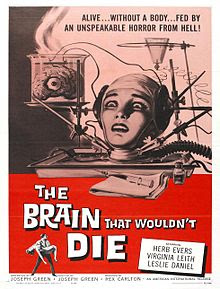
Not a brain, but a brain in a vat.  That's what won't die, at least in that part of the world (if there is one!) inhabited by philosophers.  "An unspeakable horror from hell!"  Indeed.

It's difficult to imagine a less serviceable avenue of thought than that indulged in by many philosophers for many centuries, relentlessly wondering if there is what is suggestively referred to as an "external world" and, if so, if it can be known by us. Worse, though, is their shameless tendency to write on the subject, if indeed it can be called one.  The consideration of the "question" is singularly purposeless, not merely because it's incapable of resolution, not indeed merely because it's questionable there is a "question" to be addressed, but because its consideration along with any possible resolution makes no difference to us, or to our lives.

It can't be disputed that we always act as if there is an "external world" and for the most part that our belief in it and its characteristics is substantially justified.  Anyone who seriously questions it could be accused of deliberately and thoughtlessly disregarding his purported belief.  Such a person would have to be mentally ill--"There is no world, but I live in it" isn't a statement most would make, and if one would make it seriously one would be treated, justly, as not quite sane.  That is what's done by philosophers who chew on this old chestnut and do so verbally and in print, to the amazement and bewilderment of those who listen to them or read their words (assuming, of course, that they exist).

What's particularly curious about this fixation with our claimed ignorance is that it's sometimes asserted that our incapacity is established by "scientific evidence."  There is of course the problem that it's questionable whether there can be any evidence, scientific or otherwise, if we can't know the "external world."  But it would seem obvious that the scientific evidence indicates that we evolved over time through our interaction with the rest of the world and interact with it consistent with our expectations time and time again.  If the results of experiments are "scientific evidence" it's apparent that scientific evidence in support of the existence of an "external world" is overwhelming.

Why, then, is this fantastic subject one of continuing interest and effort?  Let's ask, following Cicero:  Qui bono fuisset?  Where we humans are concerned, it's always important to consider who benefits from a particular act, question or issue.  Benefit--ours in particular--is always uppermost in our minds.

Who would benefit from a belief that we can't know the world, that we're separate from it, that it isn't real, or less than real; isn't true or less than true?

Those who thrive on it, clearly.  Philosophers, of course, do so.  For some it's their bread and butter.  Most if not all of the religious, as well.  "My kingdom is not of this world"--so said Jesus or so said someone who said Jesus said it.  The clergy in particular.  What would they do if people didn't think there was a world beyond this one; a world better than this one, which is the "real world"?

Anyone who benefits from disregard of or disparagement of the world as it is conceivably gains from the perception that there's something fundamentally wrong with things, so we may have to include politicians and pundits as well among those who claim the world isn't as it appears to us.  

No wonder that Plato, who first wrote extensively of a reality not of this world, was a totalitarian at heart.  If the world isn't real, then clearly we should seek what is real.  If we can't, we should be made to do so, for our own good.

And so we see what metaphysics and epistemology can lead to, if untrammeled by the world!  Without weights or guide lines, they ascend uncontrolled into the air like the balloon of the Wizard of Oz, they render us inhabitants of that city in the sky, Cloud Cuckoo Land of Aristophanes.  No wonder, perhaps, that Heidegger was a Nazi.  
 

Tuesday, October 26, 2021

The Coarsening of Stoicism


Stoicism is ubiquitous.  All want to be, or profess to be, a Stoic, or so it seems.  Stoicism is touted as the guide to a good life; but not merely a good one, a successful one.  After all, the ancient Stoics maintained that we may live a good life without being successful.  But who now would want to be good without being successful?  There are books, lectures and no doubt podcasts on how Stoicism may benefit entrepreneurs; may make us leaders; make us rich and powerful, make us efficient.  Marcus Aurelius is the Dale Carnegie of these times.  Reading him, we learn how to win friends and influence people.  

Stoicism is said to be desirable even when shorn of what was thought by ancient Stoics to be essential to it.  For example, the Stoic belief in a Divine Reason that is the generative and guiding force of the universe is said to be unneeded by the modern Stoic, according to Lawrence Becker and Massimo Pigliucci.  Mr. Becker goes so far as to refer to himself and others as Stoics despite the fact he (and presumably the others he refers to when stating what "we" Stoics think) don't accept the divinity of the ancient Stoics.

As Stoicism is claimed to exist without a divinity, without Providence, why should it be necessary that it retain the other characteristics of ancient Stoicism?  Why should the modern Stoic disdain the acquisition of wealth and power, which requires that we pursue things beyond our control, and concern ourselves with them closely?  Why shouldn't the modern Stoic seek fame and fortune by making use of the skills which are developed through Stoic practice?  Why try to act virtuously--why, indeed, think that virtue is the only good, and the only thing needed for happiness?

Those of us who admire Stoicism as taught and practiced by the ancients may feel gratified that it has become so popular.  Stoicism is a form of practical wisdom, and can help us in many respects just as CBT may be of assistance in addressing disquiet or psychological difficulties.  But is there a point where its popularity debases it?

Stoicism has seen resurgences in the past, but I doubt there has ever been a time before this when it was considered beneficial and admirable for reasons which seem to me to be at best tangential, at worst contrary, to what it was developed to be; a philosophy of life.  A way of achieving tranquility and equanimity.  Not a method by which to be successful in business or in other pursuits which are unrelated to virtue.  

Perhaps it's the case that coarseness is an essential component of our culture and society.  What is arguably good because it achieves virtue is accepted only to the extent that it serves another purpose, one worldly.  That's necessary to popularity, here and now.  That's been the case with Christianity for quite some time, in fact.  The moral teachings of Jesus are honored in word, but it's claimed that Jesus will assist us in this life by making us prosperous.  He'll take care of his own.  

So will Zeno, or Chrysippus, or Cleanthes, Epictetus, Marcus Aurelius, Seneca and others, perhaps.  But I'm inclined to think that most of Stoicism will fade away as it increases in popularity, and it will become yet another self-help craze, but one which those who popularize it (and make money doing so) can claim is entitled to added dignity as being based on ancient philosophy.  


Thursday, October 21, 2021

Removing Jefferson


In Gore Vidal's novel Burr, Thomas Jefferson is sometimes referred to as "Massa Tom" by some of his contemporaries who were not his admirers (most notably Alexander Hamilton).  I don't know whether he truly was called this by anyone, but clearly the reference made is to his ownership of slaves.  He apparently owned many.  

The fact he was a slave owner is, presumably, the primary reason for the decision made by a committee of the New York City Council to remove his 7 foot tall statue from New York's City Hall.  New York City's local government must struggle along its way without its presence in the future.

If memory serves, I wrote a post on the fairly recent urge of some in our Great Republic to remove statues of historical figures from the various locations in which they've been placed.  It's something which seems to concern many who declaim for or against it, and is like so much else in these sad times a cause for outrage, real or pretended.  It's something I think shouldn't be of much concern, though it may be in some circumstances.

The circumstances I think would make removal of a statue a cause of concern are very limited.  I don't particularly care if statues of presidents or kings or others are raised or razed.  Normally, they're not history or parts of history except in the most broad sense (they were raised or razed sometime).  Sometimes they are a part of history, due primarily to their age and their place in historical events.  A statue can be a work of art, in which case there's an argument it should be preserved.  But I confess that generally it's difficult for me to maintain that statues should or should not be placed or removed.  It may not be to my credit, but I'm generally indifferent to statues.

In many respects Jefferson was flawed.  Among the Founding Fathers I personally prefer John Adams, who was less a hypocrite.  But Adams had his faults as well.  The institution of slavery was loathsome, and is in a sense a taint or curse on the nation still.  I doubt this or any other statue of Jefferson is intended to be a monument to slavery, or to commemorate him as a slave owner.  Statues don't fill me with revulsion normally, so the existence of this particular one doesn't cause me pain or concern.  But it isn't clear to me that he, or anyone else for that matter, should have a statue made of him and displayed somewhere, nor is it clear to me that once a statue is made, it should not be unmade or removed.  

The reasons for removing or destroying a statue are sometimes considered good or bad, however, even if the statue itself is neither.  For example, ISIS or whatever it may now be called, and other religious zealots now and in the past, have destroyed statues (some of great antiquity) because they believe them prohibited an affront to God or to represent demons.  There is no reasonable basis for that belief.  A statue of Saddam Hussein was toppled at the end of the Iraq War.  Nazi symbols and Nazi inspired statutes were destroyed at the end of the Second World War.  

So, it's possible that the motivations for removal or erection of a statue may be subject to judgment.  That would seem to me to be the only thing of significance in the fight over statues in which we seem to be engaged.  What are the reasons for the removal of the statue in question?  What are the reasons for maintaining the statue where it is now?  What difference does it make if the statue is removed?  It will make no difference at all to Jefferson's achievements.  As to those, no statue is required.   If those are what he's to be honored for, the statue is unnecessary, and its removal isn't a cause for outrage or anger.  

Thursday, September 30, 2021

Disappointment in the Law


"There's going to be a lot of disappointment in the law."  So says Justice Sotomayor, or so she said recently in a presentation to law students sponsored by the American Bar Association.

We should be thankful for the warning, but it might be said that the law has always been disappointing in one way or another.  I venture to say that to lawyers, the law may be disappointing on a daily basis.  That may be the case for their clients as well, sadly.  The law isn't satisfying by its nature, being restrictive in many cases, a nuisance in others.

But clearly the Justice wasn't speaking about the law's often disappointing intricacy and obtuseness, or the disappointment caused by its flawed application by some of the many minions of the legal system.  She was apparently referring to something she anticipates will disappoint us in our regard for the law as something which is worthy of regard; in other words, in the law as a representation of justice.  It seems from what she said that she expects to write many dissents in the future.

As I've written before, I distinguish the law from what's moral, and therefore from what's just.  That's to say, I believe the law is the law regardless of whether its considered moral or just.  There may be unjust laws; there may be unjust decisions made by courts.  This doesn't mean they aren't law.

Neither does it mean it mean that laws may not disappoint because they're bad laws or are unjust.  So, Justice Sotomayor, being a member of the Supreme Court, likely means that she expects to be disappointed by decisions made by that august body in the future and expects others will be disappointed as well.

She already expressed disappointment with the decision of the majority of the Court to avoid addressing the Texas abortion law which was the subject of the last post.  "Disappointment" is probably too mild a word to describe what she wrote regarding the majority's evasion.  It's too mild a word to describe what I felt about it.

What she means can't be determined precisely, but I suspect that what she anticipates is that forthcoming decisions by the Supremes should be expected to reflect the positions and, presumably, prejudices of the majority of the Justices who are described as conservatives.  Just what "conservative" means in these dark times is debatable, but given the cases which are scheduled to come before them I'd guess that she anticipates disappointment with decisions in those cases addressing abortion and the Second Amendment, and other cases where individual rights--those viewed as contained within the Bill of Rights especially--are opposed to what would arguably seem to be the public interest.

The conflict between those rights as perceived and the health and welfare of others isn't something new.  And in fact it's been recognized, at least in the past and at least in the law, that those rights aren't absolute and are subject to qualification.  Now, though, it isn't apparent that we possess the intelligence and sophistication required to recognize the need for qualifications, or when we do possess them whether there is enough interest in them for them to be applied.  

Our gun-mad nation seems so enamored of firearms that many believe there is no limitation whatsoever on the desire to acquire, and perhaps even use, them regardless of what they may be.  Anti-maskers and anti-vaxxers are so extreme in their opinions that they seem convinced that their "right" not to wear masks and not be vaccinated must be honored regardless of any risk to others (which they busily downplay in any case).  Already we've seen the First Amendment construed to include "money" as a form of speech, regardless of the propensity for corruption, and corporations granted the right to practice religion or hold religious beliefs without legal restriction.

Members of the "conservative" majority on the Supreme Court are aware that some question their motivations, suggesting that they will make decisions consistent with political positions and prejudices.  So we see them busily denying they will do so, claiming that they aren't "political hacks" and that they aren't a "cabal."  Claiming that they are is said to be an attempt to intimidate the Court.  They sound rather defensive, I think.  Reacting to claims of political motivations by calling them attempts at intimidation emphasizes the significance of such motivations, in my mind.  If political motivations play no part in a Justice's decisions, why would concern about them be considered intimidating by that Justice?

"What power has law where only money rules?" asked Petronius Arbiter, courtier in the court of Nero.  Not much, it would seem; and the power of money is unrivaled when it comes to politics, thanks in part to the Supremes themselves.    Where money is power, the law will protect the moneyed interests.  Those with money will want to keep it, and in a time of limited resources that will mean keeping money out of the hands of others, and the government.  Perhaps this is what Justice Sotomayor fears will foster disappointment in the law.  If not, it's a legitimate fear.  The protection of legal rights, individual rights, is essentially selfish when it comes to gaining and preserving money and power, and that would seem the overwhelming concern of those who already have money, and power. 

Tuesday, September 7, 2021

The Grotesque Texas "Fetal Heartbeat" Law


Yes, it's a scarlet letter, but "A" may stand for any number of words beginning with that letter, including "abortion."  And to some of us, at least, abortion is far more of a sin than adultery, which even the most sanctimonious of us enjoy until discovered.  Let it stand as such, then.

It's apparent that reasonable discussion of abortion may no longer be possible (even its name is contentious) but let's endeavor to focus instead on this remarkable, and peculiar, law.  I think it's no exaggeration to describe it as grotesque regardless of where one stands on whether or not abortion should be prohibited.  Those who are convinced abortion is a dire sin or a criminal act akin to murder may not care whether it makes any sense from a legal perspective or whether it is or is not constitutional, true.  But any lawyer should care, and a lawyer I am and have been for a long time.  As a lawyer, I find it an ugly and distorted thing, as laws go.

It's unsurprising that it's been drafted, very deliberately, in an effort to avoid a constitutional challenge based on Roe v. Wade and successor cases.  But it's not artfully drafted in any sense.  It's clumsily written.  The evasion it attempts is ham-handed, even stupidly obvious.  It appears to be a cut-and-paste job.  It's as if the drafters took a law intended to make abortion a criminal offense, and then altered it in as heavy-handed a way as possible to make of it a civil law, granting a civil cause of action to private citizens.

Reading it, I was reminded of an old SCTV skit in which Rick Moranis and Dave Thomas were editing film using cleavers.  It's a Frankenstein's monster of a law, consisting of odds and ends from other laws stitched together.

It achieves its apparent purpose, to make a criminal law a civil cause of action,  by first granting standing to sue to people who suffer no direct harm or risk by virtue of the prohibited acts.  It stands standing on its head, in a manner of speaking; standing is not standing for purposes of this law.  Then, it grants "damages" in a minimum amount of $10,000 to a prevailing party who is not damaged by any of the prohibited acts in any sense otherwise recognized in the law.  Thus, damages are to be awarded to those who sustain no damages.  In addition, it provides for attorney's fees to be awarded to a successful plaintiff, but not to a successful defendant.  It makes any lawyer who defends a defendant liable for those attorney's fees.  It limits defenses which can be raised to the point where there is virtually no defense against an action.  Every effort is made, seemingly, to encourage suit and discourage any contest by making it very likely that a plaintiff will be successful.

It's clearly a parody or perversion of the laws that make a private citizen a "private attorney general" to protect the public from harm for, e.g., civil rights violations, environmental damages, lack of transparency in government, and other laws which contain similar "fee-shifting" provisions.  It's clearly an effort to impose a fine, or penalty or forfeiture in the guise of "damages."  It's brazenly, cynically, grotesque.  No effort is made to give it even the appearance of a just, equitable law.

Our Supreme Court has managed to duck the serious constitutional questions it acknowledges are presented by the law, thus assuring its enforcement until such time as it cannot be ignored by the Justices.  The wisdom of this evasion is questionable.  One would hope that if the Court decides to overrule Roe v. Wade it would do so openly rather than merely allowing its precedent to be so utterly ignored and over ridden.   

There's much more which can be said about the law and its encouragement of litigation, and of course about abortion generally, but I'm striving to limit this post to a merely legal analysis.  The fact that it is such a poorly drafted and peculiarly partial and unfair law may lead one to question it on other grounds as well, however.