Thursday, August 25, 2022

A Plea for a Science of Asininity


Mr. Ed has been called upon already, so it only makes sense--or at least pleases me--to call upon his cousin of sorts, Francis the Talking Mule.  I believe Francis came first.  Whatever god or demon it is that inspires us to make talking animals stars of books, movies, television and other forms of media and entertainments must have convinced us to use Francis before Ed, as Francis it seems was a product of the imagination of Americans in the 1940s and 1950s, and Ed of the 1960s.  And so Francis, paired with human stars like Mickey Rooney (above) and Donald O'Connor, would appear as, somehow, in the Army or the Navy, the Armed Forces being more popular or at least comfortably present to the mind in those decades than they were in the 1960s.  It's difficult to picture Mr. Ed as either on duty in Vietnam or marching on the Pentagon or protesting at Kent State or in Grant Park.

Now though this post has as its purpose a call for the study of asininity, Francis isn't entirely apropos as that word derives from "asinine" which in turn comes from the Latin asinus, meaning ass.  Strictly speaking, as a search of the sometimes useful Internet will reveal, a mule isn't an ass.  Donkeys are asses.  Mules are hybrids.  Breed a male donkey and a female horse and you get a mule.  Stubbornness is characteristic of the asinine, and both donkeys and mules are considered stubborn animals.  Because Asininity is the subject of this post, and I could think of no talking donkey that isn't a cartoon, I settle for a mule as my muse.

More than once in this blog, I've lamented over the vastness of our stupidity, taking us as a group. Well, as a species I suppose I should say.  I've speculated that stupidity is particularly widespread now, when it can be expressed immediately and transmitted instantly to others.  In other words, stupidity, now, can be flaunted globally.  Instead of isolated pockets of stupidity which could exist in isolation years ago, stupidity has spread like a virus throughout the world, via the Internet.

But I've come to wonder whether "stupidity"is an adequate word to describe what is being flaunted.  For we're not merely stupid anymore.  We're content to be stupid.  We may even be proud of our stupidity.  In a sense, we know we're stupid, or being stupid, but are stubborn in our stupidity.  We resist all attempts to enlighten and inform us.  They even make us angry.  Confronted with those efforts, we resist them just as much as we resent them.  

So, I think "asininity" better describes us.  The more we're told we're wrong and are challenged to provide support for what we think, or are shown evidence contrary to it, the more we insist we're right, and the less open to persuasion we become.  We're mulish.

An Internet search reveals that there already has been some study of stupidity, by psychologists in any case.  However, the types of stupidity that have been identified seem unintentional.  Asininity, I would say, combines with stupidity and ignorance an intent to be stupid and ignorant.  Of course, we would never acknowledge that we are stupid or ignorant, and so it could be argued that we're not intentionally so, but the intent arises on when our stupidity and ignorance are challenged in some sense.  Perhaps it's more a question of reckless disregard of evidence or argument contrary to our beliefs, but reckless disregard is a kind of intent, borrowing from the law, or at least equivalent to it in terms of liability.

Being a phenomenon, asininity should be subject to study and investigation.  It's certainly should be analyzed, as the stubborn persistence in stupidity and ignorance is worse even than those characteristic themselves, and more damaging.  It makes possible unending witlessness, the bovine acceptance of certain propositions as in effect invincible.  In essence, the end of the possibility of progress.

Perhaps causes of this condition can be identified.  The symptoms seem clear enough, as they're rampant in our society.  It's true such a study may be fruitless.  It's likely any cure would be through education, and asininity is prevalent, it would seem, in school boards here in our Glorious Union, and is being encouraged.  But even so, knowledge is more often good than bad.


Thursday, August 18, 2022

Why Be Serious?


I was glancing through the headlines of articles in the online versions of two ostensibly serious and thoughtful news/political/cultural related magazines, on different sides of the spectrum, The New Republic and The National Review, and found myself wondering whether they or similar journals are read anymore, and if so by whom?

It may be a mere suspicion, but I think fewer and fewer people read them.  One of the reasons for this, I believe, is that some effort is required to read them.  We're lazy intellectually, and when simple, agreeable or disagreeable, opinions are available without effort on our part, why seek out any other?  Particularly when we may respond to them instantaneously if we wish in a similarly simple fashion, why look for an opinion we might have to think about while reading it or responding to it?  Why, indeed, read at all? There are people who talk incessantly about everything available to be heard and seen 24 hours a day.

Another reason we may avoid reading them is that we're sick of pundits, a reason I can understand.  Yet another is that we think ourselves quite capable of coming to our own conclusions and forming our own opinions, and don't need anyone to express them for us; not anymore.  We can, and do, express them in the vast universe of the Internet whenever we have access to a keyboard, or can establish a podcast.

It's difficult to be serious--to give anything serious consideration.  It's particularly difficult to give opposing opinions serious consideration.  It's even more difficult to think.  Seriousness is a burden, and one we can do without; one we may always have wanted to do without.  Now we can because we need not listen to anyone else for any reason to have confirmation of what we think we already know or is desirable or right, or evil or wrong.  We need not seek answers or information.  We know that we're correct because there are so many like us and we may find them and revel in our sameness and ignorance shared by so many throughout the world.

Certainly there's no need to be taught anything.  The Internet is the great leveler.  It's not necessary to be intelligent, or rich, or powerful, or influential, or widely-read or educated to be "published" or become immortal, to be available if not looked-for, as anyone can achieve these things, to cause concern or disturb or enlighten others.  There's nothing special about them anymore.  More and more, there's nothing special about anyone or anything.

Simply put, there's no reason to take thought, or speech, or opinion, seriously, and many reasons not to do so.  Other things may be serious; for example, money or the lack of it, or death, or good food, good health, comfort and ease.  Material things, in other words, as they're commonly called.  They're not readily available, and not even our ability to project ourselves into the immateriality of the Internet will satisfy our need for them.


Monday, August 8, 2022

Nothing to Say


Mr. Ed, pictured above playing chess with his companion Wilbur, is famous for never speaking unless he has something to say.  I emulate him, in this blog and otherwise, and so have not posted for some time.  I find that I have nothing to say, here, at this time.

This is because I know of nothing worth blogging about.  I've tried to find something that piques my interest or my ire, but have been unsuccessful.  What more is there to be said about the venality and stupidity of our politicians, their tolerance of a fatuous and corrupt con man, their willingness to exploit bigotry and ignorance, their hypocrisy, their sanctimony?  What more is there to be said about our national fetish for guns?  What more is there to be said of the narrowness and meanness of our jurists?  How often can one lament the fundamentally cruel and intolerant fundamentalism of the Christianity popular in our Great Republic?  The remarkable propensity of people to believe anything they encounter on the Internet they find satisfying or disturbing is certainly remarkable, but even that aversion to critical thinking, which seems omnipresent in these times, has become nothing to remark about.

These and other aspects of our society have become familiar.  They're commonplace.  They're to be expected, in fact.  What, indeed, would we be without them?  We wouldn't exist. What we see and hear and read in our media (including social media) is sad, even contemptible, but dull.  It's impossible even to be outraged any longer.  Only the professionally outraged express outrage, and that also has become a part of the background noise that is our culture. 

There are dangers involved in the expectation of stupidity and corruption, of course, and to their acceptance as normal.  Perhaps Dante should have devoted one of the Circles of Hell to the sin of Acceptance.  We saw enough of acceptance and indifference in the face of cruelty and the corrupt in the 20th century to cause us concern.  If we accept what we have, and treat it as inevitable, than we'll continue to have it.

In chess a player will resign when defeat is certain.  An aspiring Stoic shouldn't resign, though, as long as it's possible to be virtuous.  Perhaps virtue includes saying what's already been said.  So, not time to resign quite yet.


Tuesday, June 28, 2022

The Church of the 50 Yard Line


As we all know, God is particularly interested in the outcome of American football games.  He watches them assiduously.  He anxiously awaits the prayers of players and coaches, thanking him for....well, for playing good football, and winning games.  In the case of a loss, he expects prayers invoking his assistance in the efforts of players and coaches to play better.

For those who conceive of God as having far better things to do, and being above the fascination of some of those inhabiting our tiny planet in a tiny solar system in one of billions of galaxies making up the universe in high school and (dare I say it?) even college or professional football, that is an irrelevant consideration for the Justices of our Supreme Court.  Much seems to be irrelevant given the increasingly narrow way in which majority decisions are being characterized by them.  The members of the majority purport to be serenely unconcerned with the implications of their decisions.  In fact, they appear angered when those implications are mentioned.

Given the importance of football here in God's Favorite Country, it's no surprise that some of us feel it right and good to thank the God of the universe for performance on the gridiron; for good, accurate passes, solid (but legal) tackles, agile running, etc.  And they should be free to do so, just as the Church of Latter Day Saints should be free to baptize the dead, and Scientologists free to believe in Xenu.

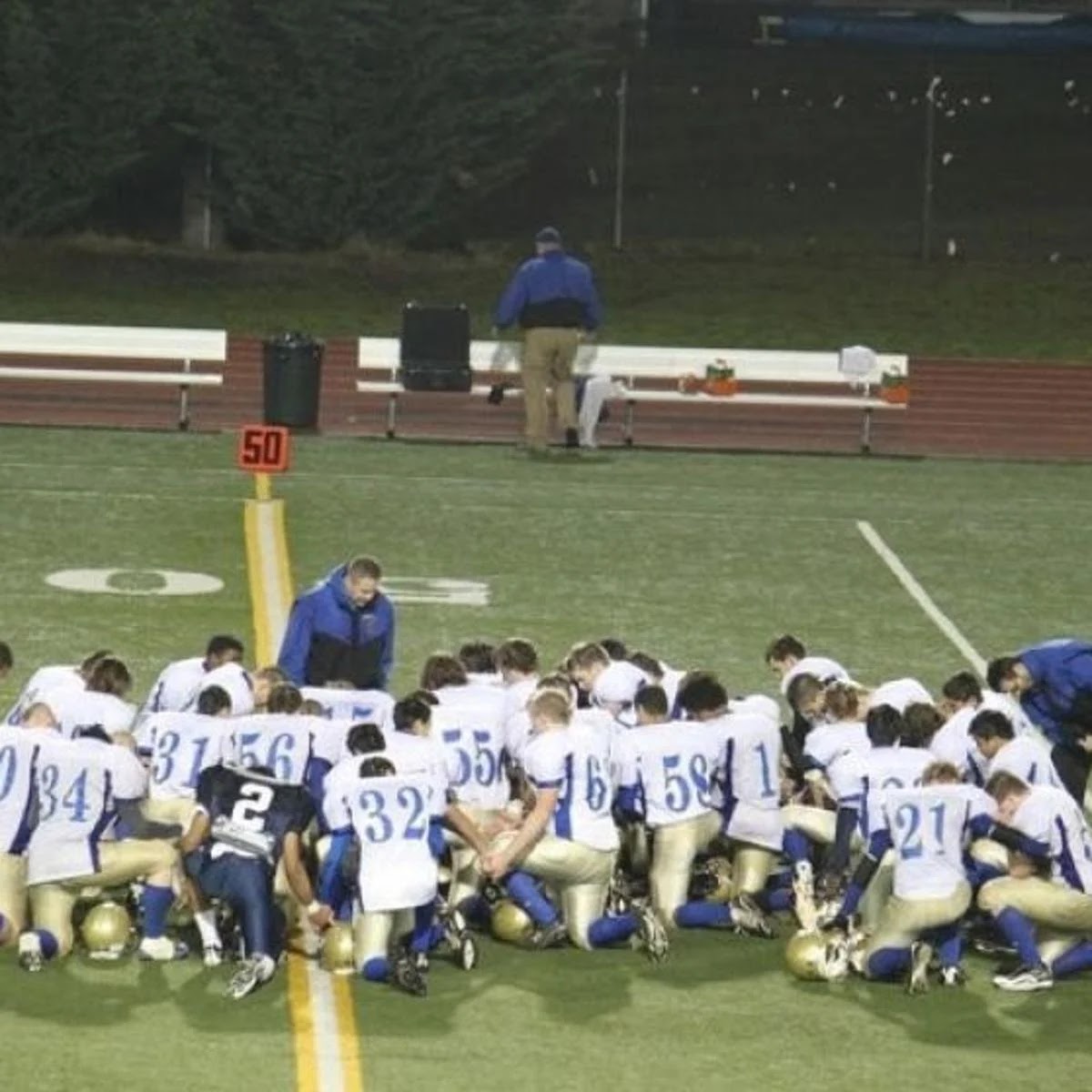
The Supreme Court should be concerned with beliefs and rituals of religions only when the Constitution is implicated.  The question in Kennedy v. Bremerton School District should have been whether a school district violated the Constitution when it fired a coach whose religious practices it had tried to accomodate, but who insisted on praying on the 50 yard line after games, joined by a number of students and players.  But that is not what the majority opinion is about.  For the majority, it was transformed into the question whether the Constitutional rights of a coach engaged in "private prayer" "alone" were violated when he was fired from praying on the 50 yard line after games, joined by a number of students and players.

The majority's insistence that the prayers in question were private religious expression that the coach engaged in alone is, to put it mildly, bizarre.  It's difficult to believe it makes this assertion given the exhibits displayed in the dissenting opinion; it's difficult to believe it believes its own claim, in fact.  It would be hard to conceive of a more public expression of religious belief than one engaged in at the 50 yard line of a football stadium; hard to conceive of prayer engaged in alone while surrounded by others.  Kennedy is shown in one of these gatherings brandishing what seems to be a football helmet standing before kneeling players, as if he was a priest raising the host, or a minister holding a Bible saying "this is the Word of God" to an attentive congregation.  Whatever he's doing in that case, he wasn't "praying alone."

The majority avoids addressing this display by claiming that such evidence was not properly before it.  The majority opinions of the court seem to be becoming more and more scholastic in nature, in that they are filled with technique--drawing distinctions, emphasizing differences between cases, narrowing focus.  Clearly, the majority doesn't conceive of the Supreme Court as a policy-making court, but rather as an error-correcting court.

The majority makes much of the fact that the coach didn't coerce any one to accompany him to the 50 yard line to pray.  One wonders if the Justices have any idea what high school students and particularly athletes in a team sport think and do.  They don't want to be singled out.  They don't want to seem against what might be conceived of as a celebration of victory.  The want to be one of the team; they want to be in with the coach.  It's difficult to believe the Justices aren't aware of this, and it is disingenuous of them to pretend otherwise. 

Sex, religion and guns are the great obsessions of our nation, particularly of those of us who are angry and self-righteous, and such people are more and more inclined to impose their views regarding them through the law.  They seem to have zealous advocates on the Supreme Court.


Wednesday, June 22, 2022

Let Us Pay For Them To Pray


In an opinion mercifully lacking in self-serving references to antiquated opinions of jurists dead for centuries, the Supreme Court of our Great Quasi-Republic has decreed that a law of the State of Maine in force since 1981 is unconstitutional.  The law provided that public funds (taxes) may, in certain circumstances (primarily where public schools are unavailable), be used to pay tuition to private schools of a parent's choice, provided the schools are nonsectarian.  A "sectarian" school is considered to be one associated with a particular religion or belief system, which teaches regular academic subjects but also promotes a particular religion or belief system or teaches subjects taught from the standpoint of that religion or belief system.

In Carson v. Maine, the Supremes have decreed that this cannot be, i.e. that if public funds are to be used in support of private schools, they must be used to support schools which promote a particular religion or belief system.  

The majority of the Court notes that this doesn't mean that public funds must be used to promote a particular religion or belief.   At this time (not yet?) the Court makes no such decision.  The majority points out that Maine may avoid this result by providing an adequate number of public schools.  Presumably, it may also do so by ceasing the program by which public funds may be used to pay tuition to private schools where there are no public schools.  If public schools are not available, it seems, it is constitutionally more appropriate that schools promoting a religion be paid public funds if public funds are used to promote education.  Constitutionally speaking, better no education at all than no religious education, saith the Supremes.

The majority makes an interesting distinction between past precedents against using public funds to benefit religions and its decision in this case.  It states that previous decisions prohibiting the use of public funds to support "church leaders" or education of religious clergy do not apply in this case.  In this fashion, a religious belief--a religion--may be supported by public funds, but particular adherents of a religious belief may not.  What, though, is the basis for this distinction?  Why is it significant?

It isn't clear to me that this is addressed by the Supremes.  It is, instead, merely a difference in circumstances relied on to avoid the need to acknowledge prior decisions as binding.  It's precedent-avoidance, of a kind indulged in by lawyers whenever they want to ignore the kind of reasoning employed in the previous case, and its holding.  

One wonders if the intent behind the doctrine of separation of church and state was to merely prevent the direct funneling of public funds to "church leaders."  Or if it was the intent that public funds be available to religious believers who are not religious clergy, but nonetheless to further the purposes of a religion.  In what sense is one or the other more likely to lead to or constitute the establishment of a religion?  In what sense is a person's ability to practice his or her religion impaired if he's unable to use public funds to pay the tuition of his children needed for them to attend a school promoting his or her religion?

I'm a cynical soul, I'll admit.  I think the number of citizens of U.S.A. who actually practice their religion, rather than merely avow it, is relatively small in comparison with its population.  Diogenes the Dog searched for an honest man. I think the search for a true Christian (for example) would be no more successful.  Practicing a religion in these times consists of simply following established rituals and ceremonies.  Perhaps that's always been the case.

But let's say that engaging in those rituals and ceremonies is practicing religion.  I doubt attending a secondary school will constitute such practice.

I, for one, would oppose the use of public funds to pay the tuition of any private school.  So the fate of this particular law is a matter of indifference to me.  The state may have an interest in an educated citizenry, up to a point, meriting expenditure of taxes received, but I don't think it can be maintained it has an interest in the promotion of any particular religious faith.

And that would seem to me to be the real question to be addressed.  Should, or may, public funds be used to pay the tuition of a Christian, or Muslim, or Hindu, or Jewish high school?  Perhaps Scientology has high schools also--I don't know.  I would say no, regardless of the religious faith being promoted.   It appears the majority of the Supreme Court would say yes.